Episode Transcript
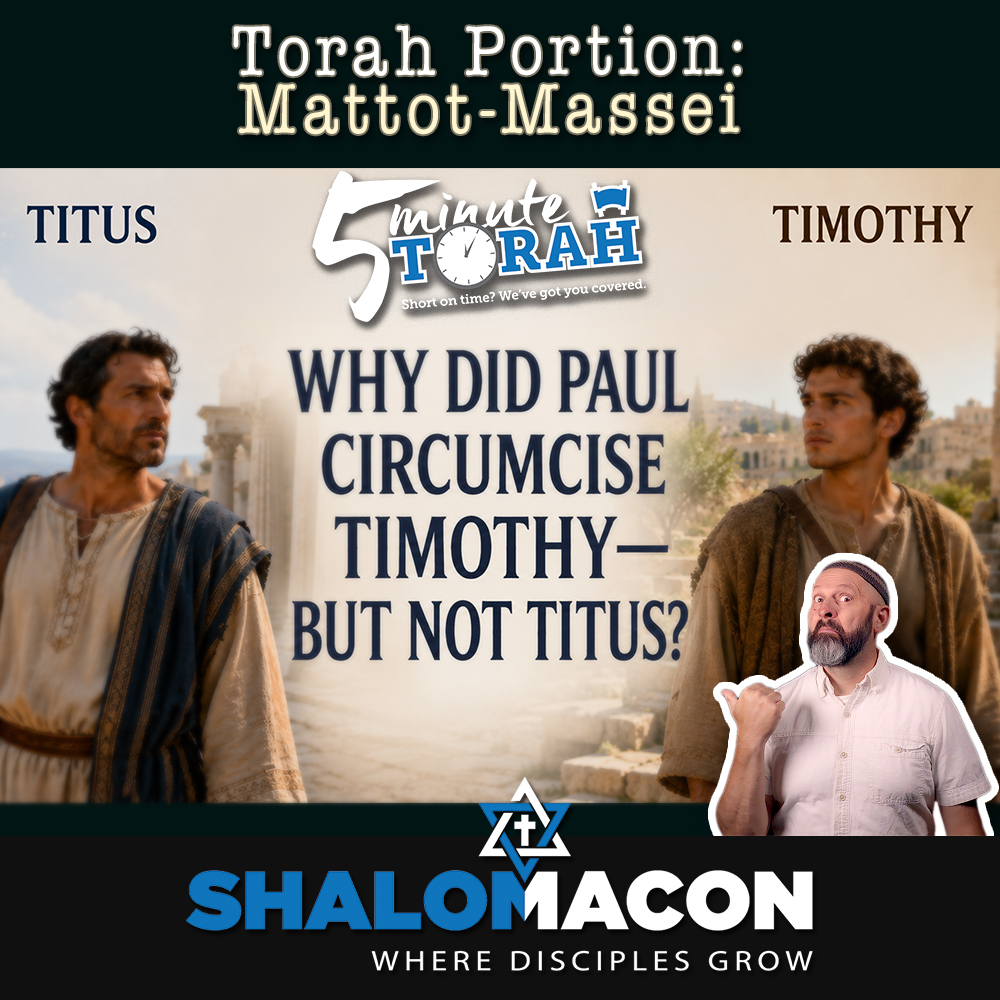
[00:00:00] Speaker A: Why did Paul circumcise Timothy but not Titus? And what do tribal boundaries, inheritance laws and the coming Messianic kingdom have to do with that question? Discover the surprising connection in this week's five Minute Torah.
Shalom and Blessings from Shalom Macon, the place where disciples of Yeshua learn, connect and grow. I'm Darren and before I get into the five minutes of my five Minute Torah commentary, I let's cover a few quick facts about this week's Torah portion. This week we are studying the 42nd and 43rd Torah portions and the final portions of the Book of Numbers. We are in the double portion of matot maseh numbers 32, 36, 13 and here are the three things that you need to know about it.
1. Vows and authority A Father's Responsibility the Torah portion of Matot opens with the laws of vows and oaths, highlighting the sacred responsibility of honoring our words before God. The Torah teaches that vows were not to be made lightly, but it also grants fathers and husbands limited authority to annul the vows of a daughter or wife under their care. This authority is not about control, it's about protection. As the head of the household, a father or husband bears the responsibility of guarding his family's spiritual and emotional well being and may nullify a vow that was made impulsively or could lead to harm. These laws remind us that our words carry great weight while illustrating the balance between personal responsibility and godly family leadership. Number two War against Midian Divine Retribution God commands Israel to wage war against the Midianites for leading his people into idolatry and immorality. At peor, Moses gathers 12,000 warriors, a thousand from each tribe, led by Pinchas the priest. Israel defeats the Midianites, putting their king to death. Along with the prophet Balaam. The women, children, livestock and goods are taken as plunder. But before the spoils can be distributed, Moses instructs the warriors to undergo purification along with the captives and everything taken in battle. This campaign is more than a military victory. It's an act of divine judgment against those who sought to draw Israel away from God. It reminds us that rebellion has consequences and that God's justice cannot be ignored. And number three Bound boundaries and inheritance Tribal Divisions of the Land in the Torah portion of Maaseh, God gives Moses detailed instructions for dividing the promised land among the tribes of Israel. The Torah carefully defines the borders of the land and assigns each tribe its inheritance, ensuring an orderly and equitable distribution. These inheritances were about far more than geography. They preserved each tribe's identity, heritage and generational legacy. By remaining connected to their ancestral land, the tribes were anchored to both God's promises and their unique calling within the nation. These boundaries reveal God's wisdom in establishing Israel and provide a foundation for the nation's future in the land.
[00:03:03] Speaker B: Are you a disciple of Yeshua? Many people say they are, but few truly understand what discipleship really means.
[00:03:09] Speaker A: Why?
[00:03:09] Speaker B: Because discipleship is a distinctly Jewish concept, an intimate relationship between a rabbi and his student. Yeshua called 12 men into that kind discipleship, and those 12 changed the world. So what do they understand about discipleship that we often miss? And how can we make better disciples if we've never truly been one ourselves? Those questions led me to write my book the Four Responsibilities of a Disciple. While many books focus on how to make disciples, I wanted to understand what it means to be a disciple because too many disciples today aren't transforming the world the way they should. What I discovered was that every disciple carries four essential responsibilities, and when these are lived, doubt they can truly change the world. If you want to know what it means to be a real disciple of our Master Yeshua, check out the Four Responsibilities of a Disciple using the link below.
[00:04:01] Speaker A: This week's Torah commentary is called the Laws of Inheritance and comes from a book 5 Minute Torah, Volume 1 the Torah portion of Maseh is the final portion in the Book of Bami Bar, or the Book of Numbers. This portion begins in chapter 33 by recounting the various encampments made by the children of Israel during their years subsequent to the exodus from Egypt. Chapter 34 defines the borders given to the children of Israel as their inheritance, and chapter 35 outlines the cities given to the Levites. In the final chapter, numbers 36, we learn some foundational principles regarding biblical inheritance. But before we get into this account, we need to understand a couple of inheritance issues. First, although this matter has been under scrutiny in recent years, according to Jewish law, Jewish identity is inherited through the mother. This explains why Paul, who is very outspoken in his epistle against circumcision for Gentiles, has one of his disciples circumcised and another one remain uncircumcised. According to Galatians 2 Titus, who was clearly not Jewish, he was Greek. Galatians 2:3 he was not obligated to take on circumcision. Since he is Greek and does not have a Jewish mother, he is under no compulsion to be circumcised. This is not the case, however, with his disciple Timothy. According to the account in Acts 16, Timothy is never referred to as a Greek, he was the son of a Jewish woman whose father was a Greek. Verses 1 through 3 this made him holocaustically or legally Jewish. His father, being a Greek, probably did not want him circumcised as a child, and therefore Paul urged Timothy to fulfill his obligation as an adult and to take on the sign of the covenant by way of circumcision. Timothy's Jewish identity, inherited through his mother, mandated his need for circumcision. Second, although Jewish identity is inherited matrilineally, tribal identity is patrinial inheritance. For example, John the immersive father Zechariah was a Cohen, a priest in the line of Abijah. Look at Luke chapter 1, verse 5. This makes John a Cohen, also Paul a Benjamite by tribal affiliation was also because his father was also descended from Benjamin. Understanding these two laws helps explain the problem of intermarriage in Ezra chapters 9 and 10, and why Ezra had the men of Israel divorce and send away their foreign wives along with their children. Finally, our current Torah portion concludes with the incident involving the daughters of Zelophchad. We talked about them previously, but now we have a new issue. This incident addresses two issues of inheritance material inheritance of daughters and tribal affiliation of wives. In this unique case, a man named Zlofkhad of the tribe of Manasseh had five unmarried daughters. However, he died before producing any male offspring. Since he had no male offspring, his inheritance was divided between his daughters. This produced a problem concerning inheritance and the potential transfer of inheritance through intermarriage. Their kinsmen spoke up. If they are married to any of the sons of the other tribes of the people of Israel, then their inheritance will be taken from the inheritance of our fathers and added to the inheritance of the tribe into which they marry. This is numbers 36 3. Since property inheritance was passed down through the males, it remained within the tribal possession no matter how many times it was inherited.
However, problems arose when a daughter inherited to whom did ownership pass upon her marriage? It is assumed that once a woman was married, she took on the tribal identity of her husband. This would cause the property to be taken from the tribal boundaries originally assigned to them. As one can see, this would quickly become a problem. Rather than having boundaries for the regions of Judah, Dan, Naphtali, etc. The land would be divided up into a patchwork landscape of tribal boundaries that would change from year to year. In order to remedy this potential problem, the Lord told Moses, every daughter who possesses an inheritance in any tribe of the people of Israel shall be wife to one of the clan of the tribe of her father. So no inheritance shall be transferred from one tribe to another. This is numbers 36, 8 and 9. The solution was for daughters who had inherited from property to marry only within their tribe. If they did not own property, however, they were free to marry into any tribe. Only if they owned property were they bound to this restriction. Only if they owned property was a restriction placed upon them in regard to whom they could marry. But why does any of this even matter? Because Israel belongs to God and He cares for it dearly. Although most believers are not concerned with the land given to the children of Israel and its ownership to the Lord the God of Abraham, Isaac and Jacob, it's of great concern. The eyes of the Lord your God are always upon it. From the beginning of the year to the end of the year. Deuteronomy 11:12 the laws of property inheritance for the children of Israel within the Promised Land unfortunately are not applicable today. Why? Because Israel is not ruled over by the principles of a Torah modeled government. One day, however, King Messiah will reign from Jerusalem and the Torah will go forth from Zion and the laws of the King kingdom will be re established. May it be soon and in our lifetime. Amen. The laws of property inheritance for the children of Israel within the Promised Land unfortunately are not applicable today. Why? Because Israel is not ruled over by the principles of a Torah modeled government. One day, however, King Messiah will reign from Jerusalem and the Torah will go forth from Tziyon and the laws of the kingdom will be re established. As we conclude the Book of Numbers, we are reminded that God's promises are far from finished. The inheritance laws we've explored may not be fully practiced today, but they point us toward the day when King Messiah will reign from Jerusalem. As we said, that hope isn't just about the future. It shapes how we live and worship today. And one of the ways we prepare our hearts for that coming kingdom is by learning to draw near to God through the timeless rhythms of prayer that have sustained his people for generations. And that's exactly why I wrote my upcoming book, Lost in Prayer. It's an invitation to rediscover the beauty, the purpose and the joy of daily prayers. Not as empty rituals, but as a way of drawing near to God and joining our voices with his people around the world. Keep an eye out for the official announcement when it releases around the first week of August. I can't wait to share it with you, and I pray it becomes a companion that enriches your walk with the Lord for years to come.