March 27, 2026

00:08:06

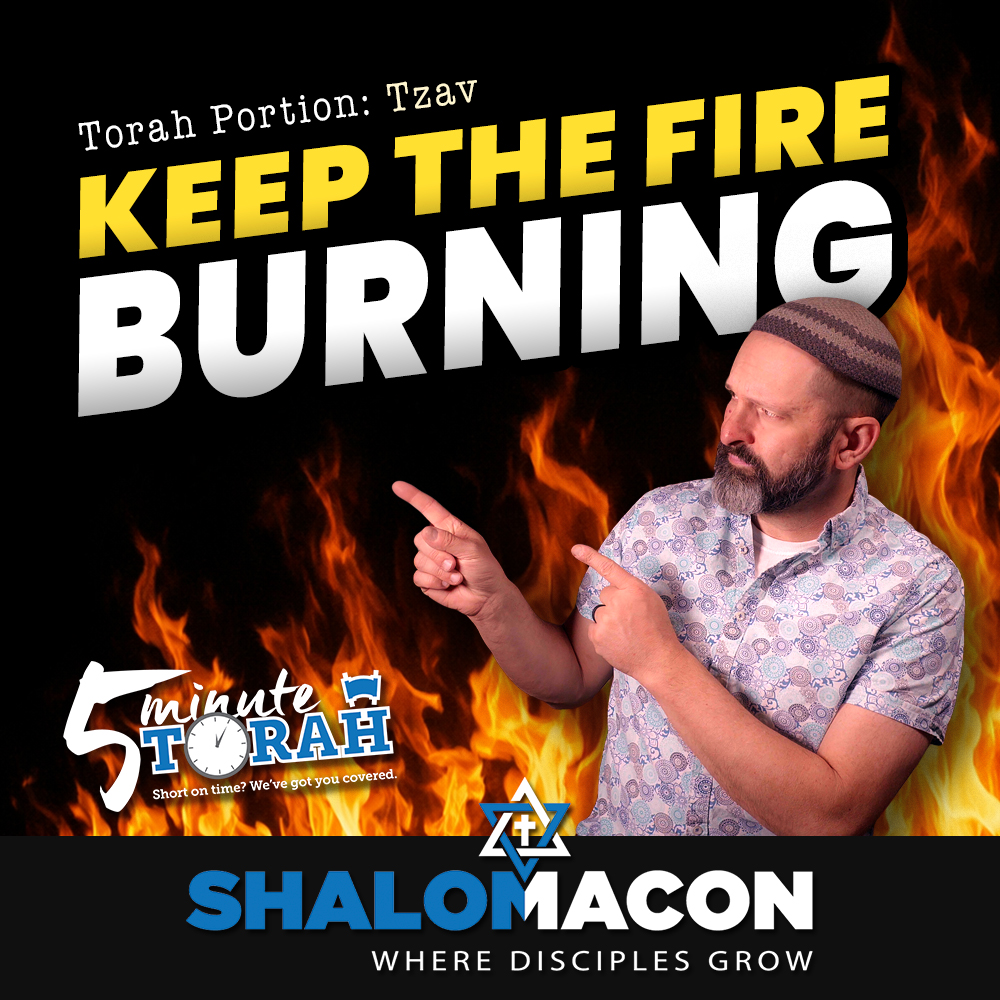
5 Minute Torah - Tzav - Keep the Fire Burning

5 Minute Torah - Tzav - Keep the Fire Burning
Shalom Macon: Messianic Jewish Teachings
5 Minute Torah - Tzav - Keep the Fire Burning

Mar 27 2026 | 00:08:06

/

Show Notes

What if the most important fire in Scripture isn’t one you can see?

The Torah commands that the altar fire must never go out—but why repeat it three times? And what does that eternal flame have to do with your daily prayers… or your own heart?

In a world without a Temple, how do we keep the fire burning? Is prayer enough—or is something deeper required?

And if the early disciples said their hearts “burned within them,” what does it mean if ours don’t?

Are we tending the fire… or letting it fade?

Let’s explore this together in this week’s 5 Minute Torah.

Join Shalom Macon Live! at 11am EST every Saturday (#Shabbat) for uplifting Worship Music and Teachings

If you get value from our work, please
consider Supporting Shalom Macon

https://www.shalomacon.org/give

-- Ways to Support Shalom Macon --

Our Website | https://www.shalomacon.org/give
Tithe.ly | https://tithe.ly/give?c=329563
PayPal | [email protected]
Text "GIVE" to (706) 739-5990

God provides for the work of Shalom Macon through the giving of those who benefit from that work and in turn, give generously to allow it to continue.

Whether you are an in-person or virtual member, your support is vital to sharing the message.

We thank you for joining us, Shabbat Shalom!Join Shalom Macon Live! at 11am EST every Saturday (#Shabbat) for uplifting Worship Music and Teachings

If you get value from our work, please
consider Supporting Shalom Macon

https://www.shalomacon.org/give

-- Ways to Support Shalom Macon --

Our Website | https://www.shalomacon.org/give
Tithe.ly | https://tithe.ly/give?c=329563
PayPal | [email protected]
Text "GIVE" to (706) 739-5990

God provides for the work of Shalom Macon through the giving of those who benefit from that work and in turn, give generously to allow it to continue.

Whether you are an in-person or virtual member, your support is vital to sharing the message.

We thank you for joining us, Shabbat Shalom!

View Full Transcript

Episode Transcript

[00:00:00] A few weeks ago, the Torah told us, do not kindle a fire. Now it tells us, keep the fire burning continually, day and night. No exceptions. So which is it? Is the Torah contradicting itself? Let's take a closer look in this week's five Minute Torah. [00:00:21] Shalom and blessings from Shalom Macon, the place where disciples of Yeshua learn, connect and grow. I'm Darren, and before I get into the five minutes of my five minute Torah commentary, let's cover a few quick facts about this week's Torah portion. This week we are studying the 25th Torah portion and the second portion of the book of Leviticus. We are in the portion of Tsav, Leviticus 6:1:8, 36. And here are the three things that you need to know about it. Number one. Temple garbage collection. Sanctity in the ashes. Every morning before the service of the holy temple could begin, the ashes from the previous day's offerings had to be removed from the altar. At first glance, this may seem like a glorified cleanup job, but it was anything but ordinary. This task was sacred and highly sought after among the Kohanim, the priests. The Talmud even records that priests would race for the honor once, resulting in a serious injury. Why such intensity? Because even the ashes of the temple were holy. In the house of the Lord, even taking out the trash was a sacred privilege. Number two, Torah Kosher laws on blood and fat. When people think of the dietary laws, they usually jump to Leviticus, chapter 11. But the Torah weaves these instructions throughout its pages. Here in tsav, we're given clear prohibitions against consuming blood and certain fats. It's not just about which animals are permitted, it's about how they are treated. The blood and the choicest fats belong to the Lord. These laws remind us that honoring God isn't only about what we eat, but how we recognize what has been set apart for Him. And number three, anointing the priests. The sacred inauguration. Our portion concludes with the ordination of Aaron and his sons. Aaron immerses, is clothed in holy garments, and is anointed with oil along with the tabernacle itself. Sacrifices follow a sin offering, a burnt offering, and the Ram of ordination. Blood is applied to the altar, to Aaron, and even to his sons in their garments. This moment sets them apart completely for service. Before they could minister on behalf of Israel, they themselves had to be consecrated body garments and identity fully devoted to the Lord. Passover is just ahead. Are you ready? Many people are looking for a balanced Passover Haggadah that will allow them to have a meaningful connection to Yeshua and his life leading up to his sacrificial death and resurrection. This is why I created the cup of Redemption, my Messianic Passover Haggadah. It not only walks you through the traditional Seder but but it also connects Yeshua's last meal and his suffering with the various elements of the Seder. It's great for homes, communities and Messianic synagogues as well as churches, and gives step by step instructions for conducting a seder, even if you've never experienced one before and it's priced low enough to snag a copy for everyone at your seder table. Just use the link in the description box below and gear up early so you can be ready for this Passover to be your best Passover this week's Torah commentary is called Keep the Fire Burning and comes from my book 5 Minute Torah, Volume 1. In our second week of learning about the sacrificial system, we read about the laws of what is known as the Korban Tamid, or the daily offering. Our portion begins by telling us this is the law of the burnt offering Leviticus 6:2 or verse 9 depending on your Bible. The burnt offerings in this passage are not voluntary burnt offerings brought by petitioners, but rather the continual or two tamid offerings, the daily offerings required to be brought at the beginning and the end of every day. One lamb you shall offer in the morning, and the other lamb you shall offer toward the evening. This is Exodus 29:39. These two offerings served as bookends to the daily services of the holy House. They also served as the basis for the daily prayer times. The morning prayers Shacharit and the afternoon prayers mincha correspond to these two daily offerings. When discussing these particular korbanot or offerings, the Torah specifies that the fire that burns on the altar should never be allowed to be extinguished. It emphasizes the point three times in our Torah portion. The fire of the altar shall be kept burning on it Leviticus 6:2 or verse 9. The fire on the altar shall be kept burning on it. Leviticus 6:5 or verse 12. [00:04:47] Fire shall be kept burning on the altar continually it shall not go out. This is chapter 6, verse 6 or verse 13. From this repetition we learned that at least three separate fires were burning on the altar in different locations, one for burning the offerings, one for the coals required to be used while burning the incense on the golden altar, and one simply to ensure that a continual flame remained on the altar in the event that the others would ever fail. This last one is where we want to focus our attention, we can derive a few applications from this command to keep the fire ablaze upon the altar. The first is the literal understanding. When there's a functioning temple, the fire on the altar must never go out. It must be tended to and stoked so that the flame of the altar will never be extinguished. The second application is that during a time when the holy temple is not functioning, the altar of fire should be kept alive through our prayers. Every morning and afternoon during our daily prayers, we recite the laws of the Korban Tamid that are placed upon the fire of the altar every single day that the holy house is functioning. Since we live in a time when the holy temple is not functioning, we keep the fire burning metaphorically upon the holy altar through this daily recitation. The last application is that we must never allow the flame of Torah and Mitzvot to be extinguished upon the altar and of our hearts. We must continually find ways to keep this flame alive. We must daily strive to increase our Torah learning and how we are living out the commandments. Everything we do should point toward the restoration of the kingdom and the return of our King. However, we should strive to keep the flame of Torah and Mitzvot alive within us and encourage others to do the same as well. Because the day is drawing near. [00:06:34] And let us consider how to stir up one another to love and good works, not neglecting to meet together as is the habit of some, but encouraging one another, and all the more as you see the day drawing near. This is Hebrews chapter 10, verses 24 and 25. When the disciples of Yeshua encountered him on the road to Emmaus, their hearts burned within them as he taught them Torah, they said. Did not our hearts burn within us while he talked to us on the road, while he opened to us the Scriptures? This is Luke 24:32. [00:07:05] Our hearts should also burn with the words of our Rabbi igniting a flame within us for Torah and misfote. However, we cannot expect that flame to last indefinitely without attendance, so we must work diligently to assure its survival. What will you do today to keep the holy fire continually burning on your altar? What will you do to help your brother attend the fire on the altar of his heart as well? Last week we asked a question that should stop us in our tracks. Who actually gets to decide how we approach God? Is it something we define or something already defined for us? Because if we assume the wrong answer, we may feel close while completely missing our opportunity for intimacy. If you missed last week's five minute tour, you need to go back and watch it. You can check it out right here, Sam.

Other Episodes