Episode Transcript
[00:00:01] Speaker A: Some of us have been running like that for years.
Running the same argument, the same defense, the same conversation we will not have the same work that hollows us out. The same thing we promised we would deal with after last year's holidays. Well, after I get through this busy season, after things calm down. Running hard. Running hard. And if you asked Forrest Gump where he was going, he had no clue. And if. If you ask most people where they're going, they have no clue, Then a person finally says it.
I'm tired.
I'm going home.
That's the moment. This is the moment.
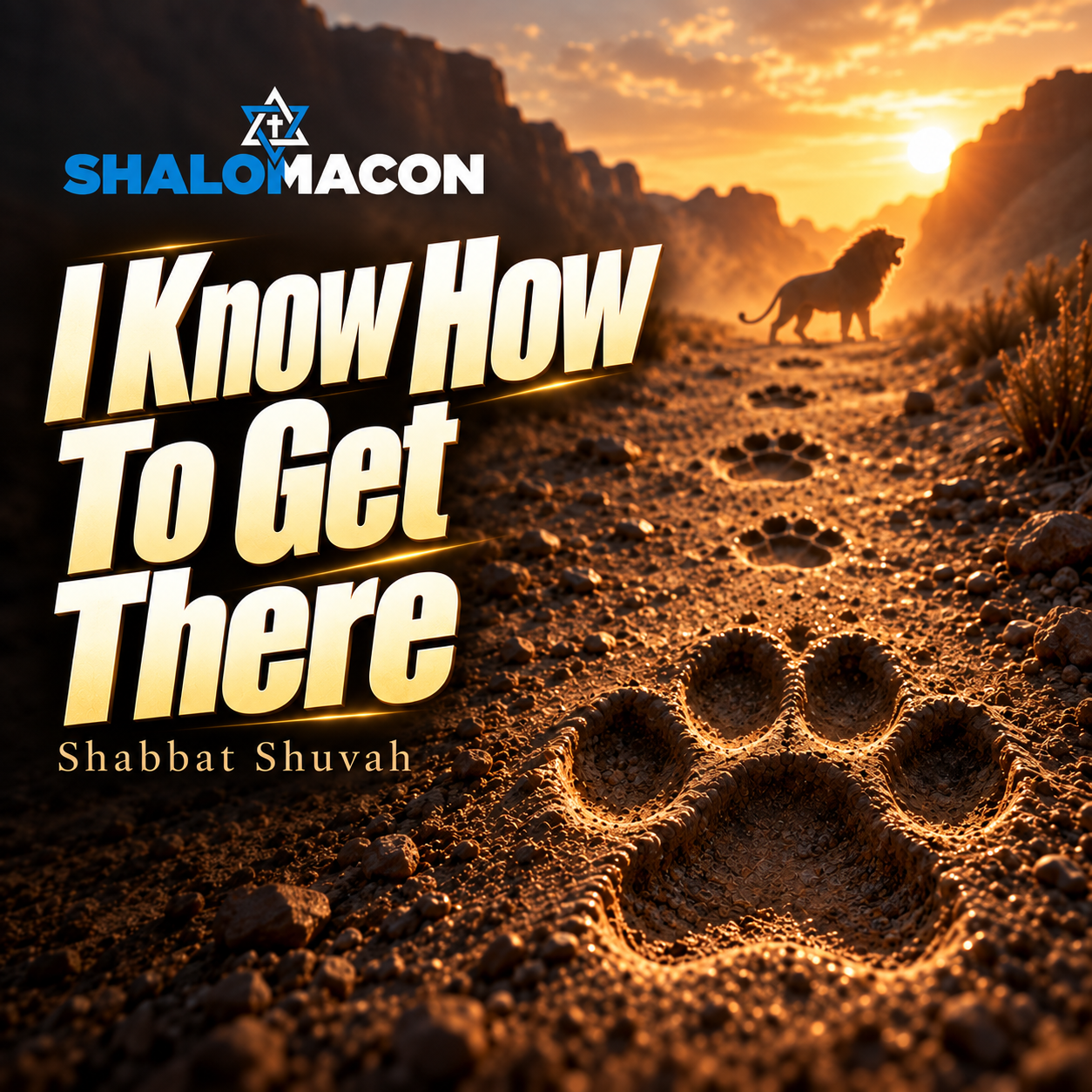
That is this Shabbat. And the last thing, it's not one step, it's a trail. You turn around this morning, there will be tracks along the way. God put them there. Things he wants you to see this year. Things that you need to pick up and carry.
That is the walk. That is what Brooks was talking about without even knowing it. Happy is the destination we keep trying to map. And the world won't let us find that map. No happier, happier ness. It's the next track, and it starts today, if you will allow it. With the turn.
You don't have to know where the year ends. You don't even have to be.
You don't even have to feel it.
You just have to be willing to say it. I don't know exactly where I'm going, but I know exactly how to get there.
[00:01:56] Speaker B: And.
[00:01:56] Speaker A: And it's with you, Father.
I'm coming home.
So we'll start with a question. Easy question. Todd did it. I'll model after him. Why are you here?
Have you ever, you know, what is your purpose in the universe?
Have you ever pondered this?
I'm kidding. That's not what we're talking about. We have enough to talk about. We're in the middle of Rosh Hashanah and Yom Kippur. Why are you here today?
Why are you a part of this experience of the high holidays? I probably know the answer. You thought, well, you know, I'd like to lose a little weight.
Yom Kippur. It's a great option.
White is your favorite color. You love to wear white.
You love the sound of a piercing animal horn blaring you away from your nap that you're trying to take.
You, like, standing for hours and hours.
Good.
Did I hit anyone's reason there?
Okay, probably not.
But why then?
You probably are here because you love God or you love his calendar or. It's a part of this thing, this community. As family, we celebrate these days together. Or maybe someone in your actual family told you you're going to be there.
That could be other than the last. Those are good reasons, but I think that we're here because of something much simpler than that. We want life to be better.
We want a little more peace, a little more peace at home, maybe a little more peace in our own heads. We may want to repair some things, a better outlook, say a word or a sentence to someone that's needed to be said for a long time. We may want to shed some old debt, to write off some old debt that we've been carrying for a while. But there's a difficulty in this whole idea, because if I asked you this morning to describe exactly where it is that you want to end up, I don't think most people could do that.
We know we want to be somewhere else, better, but we couldn't draw a map to get there. And there's great news for today. You don't need a map.
Another question.
Has anyone ever tracked a lion through the African wilderness?
If someone had said yes, my whole message falls apart. So I'm really glad I didn't think. But maybe online, who knows? I recently heard a guy named Boyd Vardy on a podcast.
South African guy, grew up on a game reserve in South Africa. He learned to track game, all kinds of game, particularly lions from some of the Shangan men who worked there. One of them, a very, very, very good tracker, Renaeus Milango, gave Boyd a line that he then proceeded to write a book around called the Lion Tracker's Guide to Life. I haven't read the book yet, but here' this is from this master lion tracker who's teaching him. And he says, I do not know where we're going, but I know exactly how to get there.
It sounds funny, but it's very deep, actually, when you let it sink in.
I do not know where we are going, but I know exactly how to get there. And you picture what a guy in the middle of the wilderness, savannah, whatever it is in Africa, 360 degrees, surrounded by vastness.
Somewhere out there is a lion. He can't see it. He has no idea where it is. Nobody gave him a map. And he knows exactly how to get there, how he finds a track, then he finds the next one, and then he finds the next one. And that's the whole method.
He doesn't need the route, he needs the next print in the dirt. And he follows it until there's another track and you understand what he's actually looking at.
Grass, a crushed Leaf, a scuff mark, whatever the thing is, the next track.
And this is a familiar lesson across all kinds of sources from which I could have drawn tackling big things in small steps.
But I think a lion tracker presents a very memorable way to bring this into our field of thought.
Because that is the method of this day and of this season.
We're not looking for a lion, but our target can be just as big and scary.
We came looking for something new, a new life.
We want the whole project.
Let's do it all. Fix the marriage, fix the temper, fix the habit, fix the distance between the relative I'm at odds with. Fix the distance between me and God. Walk out of Yom Kippur completely changed and fixed. And if that project, the magnitude of that project, it's too big.
And that's why many of us stall. That's why the work looks enormous. That's why failure stacks. That's why some people don't even really take it seriously enough to get started with it.
And if teshuvah, if repentance means that I have to admit that, that my whole life is, you know, if my whole life is a wreck, and I'm not saying it is for anyone, but these parts of my life, golly, I mean, jeez, that's a lot of work.
I think I'll just keep walking the way I'm going to because at least that's a familiar road, even if it's leading away from the goal. And so, too often we find ourselves living the opposite or a messed up version of that lion tracker's line. Our line is I know where I'm going.
I just have absolutely no idea how to get there.
And that doesn't work in the bush and it does not work here. It doesn't work in life.
I'm going to come here. I'm going to hope to get inspired. I'm going to feel God. I'm going to leave as a new human being. I'm going to be ready to tackle the world and live happily ever after. But would you please just give me the spiritual gps?
Give me the turn by turn directions. I need an eta. I want you to have all the plans for a reroute. If traffic gets in my way. While we're doing this, my friends, we're on a journey from your first day to the last on this planet. A journey to happiness.
Who wants a journey to happiness?
No one.
Well, it's probably good because it's a bit of a trick question. Arthur Brooks, an incredible psychologist who studies happiness For a living. You know what he says about happiness?
There's no such thing.
Now, that's depressing.
The world will not permit happiness.
And I don't mean like the evil world.
The life you live will not permit unlimited happiness.
It can't be completely sustained. Somebody gets sick, you lose a job, a conversation goes badly, a relationship breaks down. Your nephew misjudges a dive in the pool.
Happy is a moving target, like a lion.
Nobody ever can draw a map to the lion. The tracker doesn't carry one because the thing he's chasing won't sit still.
He has tracks. That's all anyone gets.
And so what can you be?
You can be happier.
Brook says, don't chase Happy.
Chase happier.
On a podcast, I heard him say this word that has now been adopted permanently into my vocabulary. Maybe you'll consider it happierness, the pursuit of happierness.
Happy is a place.
Happier is a direction.
It's a journey.
The tracker can't wait for the lion to magically roar and say, I'm over here.
It doesn't work like that.
He doesn't know precisely where he needs to go. But he also doesn't just wait around for that to happen. He doesn't wait for this inspiration or a moment of clarity to arrive on schedule. He looks for the next mark on the ground.
You don't have to have the deepest, most emotional spiritual experience that you've ever had this morning or in the high holy days. You just need one first true step.
And incredibly, you don't have to know where you're going. You just have to trust that you know how to get there. And you do.
Because God has given us the way.
What Vardy refers to as the first track. God has given us the first track. We find it in this week's Haftarah reading. This is called Shabbat Shuvah for a reading for a reason.
The Haftorah from Hosea. It says, shuvah Yisrael, return, O Israel, to Adonai, your God, for you have stumbled in your iniquity.
It's the first track.
It's not a five year plan. The first track is simply shoove, turn, return, come back. In other verses, it can mean restore, refresh. There are many, many, many times in life when I've taken the wrong path. I know I'm probably the only one in the room, but I speak from authority on this.
Some of you may have. And we thought we were on the right track toward things we wanted in life. But we lost our way. We lost the trail. Maybe through carelessness or apathy or sin or stubbornness or any number of decisions, rebelliousness decisions, attitudes that take us off the trail of the lion and instead put in pursuit of a wild goose, a trail that leads away from success on the journey. How do we define success on the journey?
Good relationships with God and our fellow human being. That's success.
It's not that difficult.
Love God, love people is where I derive that from. I can't take credit for it.
I learned it from my teacher.
The first step. The first step on the trail. You know what it is? It's the realization to say, I've lost the trail.
I must stop, I must turn, I must go back to where I can once again be put on the right track. It's simply a realization that the way I'm going is not leading me toward the destination or the prize I desire. The lion of happierness.
Without a doubt, it's not always a happy moment, is it, when we come to this realization.
Speaking of happy, there are some harsh realizations that sometimes need to occur in this process for us.
One particularly hard one that I have often had to confront at various times in my life I speak of me, not you, is to say, my God, how is it that I didn't realize that the reason I'm here is because of me?
It's not anyone else's fault.
That's a real hard place to come to sometimes. But it's a necessary place. That's not everyone. I understand there's a second one. It's sometimes just our stubbornness.
Our stubbornness. Sometimes when we commit to go away, to go a way, a direction, to take a path, we stubbornly just continue to pursue that path, even when we know it's not right, because we've just come too far to call it wrong.
That's a human condition of pride.
We keep walking.
And it would take an act of God to get our attention.
Good news.
We have an act of God.
It's right now.
We need to come to ourselves.
Today, the High holidays.
This is just such an act of God. Yeshua told a very famous story about a guy coming to his senses. Probably one of his most famous, widely quoted because it has such an incredibly broad reach and application. When a son takes what's his, he leaves, he burns through it. He ends up hungry enough to envy the pigs he's living with. And Luke picks this very careful next sentence about his realization. And Luke says he came to himself.
The Delitzsch. I love the Delitzsch translation. It says, he returned to his heart.
He was on the wrong path.
This isn't me. He said, that's the turn. That's the turn.
He came to himself and he said, I'll get up and I'll go to my father. And you don't have to be in a pig pen this morning.
You don't have to be slopping the hogs.
If you're from Arkansas, you may be calling them, but that's something different.
You don't have to be in the pigpen. Some of us are living incredibly respectable lives. We're running hard, we're succeeding, things look great and we're going absolutely nowhere.
Still, maybe just as lost, we just don't stink as much.
Our sentence is the same. I have lost the trail. I must return to my heart. Or better yet, I'll take my heart in my hand, I'll bring it to God. You know how you get back to it? How do you get back? You go home.
You go home. For some of us, that's a complicated word. Going home doesn't mean going back to somebody who hurt you. It doesn't mean we're forcing reconciliation. That isn't safe to force. Some people have been through this. They've made turns before. There was nobody waiting. Hear the name of this day. Shabbat Shuvah. Return.
Return to God, who is waiting at the end of this particular road. And he is not standing on the stoop, where you been?
He is the one who called you Shuvah.
Come back.
Return, and you turn around and you find out that he's been waiting there, the prodigal. He did not know what was awaiting him. But he has to follow this trail, the next track to return. And he's hopeful, of course. He knows his father. He's hopeful that his father will show him mercy. He knows his attributes. But he also, it's important to realize, does not come empty handed or empty mouthed. I should say.
Before he sets out, he commits to take words with him.
It's a really important phrase for today, before he sets out. Father, I have sinned against heaven. And before you guess where we hear that again. Take words with you. Where do you hear it? Shabbat Shuvah, the half Torah from Hosea. Return, O Israel, to Adonai, your God, for you have stumbled in your iniquity. Take words with you and return to Adonai.
Take words with you. Not a payment, not some performance. Words, that's what you have. Tomorrow night, Monday, we will have plenty of words.
If I can make a promise about Yom Kippur, I can promise you, you will have wor some of them in nice alphabetical order for you.
Alchet for the sin.
Pay attention to these words that you are taking with you.
We read the list over and over. The list is not supposed to be saying your life is a complete failure because most of you are not living like that. I hope none of you. But the day of Yom Kippur. None of this is asking you to say that you are. It's a list of things that need your attention.
That's it.
A list of things. Some of them are mine for this year. Some of them are not. They're not applicable.
And the ones that are mine, these are mine.
I have to take these.
And none of that is exciting. It's just important.
It's the first track, and those words are written for you. You don't have to be creative. It's not even that hard to find the trail. They're on the paper.
They're in the book.
What they're waiting for is for you to add your heart to them because they're useless without that.
Take those words with you. Take them as the things that you're actually saying to God. Then let God do what he can do with you to restore you, to lighten what you've been lugging to meet you on the road. Last week, we heard the sound of the shofar a hundred times.
Monday night, we'll hear it again. As Yom Kippur ends, we'll hear it once more this long. Blast the gates close right now. What sound do you hear?
Do you hear it?
It's there.
The still, small voice of Shabbat Shuva and the voice of God calling out to us all in this voice. This is the Shabbat between the sounds.
When you have to tune in, you have to pay attention. And it takes you into the conclusion of the holidays. The shofar. What was the shofar? The shofar was the first track.
The shofar was to wake you up.
And if I'm not assuming anything about anyone's journey, I'm simply assuming that you're human. I think that's safe.
And so the first realization of the sound of the shofar and repentance is just to wake you up and make you at least consider. And am I heading the right direction in every area of my life?
Every one.
Why do we need everyone?
So that we can fix them all?
No. But at least we can take the first track.
At least we can do something.
And get back on the track and follow the trail home for its him who can point you in the right direction. And it puts us right back to the start when we allow God to put us on the right path on the trail. You know what Hosea says about this today? He says, whoever is wise, let him understand these things.
Whoever is discerning, let him know them, for the ways of the Lord are right and the righteous will walk in them.
This is the path.
The road is not easy. That comes from the words of the Master himself.
He says, in this life, you'll have trouble, but you know what? You can choose the path of the Lord and he'll go with you. And in other words, we don't know exactly where we're going, but we know exactly how to get there.
Lion trackers, all of us.
My hope is that these words will bring you through this season, especially on Yom Kippur, because there are so many words and so much liturgy and so much standing and so much discomfort that that isn't your focus.
Believe me, I've done this a lot of years. I know how easy that is, to lose focus because of everything else and say, please, God, you know what? I'll be better next year if I can just get to the time when I have a piece of pizza.
Come on, God. I showed up, all right?
I know how easy that is.
Especially.
Especially if you didn't even grow up doing this.
And it can feel kind of like foreign space. Forget about all that. This is good God's thing.
It's God's voice. These are prayers that connect you to God and put you on a journey. I just want to be happy.
Happy isn't where we're going.
Happy isn't the destination.
Happier. A lifelong journey. We don't have to fix it all. We won't fix it all here.
[00:28:41] Speaker B: Today.
[00:28:41] Speaker A: You need the next print, the next track in front of you. You don't have to fix your life today.
Just take a track.
That's the assignment for this Shabbat. Stop. Admit you've lost the trail before tomorrow night. Maybe you name something that I'm bringing. I'm bringing my words with me. God, be like the famous prodigal.
Even if we don't see ourselves as pigpen dwellers, I hope you don't.
Some.
Fine. Okay, great. It's all emotional. What do you exactly want me to do? Good question. I'll tell you that on Yom Kippur on the day of, I'll bring in something practical for that.
But I want to end today with one profound bit of wisdom from a modern sage.
He had been running for three years, two months, 14 days and 16 hours. And he turned around eventually to look at this group of followers and reporters, and they said, just be quiet. He's going to say something.
And Forrest Gump paused and delivered his famous simple line, I'm pretty tired.
I think I'll go home now.
Some of us have been running like that for years, running the same argument, the same defense, the same conversation. We will not have the same word work that hollows us out. The same thing we promised we would deal with after last year's holidays. Well, after I get through this busy season, after things calm down. Running hard. Running hard. And if you asked Forrest Gump where he was going, he had no clue. And if you ask most people where they're going, they have no clue.
Then a person finally says it.
I'm tired.
I'm going home.
That's the moment. This is the moment.
That is this Shabbat. And the last thing, it's not one step, it's a trail. You turn around this morning, there will be tracks along the way. God put them there. Things he wants you to see this year. Things that you need to pick up and carry.
That is the walk. That is what Brooks was talking about without even knowing it. Happy is the destination we keep trying to map. And the world won't let us find that map. No happier, happier ness. It's the next track and it starts today, if you will allow it. With the turn.
You don't have to know where the year ends. You don't even have to be.
You don't even have to feel it.
You just have to be willing to say it. I don't know exactly where I'm going, but I know exactly how to get there. And it's with you, Father.
I'm coming home.
May you be inscribed and sealed for an incredible upcoming year of 5787. Gemar Chatima Tovah Shabbat Shalom.
[00:32:30] Speaker B: I'm Darren with Shalom Macon. If you enjoyed this teaching, I want to ask you to take the next step.
Start by making sure you're subscribed to our channel. Next. Make sure you hit the like button on this video so that others know it's worth their time to watch.
Last, head over to our website to learn more about Shalom Macon, explore other teachings and events, and if you're so inclined, contribute to the work that we're doing to further the kingdom. Thanks for watching and connecting with Shalom Macon.