Episode Transcript
[00:00:00] Speaker A: So before studying the Gospels from a Jewish context, I felt like the man who had just eaten kernels of wheat.
I had the essence, yet I was missing so much flavor.
I had no idea that there was even such a thing as bread or cookies or royal delicacies of honey and oil. And I know many of you feel the same, yet maybe some of you here or listening online have been like the man who said, because I have the kernel, I eat the essence. So I don't need the rest of that.
I don't need the Jewish stuff. I have Jesus, I don't need anything else.
And you're correct, you do not need it to be sustained.
But why would you live off of raw kernels when you could have all of the delicacies? By understanding Yeshua and his teachings from a Jewish perspective.
So this morning I'm going to begin a two part series. But of course here at Shalom Makin we do things a little bit more unorthodox. So I'm going to begin it today, I'm not going to finish it next week because I'm going to be in the mountains in Tennessee and then I'm going to finish it two weeks from now, this two part series. Okay, so just going to go ahead and let you know that before we get started.
But I wanted to, when Rabbi reached out about teaching, I wanted to, you know, I was looking at the Torah portions and I didn't know exactly what I wanted to do, but I just had this inspiration to really, to really go in and do a series specifically on Yeshua and in the Gospels, like that's what I wanted to do something on that.
And you know, for us as non Jews getting into, for many of us as non Jews, Gentiles getting into the Messianic world, we get into it via Yeshua, clearly. And so I really just wanted to revisit some of his signs, but his miracles from a Jewish perspective, from a Messianic Jewish perspective.
And so that's what we're going to do today and in a couple of weeks.
And what? Also, like, why does that even matter? Okay, so I wanted to start with a parable that's attributed to the Rashbi Rabbi Shimon Bar Yochai.
And this is what it says. And listen closely.
This is likened to a man who lived in the mountains and was not acquainted with the city inhabitants.
He sowed wheat and then he ate the kernel of wheat just as it was.
One day he came to the city where he was served with good bread. This person said, what is this? They Answered him, this is bread to be eaten.
He ate, and it was delicious to his palate. He said, what is this made from? They said, it is made from wheat.
Afterwards they served him cookies mixed with oil.
He tasted them. He asked and said, what are these made from? They answered, from wheat.
Afterwards they offered him food fit for kings, kneaded with oil and honey. And he said, what are these made from?
And they told him, from wheat.
He said, I certainly have all of these because I eat the essence of them all, which is wheat.
And because of this opinion, he did not learn how to make all of these delicacies, and he did not know the delights of the world. Thus they were lost to him.
So before studying the Gospels from a Jewish context, I felt like the man who had just eaten kernels of wheat.
I had the essence, yet I was missing so much flavor.
I had no idea that there was even such a thing as bread or cookies or royal delicacies of honey and oil. And I know many of you feel the same, yet maybe some of you here or listening online have been like the man who said, because I have the kernel, I eat the essence. So I don't need the rest of that.
I don't need the Jewish stuff. I have Jesus. I don't need anything else.
And you're correct, you do not need it to be sustained.
But why would you live off of raw kernels when you could have all of the delicacies? By understanding Yeshua and his teachings from a Jewish perspective, however, that's probably not most of you in the room, you've probably been eating bread, no longer kernels, but maybe you've just been only eating bread, missing out on the cookies.
And the king's bread needed oil and honey. We've been missing out on those cookies, Dave. We're too thin, right? We're too thin.
Exactly.
But there are levels in this parable. So I hope for these two weeks we'll get to taste a little bit of those delicacies whose essence is Messiah.
But okay, Derek, that's wonderful and great, but what's the point of learning something deeper about Yeshua's seven Signs? We already believe in him.
And I would respond to you and say that it's not just a matter of believing, but this is a matter of discipleship.
And I would direct you to someone in this room at the back of the room, Darren Huckey, who wrote a book about this entitled the Four Responsibilities of a Disciple.
And you should go and purchase it later this evening once Havdala has come in after the root beer float purchase online. He didn't tell me to say that. I promise. Okay. What, in bulk? In bulk? Yes. Don't let your orders be thin. Okay.
All right.
There you go. All right.
But in it, Darren mentions that memorization of Yeshua's teachings is one of the responsibilities of a disciple. Okay. But then he goes on to say that it's not just memorization, but understanding Yeshua's interpretation of the Torah.
And I would just want to add to that that I think that there's another subset that could be said that not only his memorizing his words and understanding his words and his interpretation of the Torah, but also understanding his actions, his signs and his miracles in their proper Jewish perspective.
And did you even know that there were other rabbis, specifically in the Galilee, who also performed incredible miracles? Hanina Ben Doza. Honi. The circle drawer.
So what makes Yeshua's miracles so special?
Shouldn't we, as his disciples, those of us who claim his name, know and understand the impact of his deeds?
So it's no secret that John's Gospel is a mystical gospel. And while you all know that I love going in that area, I don't plan to give you some highly advanced mystical insight. But what I do hope to uncover is that every single word in John's Gospel holds significance.
And each of these signs have a lot of depth.
And there's a lot that could be said. And we're only going to touch on a few aspects of each of these because there's just too much, too much for two weeks.
But John says right here at the end of his Gospel that he wrote all of these things down so that you may believe.
And this is not a rational or logical decision of believing that Yeshua is the Messiah. Rather, he uses the active form of believe 98 times in his Gospel. Not once does he use that word as a noun, every single time as a verb.
So he is telling us that belief isn't some one time decision, but rather it's an active, perpetual connection of complete and utter devotion to Yeshua.
So maybe in the past you've made the decision to believe, but the question we'll return to is, are you actively believing?
So with that being said, let's begin with sign one.
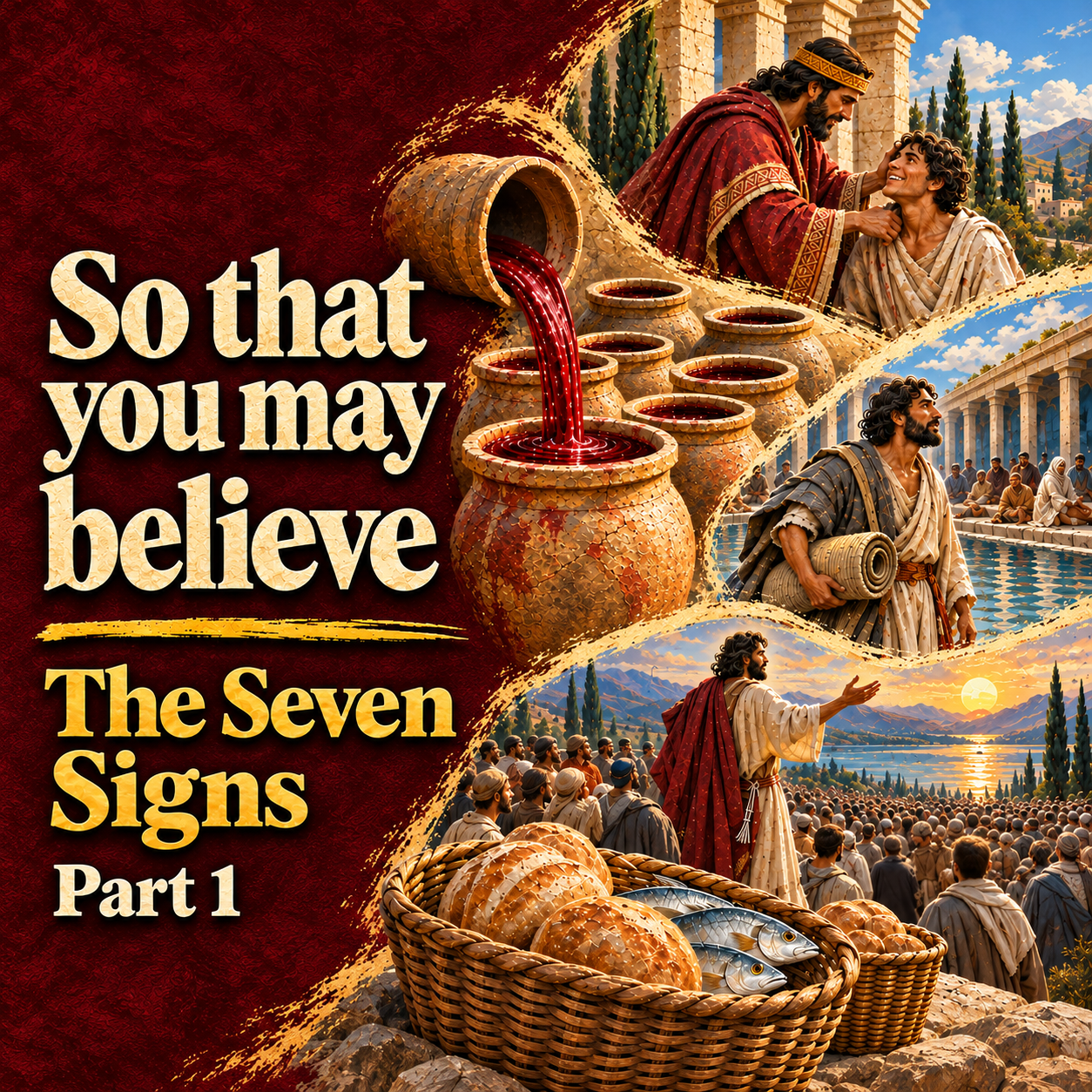
The miracle of water into wine. So John chapter two, we're going to open John chapter two, verse one and two. This one's going to be a big one. We start out big, okay. And then we'll kind of take a step back. It'll be a little more Chill. But this one, we're jumping into the deep end. Okay, so he Sundays on the third day there was a wedding in Cana of Galilee, and the mother of Yeshua was there. Now, both Yeshua and his disciples were invited to the wedding. Okay, so first, let's set the context. In the Mishnah, it states that new brides were typically married on the fourth day of the week, which is Tuesday night. Okay, but a Jewish wedding feast is seven days.
Therefore, if the first night was Tuesday, then the final night of the wedding would be Monday night. Okay, now why is that important? Monday Night Football? No, because Monday night begins the third day of the week.
And many Christian scholars even affirm this viewpoint, that on the third day is at least on the simple level. Speaking of the third day of the week and the last night of the wedding festival, this also makes sense as to why they would have ran out of wine, because this is the last night of a very long week of partying. Okay?
And when they ran out of wine, in verse three, it says, the mother of Yeshua says to him, they have no wine. And Yeshua says to her, woman, what does your concern have to do with me?
My hour has not yet come.
And his mother says to the servants, whatever he says to you, do it.
So now we've got a hidden crisis.
People are having a wonderful time, partying and celebrating, yet the servants notice the vats are completely empty. Whatever is in everyone's cup is the last of the wine.
The bride and the groom, along with their families, are on the brink of embarrassment. And what a terrible way to end their week long celebration.
And we know the story though, that Yeshua is going to turn the water into wine and going to be of greater quality. And the toastmaster talks about how Yeshua is going to bring the greater wine at the end. And in short, everyone ends up happy and Yeshua saves the day. Woo hoo. Right everybody? We know. Okay, we know. But there's so much more going on, much more than meets the eye.
So first, what does this wedding celebration represent?
Let's look a little bit deeper.
It represents the messianic age. In Yeshua's parables, weddings are always representing this messianic banquet. So therefore, when Mary, who is one of the only people in the world at this time, who believes that Yeshua is the Messiah, because remember, she hid those things in her heart, says to him that they have no wine. He responds with, my hour has not come yet.
Essentially, he is saying, it's not the messianic age.
Why are you pressuring me to do this?
Mary does not take no for an answer, like all good mothers.
But what is Mary really doing?
She is trying to initiate the redemption, calling her son to act that maybe it's not the appointed time to reveal yourself, but real people are in real need.
So the hour must be hastened to time to initiate the Redemption.
Let's go a little bit further. It says now there were set there six water pots of stone according to the manner of purification for the Jews, containing two or three Batima piece, okay? And Yeshua said to them, fill the water pots with water, and they were filled up to the brim. And he tells them to draw them out. And then ultimately you continue to read. And the toastmaster comes out, the water's transformed into wine, and he's like, you've set out the best wine for the end.
So let's go deeper. What's this wine about?
What does the water represent, and what does the wine represent?
I explained that the wedding represents the Messianic banquet, yet within Jewish understanding, water represents the revealed aspects of the Torah. As we know, water is likened to. To Torah, yet wine is likened to the concealed or secret aspects of the Torah.
In fact, it has the same numerical value. Wine and secrets, same thing. So therefore, the sages actually comment, and they say when wine goes in, secrets come out.
It's a real thing.
So Yeshua is giving us access not only to the revealed levels of the Torah, but to the inner Torah as well as.
And this is not just any wine.
This miracle that Yeshua is performing is drawing from what's called the Yayin Ha Meshumar, the wine preserved from the six days of creation.
You ever heard of that? Familiar with that?
Maybe a Mila Messiah at the end of Pesach, Passover.
If you haven't done that, do it this year.
So the Midrash states in numbers, in the time to come, the Holy One, blessed be he, will make a grand banquet for the righteous. And at its conclusion, he will give them wine preserved in its grapes since the six days of creation, to drink.
But what actually is this wine? The Zohar comments on this and says, what is the meaning of the wine preserved in its grapes from the six days of creation?
This refers to the primordial light, also known as the light of Messiah, that the Holy One, blessed be he, created on the first day? And it remains sealed and preserved within its source, untouched by any external forces until the day when all the secrets shall flow forth.
So this wine is the light from day one, the Light of Yeshua himself that holds the secrets of Torah and divinity and everything.
And those six vessels, remember that there's six vessels representing the six days of creation, and they're made of stone, because those six days were completely pure before sin entered into the world.
The Shelah Hakadosh says about this wine, the meaning of the preserved, of it being preserved is obviously that it has not come out of its grapes. It is kept a secret.
The Talmud describes the heavenly wine as something no one on earth has ever seen the like of, or something preserved in its grapes, meaning it exists, yet only in potential.
So when Yeshua performs this miracle, he is literally bringing forth heavenly wine, wine from the age to come.
This wine is supposed to be locked away as hidden potential stored for the. For the Messianic age, which is why he tells his mother, my hour is not here.
But he brings forth into actuality what is locked in potential.
And so the wine of the Messianic age is being revealed, and a taste of the world to come is here and now.
So he's giving us access to this now if we'll abide in him.
So Yeshua is not only initiating the Messianic age, he is also the one who brings this wine preserved from the six days of creation, this deeper, innermost level of the Torah, making it available to us now.
But I want to look at this as well. Just as God created this preserved wine at the beginning of his creation, Yeshua's miracle of transforming the water into wine was the beginning of his signs.
And so while on the literal level, this phrase on the third day was probably referencing the third day of the week, it also connects back to Mount Sinai. In Exodus 19, it states on the third day when Hashem would reveal his glory to the children of Israel by giving them the Torah. John states that this first sign on the third day is the beginning of signs of Yeshua when he revealed his glory.
The revelation of Yeshua's glory was revealed at a wedding, and the revelation of Hashem's glory was revealed under the wedding chuppah at Mount Sinai.
So that's great.
What does it matter?
I'm not telling you yet.
Sign number two, healing of the servant of the king's son.
So let's move to John 4. Beginning in verse 46, we see Yeshua has traveled back from Cana after Passover. And in verse, and he's in. He. Excuse me. And there's a servant of the king, probably a servant of Herod Antipas in capernaum who's about 15 to 20 miles away from Cana, and his son has fallen deathly ill. And in verse 47, John says, when he heard that Yeshua had come out of Judea into Galilee, he went to him and implored him to come down and heal his son, for he was at the point of death. Yeshua says to him, unless you people see signs and wonders, you will by no means believe.
This Nobleman travels about 20 miles to get to Yeshua and implores him to come to Capernaum to heal his son. He says, sir, come down before my child dies. And Yeshua responds to him and says, go your way, your son lives.
So he has to Travel back another 15 to 20 miles, not knowing, not being able to see with his own eyes if his son is healed yet.
And we ultimately know, right, that he returns and his son is healed. That exact hour.
And this miracle, it echoes the same miracles performed by Elijah and Elisha. Elijah resurrects a widow's son. Elisha resurrects the Shunammite woman's son. We read about this actually today.
However, we also even see that Elisha, in Second Kings, chapter five, he tells Naaman from a distance to enter into the Jordan River. And his leprosy is healed.
So he doesn't come, come to him into his, into his house. He speaks to him from a distance.
But all of these miracles, the resurrection of the. Of the boys, Elijah and Elisha had to be in the house in the same room.
Yeshua is like the culmination of these prophets because his power and prophecy is greater, because something in someone greater is here, even greater than Elijah and Elisha.
But every detail in John matters, and the story continues. The man's servants meet him on the way and tell them that his son lives.
And then he inquired to them on the hour when he got better. And they said to him, yesterday, at the seventh hour of the day, the fever left him. So the Father knew that it was the same hour in which Yeshua said to him, your son lives. And he himself believed in his whole household. So what's the significance of this seventh hour?
Right, because every, every detail matters in John.
So there is a midrashic tradition that states on the Friday of, of the creation week, when Adam and Eve were created. And this is found in Leviticus Rabba 29. It lists hour by hour, what happened. And I'm going to pick up in the fifth hour. In the fifth hour, he, God shaped the dust in the sixth hour, in he made it into a lifeless body. And in the seventh hour, he breathed a soul into him.
So according to the Midrash, it was the seventh hour of the day when life was breathed into Adam. And it's the seventh hour of the day when this boy, who had essentially reverted to being a lifeless body, Yeshua, heals him from a distance and his life returns to him.
Let's move on to sign number three, the healing at the Pool of Bethesda in John chapter 5.
So the third sign opens up and it says, and after this, there was a feast of the Jews, okay? And what you'll actually know is that John's Gospel is built around the festivals, okay?
We see Passover three times. We see Sukkot once. We see Hanukkah in there as well. And then here in chapter five, we have an unnamed feast.
And so John has built his Gospel around the appointed times, because I want you to go home and study these. But you'll begin to see that the appointed times are connected to each of these signs as well.
And while scholars have debated what the feast is in John chapter five, I have been doing a lot of research, and I found this really, really unique passage in this one really esoteric book and realized that I figured it out, but that I have no idea which holiday it is, okay?
It could be any of them. I mean, it really could.
So nonetheless, the point is here is that there's a man who is lame, okay?
And he is here at the pool of Bethesda, and this is where the angel would stir up the waters. And you know the story, okay? And there's a lot of imagery here that I could go into. There's actually two pools. Daniel Lancaster points out that it was called Beit Eshtayin, the House of Two Springs, a northern pool and a southern pool. Angel, you know, a whole lot of stuff. We don't have time for it, so the responsibility is upon you.
However, verse 5 states, now, there was a certain man who had an infirmity for 38 years.
Once again, these numbers. Why does John tell us 38 years?
Who else was lame and couldn't walk into what they were promised for 38 years?
The children of Israel.
This lame man represents Israel.
Remember, it was the children of Israel who were sentenced to die in the desert.
And Moses recounts this to the next generation before they cross into the Promised land. In Deuteronomy 2, he says, and the days when we went out from Kadesh Barnea until we crossed the Brook of zered numbered 38 years.
Until all the generation of the men of war expired from the midst of the camp, just as Hashem swore to them.
When did Hashem swear?
Yes, remember the sin of the spies.
They go out and scout the land, and they say, it's not good. The 10 come back with a bad report. Joshua and Caleb are like, no, we can do this. But due to that bad report, Hashem condemns that generation, the men of that generation, that they will wander in the wilderness for 40 years, total an additional 38 years from when it happened.
So we have here a man who has not been able to walk for 38 years, mirroring the nation, mirroring the nation of Israel, who has not been able to enter the Promised Land, or was not able to enter the promised land for 38 years.
And we have this interesting Jewish understanding that there's a connection between the Holy Land and Shabbat. And even the writer of Hebrews makes this connection in chapter four between the Holy Land, the Promised Land, with the Sabbath.
And this is where holy space and holy time converge, pointing to the world to come.
And maybe this is a reason why, if you continue to read in the passage that Yeshua heals the man on Shabbat, because Yeshua is displaying the transformative power of the age to come to this man who represents the children of Israel. Just as Joshua led them out of the wilderness into the Holy Land, Yeshua will lead Israel by healing their infirmities and iniquities into the world to come.
But there's a little more here going back to the children of Israel being condemned to wander the wilderness for 38 years due to the sin of the spies.
According to tradition, what day of the year did this happen on?
When were they condemned? Does anybody know?
It's a really sad day.
The 9th of AV.
The 9th of AV. And the Midrash relates that Hashem condemns The men, ages 20 to 60 of that generation to die in the wilderness on the 9th of AV. And each year, on the 9th of AV, approximately 15,000 of these men would die.
The Midrash states that they would go and dig their own graves. All of the men, they would go and dig their own graves. They would lie down and sleep in them. And then the next morning, Moses would send out a crier who would call out, let the living separate from the dead. You didn't know who was going to die when you laid down that night.
And those who did not pass away would rise up out of their graves. And the Midrash continues to say that this occurred until the very last year.
The last 15,000 went to dig their graves with no hope of getting back up.
Yet Moses sent out the crier the next morning anyways. Let the living separate from the dead. And to everyone's shock, they all got back up after realizing that Hashem had shown them extreme compassion, that they had been spared. They ultimately got up and walked with the second generation into the promised land.
And this seems to connect with Yeshua saying, pick up your bed and walk beyond the halakhic implications of carrying on Shabbat.
What was this man actually carrying?
He was carrying what essentially had been his grave.
That portable bed had been the place of immobility for him for 38 years, and in essence, a grave.
Yeshua is having the man who represents Israel displaying that he is fully restored, that he is able to tap into the power of the world to come and walk into his destiny while carrying his former bed, his former grave.
Now consider later in the chapter, it's the same day Yeshua is arguing with the Jewish elite on, you know, the fact that he healed on Shabbat and told him to carry his his bed.
And he says to him in verse 20, in, in chapter 20, or in verse 24 and 25 and 28, most assuredly I say to you, the hour is coming.
And now is when the dead will hear the voice of the Son of God. And those who hear will live. For as the Father has life in himself, so he has granted the Son to have life in himself.
Do not marvel at this, for the hour is coming in which all who are in the graves will hear his voice and come forth.
Now this would make a lot more sense to be the seventh sign, which we all know is Lazarus resurrecting from the grave. But for some reason he says it when this man starts walking again, maybe it is because it connects back to these 38 years.
So just as when the crier's voice that Moses had sent called those who are alive to rise out of their graves, the dead will hear the voice of the Son of God and rise out of their graves.
And just as the layman heard the voice of the Son of Man and rose up from his proverbial grave, so John is showing us that Yeshua is not only fulfilling the messianic hope and expectation that Isaiah says the lame shall leap like a deer, but more than that, that he's the hope, the restorer, and that the resurrector of Israel is here.
And this third sign is indicating that their 38 year sentence is over if they will just hear his voice and not harden their hearts.
So let's go now to Our final sign for today, sign number four, the feeding of the 5,000.
So we're going to be looking at the first half of John 6.
So Yeshua's fourth sign and the final one for today is this. And because Passover was near, that's important here. There were large caravans that were beginning to form in the Galilee and head south toward Jerusalem. Okay.
And word is spread about this miracle worker named Yeshua. And so lots of people are beginning to form.
Now, this story is also found in other gospels, and they give us a little extra detail.
And so right before this sign, Yeshua has actually just learned that his cousin John the Immerser was executed.
And he wants to actually go out alone and pray and mourn by himself.
But he sees all of these people.
And Mark in his Gospel says, and when Yeshua, he had come out, he saw the great multitudes and was moved with compassion for them because they were like sheep not having a shepherd.
So he began to teach them many things. You'll see the shepherd and teacher motif here in this sign.
So maybe this is why both Mark and John specify that there was grass, green grass in particular, echoing Psalm 23, that Hashem is my shepherd. He causes me to lie down in green grass. Because Yeshua instructs the 5,000 men to recline down on the grass in verse 10.
And this word reclining actually gives the idea of reclining at the table for a grand feast, with Yeshua being the good shepherd who tends to his flock. Yeshua takes the five loaves and the two fish from the young boy and distributes the bread and the fish. And we know, miraculously feeding the 5,000 men plus all the women and children.
And we could look again about how this miracle compares with Elijah and Elisha, who sustained a widow and her son with just a handful of flour in a bowl and a little bit of oil for several years. Or when Elisha instructed the widow to pour the remnants of a jar into every available container. That's what we read this morning. Sorry.
When he fed, or when he fed 100 men with only 20 barley wafers. Very similar, but still.
Okay. 20 barley wafers to 100 men. 5 barley loaves to 5000 men. You can see the exponential increase that Yeshua brings, right?
But once again, there's something even greater happening here.
Qohelet Rabba. Ecclesiastes. The Midrash on Ecclesiastes 128 says, Reb Berekiah said, in the name of Rabbi Yitzhak, the lateral Redeemer will be like the First Redeemer. What does the Torah say about the First Redeemer? The First Redeemer made manna to descend, as it is written, behold, I will rain bread from heaven for you.
In the same way, the Latter Redeemer will make manna descend, as it is written, may he be as abundant grain in the land.
And Yeshua says later in this chapter that he is the bread from heaven.
So he is not just performing a miracle. Rather, he is displaying himself as the Latter Redeemer, the Messiah, the prophet, like Moses, which is why probably in verse 14, right after this miracle has occurred, the men say, this is truly the prophet who has come into the world.
But going back to verse 12 and 13, says, so when they were filled, Yeshua says to his disciples, gather up the fragments that remain so that nothing is lost.
Therefore, they gathered them up and filled the 12 baskets with fragments of the five barley loaves, which are left over by those who had eaten.
So my question here, why include this? It's in other gospels as well. Why did they gather up fragments of bread?
Well, on a simple level, there's a rabbinic tradition that prohibits wasting food, right?
I'm sure some of you have heard your mama and your daddy say, why are you throwing that in the trash? Okay, but there's. But there's something deeper going on here.
In Hasidic understanding, loaves of bread represent a master's teachings, the entire corpus of all of his wisdom.
Yet the fragments of the bread are individual discourses, teachings or parables of the master.
And Hasidic philosophy goes on to explain that each of these fragments, meaning each of these single teachings or discourses or whatever, contain the same spiritual DNA of the entire loaf, the entire breadth of knowledge of the Rabbi.
So therefore, they teach that if the disciple can grasp even just one lesson, if he or she can eat just a fragment of the bread, thus internalizing the teaching they have tapped into the spiritual essence of their Rabbi.
So now we see why these fragments, or we're beginning to see why these fragments had to be gathered. These fragments represent the individual teachings and lessons of Yeshua that are gathered into 12 baskets.
And these 12 baskets represent the gathering in of the 12 tribes of Israel. And Yeshua is saying, just as he will gather in the lost sheep of the house of Israel, he looks at his disciples and says, I need you to gather and collect all of my individual teachings so that my sheep will eat and remember what he told Peter at the end of John's Gospel, feed my sheep.
So this bread gathered into 12 baskets alludes as well to the 12 loaves of the bread of the presence in the holy place in the temple.
This was also miraculous bread, as tradition explains that it remained warm from Shabbat to Shabbat and never spoiled, and that all the priests ate from it.
Yet during the second Temple period, there were over a thousand priests in the temple who ate from this bread.
And so they actually, in the Talmud, it talks about this miracle that would occur. And it says every priest, this is in Yoma 38, every priest who received a piece of the bread the size of an olive would eat it and be satisfied.
And some would eat it and even have leftovers.
So the gathered bread fragments represent this heavenly bread found in the temple, which just a small amount was enough to satisfy.
Meaning that Yeshua's teachings, even a single lesson, if we will truly consume it and internalize it, has the power to satisfy the depths of our souls.
It is at the end of this chapter in John 6 when Yeshua gives, gives the hard saying about how one must eat his flesh and drink his blood.
And then you know what happens? All of these multitudes of disciples leave him and follow him no more. That's what John says. And then Yeshua looks at the 12 and asks them, you do not want to leave too, do you?
And Peter responds, master, to whom shall we go?
You have the words of eternal life.
We have come to believe and know that you are the Holy One of God.
And that's what this is all about, that Yeshua has the words of eternal life.
But as disciples of Yeshua, people who attend a messianic Jewish synagogue here at Shalom Makin, we have to go back to the beginning here.
Do we know his words?
Do we believe his words?
And do we abide in them?
As we conclude the first part of this study, John reveals these first four signs.
But these are not just four incredible miracles, but rather they are four windows into the identity and mission of the Messiah.
So, as I told you, we got a couple of weeks before we'll return to this, but I want you to spend some time thinking and reflecting, both of you, here and online, what these signs mean.
If these are four windows into the identity and the mission of the Messiah, then what does that mean for you as his disciple?
What does it mean for you to know that Yeshua reveals the abundance and the glory of the Messianic age by bringing forth the wine preserved from the six days of creation?
What does it mean for you? That Yeshua heals a little boy, a probably a gentile royal official son from a distance at a specific hour of the day, the same hour when Adam's soul was breathed into him.
What does it mean for you that Yeshua heals a lame man at Bethesda, revealing himself as the restorer of Israel, who heals, raises up and leads his people to the Messianic era and the life of the world to come?
And what does it mean for you that Yeshua has the miraculous feeding of the 5,000 where he reveals himself as the latter Redeemer, the prophet, like Moses, who feeds, teaches and gathers the people of Israel?
Because if he truly did these things and now you have a little bit more of an appreciation for maybe what they meant, the question becomes how will we respond?
And I want you to remain in that tension for 14 more days because we've still got three more signs to cover and we still have to sort of unpack.
What does this mean for me?
But I'll let you in on a little secret.
I don't know what it means for you.
That's something you're going to have to figure out.
Shabbat Shalom
[00:41:14] Speaker B: I'm Darren with Shalom Macon. If you enjoyed this teaching, I want to ask you to take the next step.
Start by making sure you subscribe to our channel. Next. Make sure you hit the like button on this video so that others know it's worth their time to watch.
Last head over to our website to learn more about Shalom Macon, explore other teachings and events, and if you're so inclined, contribute to the work that we're doing to further the kingdom. Thanks for watching and connecting with Shalom Macon.