Episode Transcript
[00:00:00] So imagine someone has hurt you so deeply that you cannot find anything good about them or any way to forgive them.
[00:00:09] Every time you think about them, all you can think about is the evil and harm they did to you.
[00:00:16] You have replayed their offenses continuously in your mind, and that person has truly become the worst person in the world to you.
[00:00:27] Now I want you to stop and imagine them as a little child.
[00:00:37] And now I want you to look at our children.
[00:00:42] Before that person knew how to lie, before they learned to manipulate and betray, before they had accumulated all the sins, failures, wounds, and mistakes that formed them into the person they became.
[00:00:57] They were once little children, just like these. Looking back at you, could you hate that child?
[00:01:08] Could you rejoice if something terrible happened to them?
[00:01:12] Could you humiliate that child or say that they are beyond redemption, as the 13 attributes teach us? When we can no longer find any good in the person someone has become, remember that they were once innocent little children, just like the ones behind me.
[00:01:36] Hashem does not look at us according to the worst things we have ever done. He remembers the days of old, the days of our youth when we were pure and blameless.
[00:01:47] What if the deepest level of mercy means learning to look at people again not as the person that they have become or even the person they could become, but as the pure, innocent babe they were before the world wounded them.
[00:02:10] Okay, Dr. David said he's teaching the kids this morning, and he said, we're into our portion God Kitetse. And he said that there's 70 something mitzvah to go over. So he was like, you need to go really long today, Derek. All right, so I'm going to go ahead and preface it with that. No, Good morning, Shabbat Shalom. And last week we began studying the 13 attributes of mercy from the book Tomer Devorah, which I forgot to bring today, but it's found in Micah 718 through 20, which we're going to look at right here now, which states, who Hashem is like you, he bears sin and removes iniquity to the remnant of his inheritance. He does not maintain his anger forever, for he desires kindness. After Teshuvah, he will have mercy on us. He suppresses our sins. May you cast all their sins into the depths of the sea. Give truth to Jacob, kindness to Abraham, as you have sworn to our forefathers from the days of old.
[00:03:12] So last week we covered attributes one through seven, and the summary of those attributes were the first, endure the offense. Second, bear the consequences.
[00:03:24] Third, repair what was damaged. Four, remember that the offender is family.
[00:03:30] Five, release your anger. Six, remember their goodness, and seventh, restore them when they repent.
[00:03:40] Okay, so while this is a quick review of last week, if you have not listened to that message, you have to leave and go listen to it and then you can come back later. Okay? No, seriously, do though, go and listen to it. Because everything that I say today is built on that message from last week.
[00:03:58] So today we will continue our ascent up and as I said last week, uncovering the deeper layers of our hearts and as we go through attributes 8 through 13.
[00:04:11] So before we begin, I also want to repeat the caveat because it's very important that I said last week so that we're all on the same page.
[00:04:19] Mercy does not mean pretending that evil is good, abandoning wisdom, or refusing appropriate boundaries. It means refusing to allow another person's sin to determine the condition of our own soul.
[00:04:34] So please do not take my words out of context thinking that I am permitting abuse, just as you would not take Yeshua's words of turning the other cheek as permitting abuse. Okay, so with that being said, let's go and start with attribute number eight. He suppresses our sins so there's another allegory in Jewish thought is that when someone performs a mitzvah or a good deed, that mitzvah ascends up and goes into heaven and enters before Hashem.
[00:05:06] Sins, on the other hand, are not allowed to ascend and enter before him. Rather, he suppresses them so that they will not enter. As it is written, evil will not dwell with you. Psalm 55.
[00:05:19] Therefore Hashem does not say, if you have done forty mitzvahs and thirty sins, you are rewarded for ten mitzvahs. Rather, he suppresses the thirty sins, giving us an opportunity to do Teshuvah and punishing if we do not. But then likewise, he rewards completely for the 40 good deeds a person does.
[00:05:42] So we also must too emulate this trait. We must not suppress the good others have done for us and remember only the evil that they caused us. On the contrary, we should suppress the harm and forget it and push it to the side, not letting the evil dwell within us.
[00:06:02] We should always set the good before ourselves.
[00:06:06] We should not say in our hearts that although they did me a good turn, they also did me a bad one and forget the good. As a result, we are to ignore the bad to the best of our ability. Just as Hashem suppresses sins and focuses on the good, so there are plenty of examples in the New Testament. But we see Yeshua powerfully display this attribute in John 8:1 11, when a woman who has been caught in the act of adultery is brought before him. While we know this is a test from the Pharisees and the scribes trying to trap him, he could have easily exposed how terrible and the gravity how terrible her sin was, and the gravity that her sin was as well. But instead of making it a public spectacle, which is what the Pharisees and scribes wanted to do, Yeshua does something different.
[00:06:58] He turns the situation upside down. And he not only suppresses the accusations made against her, he also pronounces he does not accuse her.
[00:07:09] And he does something even further interesting. He also suppresses her future sins by saying the words go and sin no more.
[00:07:20] So a practical example for this. Imagine someone here at Shalom Macon has made a serious mistake.
[00:07:27] Maybe they mishandled their responsibility, they lost their temper, made a theological statement that was simply wrong.
[00:07:34] Maybe they dress immodestly in shoal, or they're just plain disrespectful.
[00:07:39] We could easily tell someone, did you hear what so and so did?
[00:07:44] Did you hear what they said not too long after that? What has happened in private now is common knowledge.
[00:07:51] But what would it mean to suppress their sin?
[00:07:54] It might mean you have the opportunity to expose someone's failures, but you choose not to.
[00:08:00] Not because of what they did was right or that accountability is off the table, but because you refuse to let failure become part of their identity.
[00:08:10] Instead, you remember their good points, and instead of repeating their bad points, you not only suppress them, but you repeat the good about them, even if they have offended you.
[00:08:23] Perhaps one of the greatest tests of whether we have truly forgiven someone is whether or not we feel the need to tell people about the sins they committed.
[00:08:35] So let's move to attribute number nine.
[00:08:38] May you cast all their sins into the depths of the sea.
[00:08:43] So when there are wicked people in life, or people who become our enemies or our adversaries, or just someone who goes off the derrick, off the path of holiness, and they defy Hashem.
[00:08:54] Sometimes they do not and will not repent due to them due to this. Excuse me, Hashem sends his justice, his judgment and punishment upon them.
[00:09:06] When a person sees the suffering of someone who has harmed him in the past, he should not rejoice over his adversary's downfall or maintain his hatred.
[00:09:18] He should have mercy upon that person and view him as a tzaddik, a righteous one, since he has been purified through his suffering when a sinner was whipped with lashes. This is from this week's Torah portion due to his sins. It states, if the wicked person is liable for lashes, do not add additional lashes, lest your brother will be degraded in your eyes. Deuteronomy 25:2 3.
[00:09:46] The idea is that the sinner, before being whipped, is called wicked, a wicked person, but after he is called your brother, meaning that after he has received his due punishment, his sins are absolved and he returns to the fold of the brotherhood.
[00:10:06] In the New Testament, Yeshua demonstrates this attribute while he is being crucified. Nonetheless, in Matthew 27:44 and Mark 15:32, we typically think that there's two robbers on the side, or two, two criminals on either side. One's good, one's bad, right? No. The text states both. In those scenarios, both robbers who were crucified beside him were were insulting and mocking him.
[00:10:33] However, Luke records later in the day that only one kept insulting him. The other one stops the rebel who was receiving his due punishment and had just been mocking Yeshua, asks him to remember him in his kingdom.
[00:10:49] Yeshua, nearing death, responds with mercy, stating that he will enter into Gan Aiden into paradise with him. Yeshua views this person, who was an enemy just hours before, as a tzaddik. He views this man's sins as being cast into the depths of the sea and draws him near.
[00:11:09] So a practical example here is Imagine someone hurt you 10 years ago, and imagine their life has been difficult since they hurt you.
[00:11:17] They have faced legal issues, their life is in shambles, they cannot hold a steady job. They they are frequented with tragic circumstances.
[00:11:26] Is there a piece of you that is satisfied that they are getting what they deserve?
[00:11:32] Is there a part of you that is happy that they are going through it?
[00:11:37] What would mercy look like in this scenario?
[00:11:40] Instead of being happy with their downfall, Hashem calls us to view them as forgiven.
[00:11:47] They have paid their debts, so to speak.
[00:11:50] Hashem has cast all their sins into the depths of the sea. And it may have not been pretty, but those sins are gone.
[00:11:57] They are no longer viewed as an enemy or an adversary, but should be viewed as a brother or a sister.
[00:12:05] This attribute is called in Hebrew veitashlik, and it becomes the foundation of the name of the tashlik service we do on Rosh Hashanah afternoon. This is when we cast stones into the water representing the sins that held us down.
[00:12:20] The idea, though, in Rosh Hashanah is that the power of the sins you committed has been broken.
[00:12:26] The addictive behavior or bad habits. That power is first broken, and then we cast the stones into the depths of the sea. As a physical action demonstrating the spiritual reality, they represent the remnants of that sin.
[00:12:43] So we cast all of the dead remnants of those sins into the abyss.
[00:12:49] So just as the sinner has become broken through suffering and hardship, we view the remnant of their sins as being cast into the depths of the sea, and they are restored as a brother.
[00:13:03] Moving on to attribute 10. Give truth to Jacob.
[00:13:08] So Hashem shows us his mercy even more.
[00:13:11] When average Jews, or those of us who are disciples of Yeshua from the nations, do not know how or for whatever reason, choose not to go beyond the precise letter of our obligations, Hashem treats us with true justice.
[00:13:27] Instead of dealing with them according to the strict letter of the law and judgment, he interacts with them. Mita k Nega, measure for measure.
[00:13:38] Because they are doing their best and trying to live according to the truth of the Scriptures and Messiah, he judges them with true justice rather than strict harsh judgment.
[00:13:52] We are called to do the same when someone only does what is obligated, doing at least what they know is just and true, but no more. We should give them the benefit of the doubt and try to see things from their perspective.
[00:14:07] Yeshua teaches us this. In Matthew 7:1 and 2 he states, Condemn not that you not be condemned for with what judgment you judge others, you will be judged, and with the measure you use, it will be measured back to you.
[00:14:25] So imagine you're here at synagogue and someone, a good person, who really loves Hashem or walks by and doesn't speak to you, okay?
[00:14:34] You begin to think maybe they're a little haughty or they don't like you.
[00:14:39] You begin to create an entire narrative about their character based on a small interaction.
[00:14:44] What if they were distracted?
[00:14:46] What if they have little children or are dealing with something difficult in their lives?
[00:14:53] Mercy in that situation is to judge favorably when there is room to do so.
[00:14:59] And there is usually always room to do so.
[00:15:03] Yeshua's command is to judge people and their intentions favorably because the same measure will be used on us.
[00:15:11] We desire mercy on days we struggle. Therefore we are called to show mercy and become humble about what we actually know of another person's heart.
[00:15:22] And I want to speak on that for just a second.
[00:15:26] Some of you know, I spent a few years in the Hebrew roots movement, and this isn't a complete indictment upon everyone in there. But if you're part of that or have some of that theology and you're listening today, what I noticed during those few years is that that movement really misses this attribute because they view people. If they aren't if they aren't theologically correct on everything, or they don't do X, Y and Z, they treat them with harsh judgment. And Hashem says, no, that is not how I treat people. It can happen in the Messianic movement, it can happen in Christianity. It can happen with anybody. But we should view people whether or not they do all the right things and they do all of the correct things.
[00:16:11] We should treat them with justice, not harshness to the letter of the law.
[00:16:18] Going on to attribute 11 kindness to Abraham.
[00:16:23] This attribute is about a different group of people. Those who do go beyond their required obligation, as did Abraham.
[00:16:31] Hashem treats them beyond the letter of the law. Hashem does not exact from them the full extent of his justice, even in the correct way. He treats them even better than that, as they themselves behave so too. We should act. We should be righteous and correct and just in our dealings with all people. But we should go beyond the letter of the law with those who are good and pious.
[00:16:58] We should be full of kindness, acting with greater mercy and patience to those who are especially kind and giving.
[00:17:06] If you are slightly patient with others, these people you should be so much more. They should be very esteemed in our eyes, beloved to us, and be amongst our closest friends.
[00:17:19] We see this demonstrated in Acts 10 with Cornelius the centurion, who as a God fearer and a righteous, pious Gentile, gave alms to the Jewish people, prayed at the three daily appointed prayer times, had a good reputation amongst all of the Jews, and even while living in a hostile city towards the Jews Caesarea, he, as a Gentile going way above and beyond his obligations, displaying kindness to God and others, was met by heaven with extreme kindness. When Hashem sends him a vision of an angel during his prayer to send forth for Simon Peter, and it is through that kindness that Cornelius and his entire household become the first Gentile disciples of Yeshua to receive the Ruach Hakodesh and speak in tongues.
[00:18:12] So imagine It's Monday morning, 2am and one of your best friends or your mentors or just someone who is an exceptional person is texting you and calling you needing assistance.
[00:18:26] Now, while this scenario is not an emergency, maybe they are trying to reach a work deadline in the middle of the night and you're the only one who can help.
[00:18:34] Or maybe there's a pest in their home and they can't sleep knowing it's in there.
[00:18:39] Maybe their air conditioning went out and they know you have extra portable fans.
[00:18:44] You could easily read the text message, hit the silence button, put the phone down and go to sleep.
[00:18:51] But then you're confronted with this attribute kindness to Abraham, and you remember. You remember who this person is, that they are the embodiment of kindness, and you remember how much they have helped others and even yourself.
[00:19:09] So you pick up the phone and you get out of bed.
[00:19:13] And oftentimes, and I do want to say this, a deeper point of this attribute is could you show this level of kindness to your enemy?
[00:19:21] And that's a good question to reflect on. But I don't want us to miss the point. We oftentimes focus how can I be kind to those who don't like me? But we oftentimes miss we should be kind to people who are exceptionally kind.
[00:19:37] We can sometimes shrug that off and take subconsciously take advantage of that person or not show them the respect that they deserve.
[00:19:48] Move on to attribute 12 as you swore to our forefathers. I'll go ahead and tell you. Buckle up for the last two okay There are those who act improperly, yet Hashem has mercy on all. I shall favor those whom I shall favor. Exodus 33:19 so there is a treasure house of grace that Hashem graces and gives to these people as a free gift.
[00:20:18] This is because Hashem says they have the merit of the forefathers and I swore to the avout the fathers. Therefore, even if they act improperly, they will merit because they are the descendants of the forefathers to whom I swore to.
[00:20:36] Consequently, I will lead and guide them until they are rectified.
[00:20:41] So too we should act even if we are harmed by wicked people.
[00:20:47] And you'll see the context of this in a moment. We should not respond to them cruelly, humiliate them, or the like. Rather, we should have mercy on them and say, after all, they are sons of Abraham, Isaac and Jacob. If they are unworthy, their forefathers were worthy and proper.
[00:21:06] A person who disgraces the children disgraces the forefathers.
[00:21:11] One should conceal this person's shame in order to help rectify them as much as possible.
[00:21:17] When tempted to shame someone through disgracing and retaliating against the offender, one should say, I do not want his forefathers disgrace because of me.
[00:21:27] So in the New Testament, Yeshua demonstrates this attribute in Luke 19 when he comes to visit Zacchaeus house. Y' all remember little Zacchaeus? Remember that song? I can't remember.
[00:21:39] There you go. Of course, the music, you know.
[00:21:44] So Zacchaeus is a sinner.
[00:21:47] He is a rich tax collector. He's maybe a wee little man too. But he's also a rich tax collector, an absolute betrayer of the Jewish people of Israel. When Yeshua tells him that he will be staying at his house, all of the people complain, saying he is going to be a guest with a man who is a sinner.
[00:22:06] Listen, everyone knows that this man is a sinner. Even Zacchaeus pleads his calls to Yeshua.
[00:22:13] Yeshua could have passed by this wealthy tax collector's house condemning him, just as he condemned Capernaum and Bethsaida for not repenting.
[00:22:24] Yeshua does condemn, however, notice what he says instead.
[00:22:29] Today, salvation has come to this house because he is also a son of Abraham.
[00:22:38] Yeshua suppresses Zacchaeus sins and instead points out his merit as a son of Abraham. Because he is a descendant of the forefathers, he was shown a free gift of mercy.
[00:22:53] So, first, while the theological implications of this attribute are enormous.
[00:22:58] Okay, and we don't have time to get into that today, please do go back and read Romans 9:11 with this attribute in mind.
[00:23:06] The primary subject of this attribute is someone who is Jewish, a descendant, a physical descendant of Abraham, Isaac and Jacob.
[00:23:16] They are to be shown mercy and not have their sins weaponized against them, not because they necessarily deserve it. But when we shame a Jewish person, we bring shame to the forefathers and by extension, shame to the God of the forefathers.
[00:23:31] Throughout history, Jewish people have had their sins and failures magnified and their humanity reduced to their worst moments, resulting in humanity's worst moments.
[00:23:42] Do you see why this world continuously targets the Jewish people?
[00:23:48] And it's been bad in the past and it's reaching a fever pitch in our generation.
[00:23:52] This world is begging you to slander the Jewish people and weaponize any error that they may be committing, intentionally targeting our younger generations through social media to do so.
[00:24:09] See why it is because it ultimately brings disgrace upon the forefathers whom Hashem swore to, which ultimately brings disgrace to Hashem, the God of Abraham, Isaac and Jacob and all of their descendants.
[00:24:25] Instead, we should be showering the Jewish people with grace, having a good reputation amongst them, and refusing to weaponize their sins and mishaps.
[00:24:36] The world wants to falsely accuse the state of Israel.
[00:24:40] This naturally leads to false accusations of the Jewish people and ultimately Hashem.
[00:24:47] And they're using the same old tropes. The God of the Jews calls for genocide.
[00:24:55] He called for genocide against Amalek, Remember?
[00:24:59] Happens every day on social media, ignorantly spouting lies, perpetrating the fragments of the heresy of Marcion. That the God of the Old Testament is evil and has been overtaken by the good grace filled God of the New Testament.
[00:25:13] But is that who Hashem is?
[00:25:16] God forbid we are through 12 attributes, is he who they falsely accuse him to be?
[00:25:25] He's the total opposite.
[00:25:28] So we need to remember the merit of the forefathers and the sanctification of Hashem's name when we speak of the Jewish people and frankly of the Jewish state, because whether we like it or not, they oftentimes are inseparable.
[00:25:42] But Paul makes some additional theological arguments in Galatians. And while this attribute centers around the Jewish people, when we as Gentiles swear allegiance to Messiah due to his faithfulness, we are also made children of Abraham, not instead of, but in addition to so this application of this attribute extends to all disciples of Yeshua as well.
[00:26:09] So imagine you're back at Shalom Macon and someone has really messed up.
[00:26:16] They've committed a maybe they've committed a serious moral failure, damaged their reputation, hurt someone, or even shamed the community.
[00:26:26] Everyone knows about it, and now everyone is talking.
[00:26:31] You know what happened and someone brings it up.
[00:26:35] You could tell the entire story. You can even add extra details that are true to make that person look even worse.
[00:26:43] And maybe that person even hurt you in the process, intentionally.
[00:26:48] So there's that part of you that really wants everyone to know exactly who this person is.
[00:26:54] But then you are confronted with this attribute and you remember this person is still a child of Abraham.
[00:27:03] Maybe their actions do not reflect it. Now, maybe they have fallen terribly short, and maybe they deserve correction and accountability. But you remember their failure does not erase their inheritance.
[00:27:17] So instead of exposing their sin and shame, you refuse to weaponize it against them. Because while everyone else wants to humiliate and expose them, you choose not to.
[00:27:27] You protect their dignity while praying for their restoration.
[00:27:32] The temptation for us to expose other people's failures is extremely alluring.
[00:27:38] Social media allows us to disgrace and humiliate people to an extent we cannot even fathom.
[00:27:45] But what if before exposing someone, we stopped and remembered this person has a father and ancestors?
[00:27:54] And if they are a descendant of Abraham, Isaac and Jacob by birth or through Messiah, I do not want to disgrace the fathers by exposing their shame.
[00:28:07] Sometimes mercy means refusing to shame someone you have every right to shame.
[00:28:16] All right, moving on to number 13.
[00:28:20] Make sure it's fastened.
[00:28:23] Hashem has an attribute with his children that when the merit of the forefathers has been spent, and so too all other merits, and they are found completely unworthy, what can he do?
[00:28:37] The verse states I remember for you the kindness of your youth, the love of your bridehood. Jeremiah 2:2 Hashem actually remembers the days of old, the love and innocence of the past, and he shows mercy. He remembers all of the mitzvah done since the day of birth. He remembers all of the attributes in which I have spoken of, and this attribute includes all of them together.
[00:29:05] So too we should behave towards others.
[00:29:08] When someone is harmed by a completely wicked person, and it is clear it was done deliberately, and there is no way to judge them favorably with any of the 12 attributes that we have stated, they should say there was once a previous time when they had not sinned at that point or in previous days they were good.
[00:29:33] He should remember the good deeds that the person did when he was a child, or at least when he was an innocent baby.
[00:29:42] From this point of view, there is no one unfit to receive our favors, prayers, and mercy.
[00:29:49] In Luke 15, Yeshua tells the parable commonly known as the prodigal Son and I want to focus on the prodigal.
[00:29:58] He acts with total depravity and wickedness. He insults his father, demands an early inheritance, which is essentially wishing for his father's early death, throws away his family identity and throws everything away for a life full of sin and recklessness until he is utterly destitute.
[00:30:18] You know the story. He returns home in repentance with a contrite heart, and his father runs to him and embraces him and kisses his son. He restores him and throws him this massive feast. However, there's a slight nuance and a slight detail we miss in this story.
[00:30:34] While the son had repented in his heart, his father did not know that his father only saw him from a distance.
[00:30:43] Yeshua says once the father saw him from a great distance. His father in that moment had compassion to reach him, to greet him.
[00:30:53] The father sees him while he is still far away.
[00:30:56] Before the son can explain himself, before he can offer his confession, before he can make restitution, his father is already running toward him.
[00:31:07] His father does not see the corrupt, broken man he had become.
[00:31:12] What does he see?
[00:31:15] His father looks at this deeply flawed man and sees his little boy, his baby.
[00:31:23] He sees him playing in the yard, belly laughing on the floor, fast asleep in his crib.
[00:31:31] He remembers the boy's cry when he was first born.
[00:31:35] The father actively chooses to bypass the current rebellion by tapping into the original first love he had for his son from the days of old, before the sin ever occurred. So imagine someone has hurt you so deeply that you cannot find anything good about them or any way to forgive them.
[00:32:00] Every time you think about them, all you can think about is the evil and harm they did to you.
[00:32:06] You have replayed their offenses continuously in your mind, and that person has truly become the worst person in the world to you.
[00:32:17] Now I want you to stop and imagine them as a little child.
[00:32:27] And now I want you to look at our children.
[00:32:33] Before that person knew how to lie, before they learned to manipulate and betray, before they had accumulated all the sins, failures, wounds, and mistakes that formed them into the person they became.
[00:32:47] They were once little children, just like these looking back at you.
[00:32:55] Could you hate that child?
[00:32:58] Could you rejoice if something terrible happened to them?
[00:33:03] Could you humiliate that child or say that they are beyond redemption, as the 13 attributes teach us? When we can no longer find any good in the person someone has become, remember that they were once innocent little children, just like the ones behind me.
[00:33:26] Hashem does not look at us according to the worst things we have ever done. He remembers the days of old, the days of our youth, when we were pure and blameless.
[00:33:38] What if the deepest level of mercy means learning to look at people again not as the person that they have become, or even the person they could become, but as the pure, innocent babe they were before the world wounded them?
[00:33:57] When the wicked give you no reason to see anything good in them, remember them as little children made in the image of God.
[00:34:07] And remember these faces behind me on the screen when you find it impossible to forgive or show mercy.
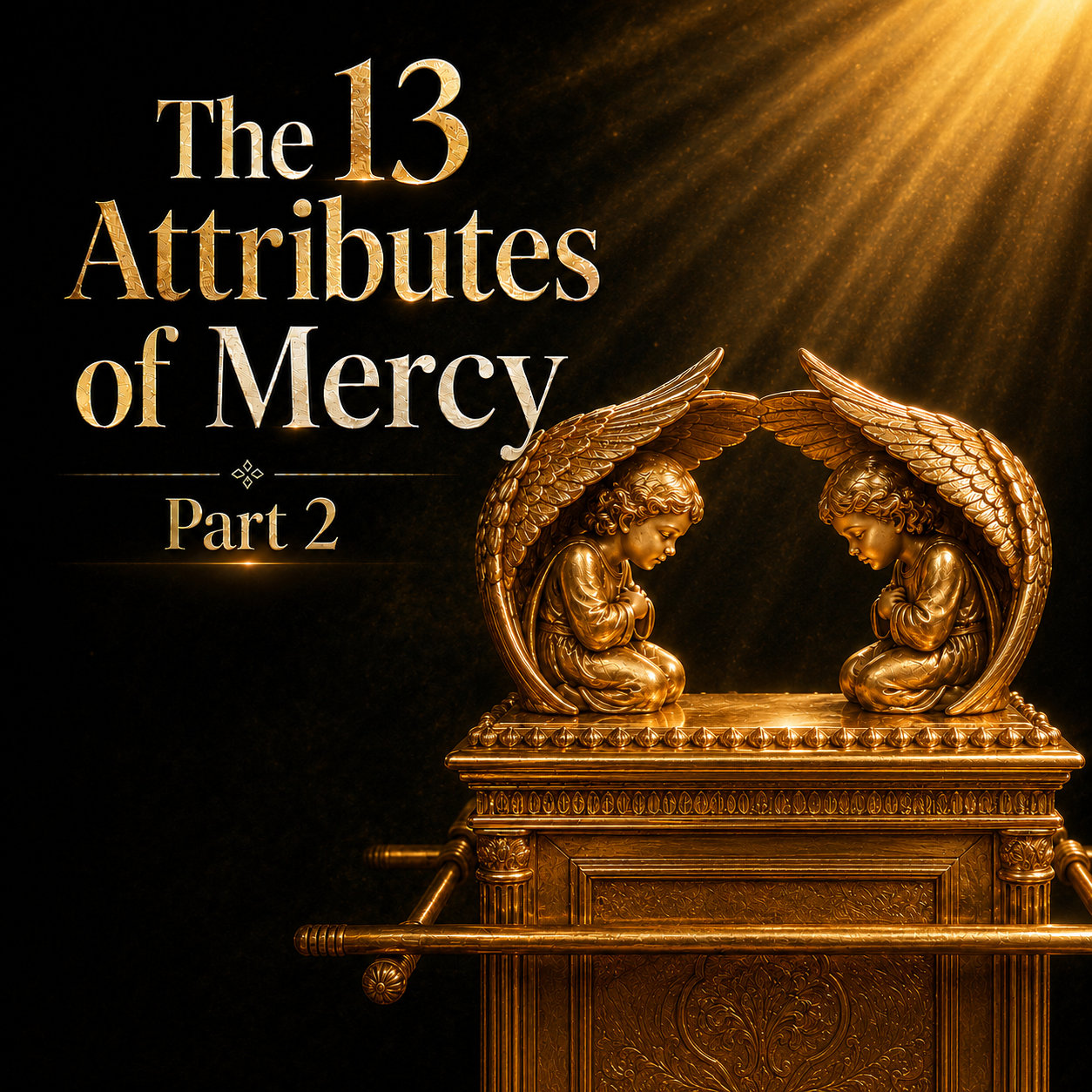
[00:34:17] So Jewish tradition tells us that the two cherubim, or the cherubim were angels made of gold, were hammered out. They sat on top of the mercy seat of holies.
[00:34:32] The tradition tells us that these two cherubs had the faces of children, one boy and one girl.
[00:34:42] The Torah states that in Numbers 789 that Hashem spoke between the cherubim.
[00:34:49] So we see the holiest place on earth is not just the holy of holies. It is not even the ark itself. It is not even the mercy seat.
[00:34:58] Rather, it is the space between the cherubim, the space between the children's faces.
[00:35:06] That is where Hashem speaks from, from between the children.
[00:35:11] So, as the scriptures in Jewish thought teaches, if we ourselves are a miniature temple, if we are a microcosm of the temple, then perhaps we can use this imagery to think about our own inner life.
[00:35:26] So where in our temple does Hashem's voice speak?
[00:35:30] He speaks from the pure and innocent place within us, our own inner child.
[00:35:38] We must acknowledge that we have an inner pure place within us before we were ever wound by the outside world, wounded by the outside world. Because that place, no matter how far we have fallen, is unsullied.
[00:35:52] We must remember to show compassion to ourselves. And remember that we, too, were once little children.
[00:36:00] Because at the core of our being resides that little child who just wants to be loved and wants to give love.
[00:36:10] So no matter how far we have fallen, that little boy or little girl is still there.
[00:36:19] It is this place where Hashem speaks to you from in order to remind you who you truly are.
[00:36:27] His child.
[00:36:30] So we are to remember the days of old in order to show someone else mercy.
[00:36:35] But Hashem also asks you to remember your own days of old and show yourself mercy.
[00:36:44] To be able to demonstrate this level of mercy to the wicked, we must first demonstrate it to ourselves.
[00:36:52] This is why the cherubim on the Ark faced one another.
[00:36:57] Hashem is found in the space between, where each of us are able to see the other as pure, innocent children.
[00:37:12] So, in conclusion, we have, in summation, the full 13.
[00:37:16] Endure the offense, bear the consequences.
[00:37:21] Repair what is damaged.
[00:37:23] Remember that the offender is family.
[00:37:26] Release your anger.
[00:37:28] Remember their goodness.