Episode Transcript
[00:00:00] Have you ever looked at someone else's life and wondered why they seem to get all the opportunities while you feel overlooked? Have you ever questioned why certain doors open for others while the doors you want remain firmly shut? Why do some people thrive in their spiritual life while others become consumed by frustration and disappointment? The answer may surprise you. Let's see what Scripture has to say about it in this week's five Minute Tour.
[00:00:30] Shalom and Blessings from Shalom Macon, where disciples of Yeshua learn, connect and grow. I'm Darren and before getting into the five minutes my five Minute Torah commentary, let's cover a few quick facts about this week's Torah portion. This week we are studying the 38th Torah portion and the fifth portion of the Book of Numbers. We are in the portion of Korach Numbers 16:1, 1832 and here are the three things that you need to know about it.
[00:00:54] 1. Korach's claim A holy Rebellion Korak challenges the leadership of Moses and Aaron, arguing that all Israel is holy and question why they should hold positions of authority. His complaint sounds spiritual on the surface, but the story invites us to look deeper at the difference between genuine concern and personal ambition. The account reminds us that a message can contain elements of truth while still being driven by the wrong motives.
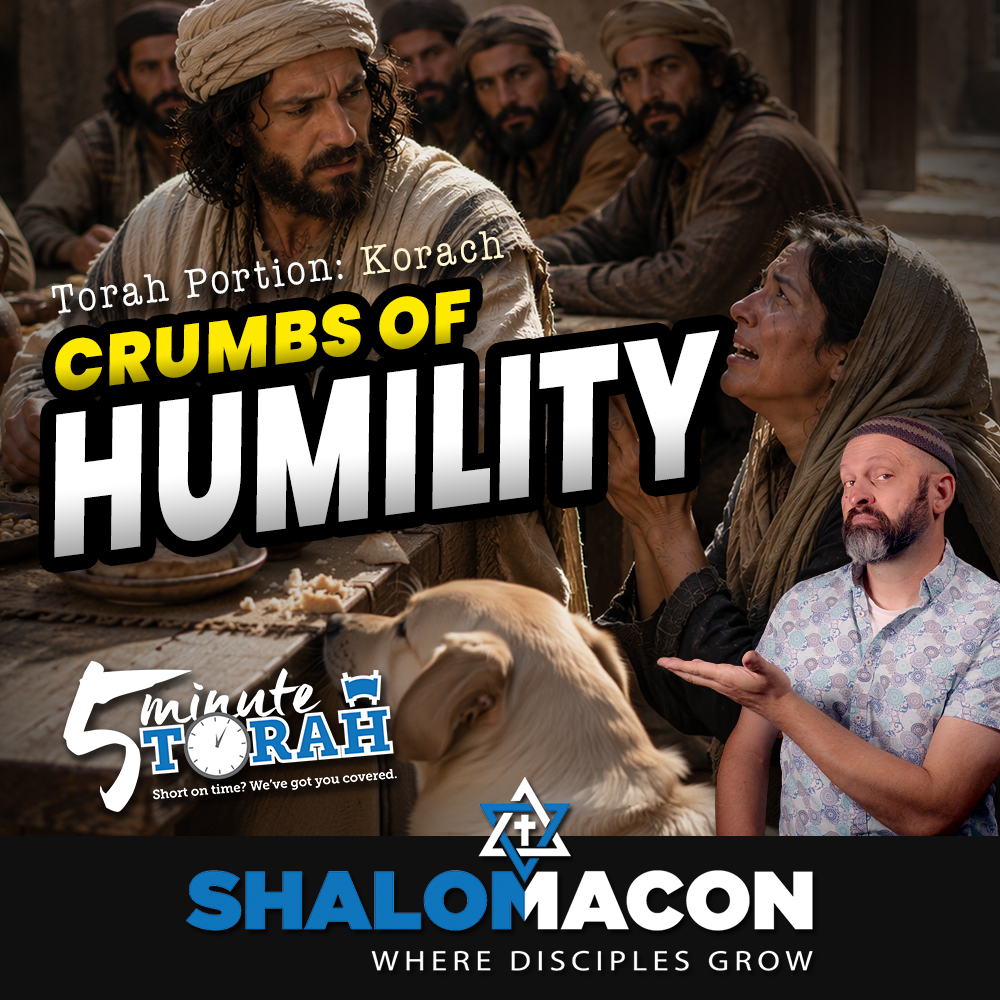
[00:01:21] 2. True leadership Moses vs Korach the contrast between Moses and Korach is striking. While Korak seeks a position he was not given, Moses repeatedly responds with humility, falling on his face before God. The portion reminds us that biblical leadership is measured by service and obedience, not status or recognition. Rather than grasping for authority, Moses demonstrates what it looks like to carry the burden of leadership faithfully. And number three Aaron's rod, the sign of God's choice To settle the dispute, God instructs the leaders of the tribes to submit their staffs. The Aaron's rod miraculously buds, blossoms and produces almonds overnight, confirming God's choice of Aaron and his descendants for the priesthood. The miracle demonstrates that divine calling is established by God, not seized by human effort. It also serves as a lasting reminder that God is the One who appoints and validates those he calls. Every week, people ask me how they can go deeper in the Torah. That's why I wrote the Five Minute Torah Series. Each chapter is based on the weekly Torah portion and is designed to help you discover practical lessons, spiritual insights, and a fresh perspective that you can apply to your life immediately. They're short enough to read in just a few minutes, but meaningful enough to spark conversations that will last all week. If you're Ready to see the Torah in a whole new way? Pick up volumes 1, 2, or 3 of the 5 minute Torah today. This week's Torah commentary is called the Test of Humility and comes from my book, Five Minute Torah, Volume one. If you read this week's Torah portion, you already know that the story of Korach is a sad one, but we can learn many important lessons from it. The primary and most obvious lesson we can learn from Korach's mistake is in regard to humility. However, a deeper understanding reveals that his lack of humility stemmed from his disregard for distinction. Let's explore this further. Korach was a Levite of the Kohathite family, a cousin of Moses and Aaron. He wasn't just the average Israelite. He had special privileges that the average Israelite did not. Being a Koethite, he was also responsible for transporting the most holy items in the Tabernacle, the Ark of the Covenant, the Table of Showbread, the golden menorah, etc. And as a Levite, he was also supported by the tithe of his Israelite brothers. He was not content, however, to enjoy the privileges of a Levite. He wanted the privileges of the priesthood. Priesthood also. He did not like the distinction between the priests and the Levites, since the priesthood is determined by birth. Korach felt this was unfair, and his indignation ultimately led him to destruction. He failed the test of humility because he failed to recognize the distinct calling of Aaron's sons. His name was to be forever remembered and associated with arrogance, pride, and jealousy. We read about another person in the Scriptures, however, who passed a similar test with flying colors. And once Yeshua was approached by a Gentile woman who begged him to heal her daughter. See Matthew 15:21, 28. Yeshua's response was shocking. He refused, and simply because she was a Gentile, he responded, I was sent only to the lost sheep of the house of Israel. It is not right to take the children's bread and throw it to the dogs. A dog?
[00:04:40] Really? Is that what he was saying?
[00:04:42] Now imagine Korach asking Moses, can I please offer the incense? Or maybe light the menorah just once, please? And then Moses responding, those things are for the priesthood, Korach, not for a dog like you. How do you think he would have responded? This Gentile woman's response was far superior to anything that Korach would have come up with. She replied, yes, Lord. Yet even the dogs eat the crumbs that felt fall from the Master's table. She recognized what Yeshua was saying and used it to her advantage. Rather than throwing a fit for being rated a second class citizen, she recognized the fact that she was not Jewish and was not necessarily entitled to his attention. She then persisted with humility to make her petition and was rewarded for it. Paul reminds us that we all play a part in God's purposes, whether Jew or Gentile, Levite or priest, or apostles, prophets or teachers, etc. The eye cannot say to the hand, I have no need of you, nor again the head to the feet, I have no need of you. On the contrary, the parts of the body that seem to be weaker are indispensable, and on those parts of the body that we think less honorable, we bestow the greater honor, and our unpresentable parts are treated with greater modesty, which our more presentable parts do not require. But God has so composed the body, giving greater honor to the part that lacked it, that there may be no division in the body, but that the members may have the same care for one another. This is First Corinthians, chapter 12, verses 21 through 25 we are all members of the same body. When we are not happy with the fact that God has made us all different with different responsibilities, then we will never truly be content with who we are and we will not fulfill the calling he has designed specifically for us. We can choose to be like Korach and reject those differences, or we can be like the Gentile woman who recognized them and used them to her advantage. The choice is ours. Before you go if you enjoyed this video, be sure to check out last week's video on Shalach called the Eyes of the Heart. As we've seen today, two people can look at the same situation and come away with completely different conclusions. The 12 spies, including Joshua and Caleb, all saw the exact same land that the exact same giants, the exact same obstacles, yet they walked away with completely different perspectives. If you want to know what made the difference, just click the link right here to keep learning.