Episode Transcript
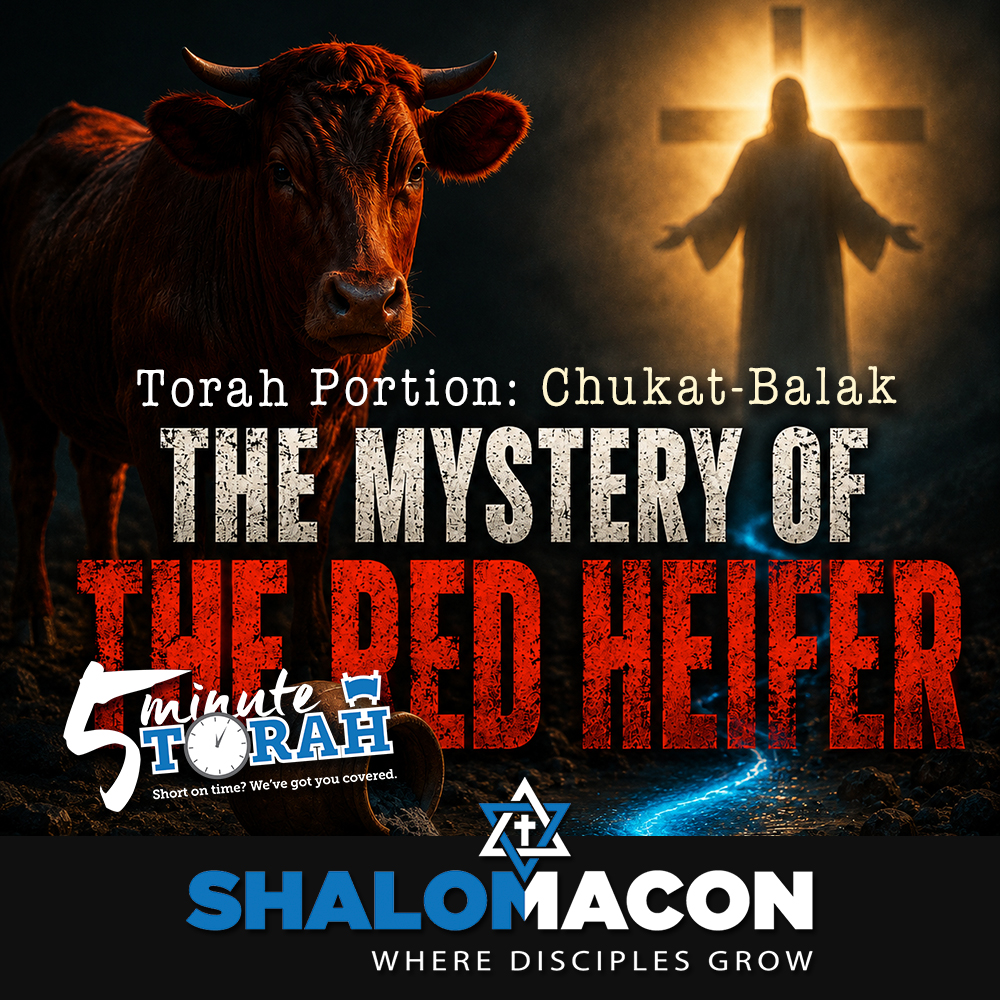
[00:00:00] One medicine can make a sick person well and a healthy person sick. The medicine hasn't changed. The difference is the condition of the person receiving it. Surprisingly, this strange principle may explain one of the greatest mysteries in all of Scripture. Why did some people encounter Yeshua and find life, while others encountered the same Messiah and walked away offended? The answer may be hidden in one of the Torah's greatest mysteries. Let's unravel the mystery of the Red heifer together in this week's five Minute Torah.
[00:00:34] Shalom and Blessings from Shalom Macon, the place where disciples of Yeshua learn, connect and grow. I'm Darren and before getting into the five minutes my five Minute Torah commentary, let's cover a few quick facts about this week's Torah portion. This week we are studying the 39th and 40th Torah portions and the sixth and seventh portions of the Book of Numbers. We are in the double portion of chukkat Balak numbers 19 1, 25, 9 and here are the three things that you need to know about it. Number one the red heifer Life through the Ashes Death the portion of Chakat begins with the mysterious ritual of the red heifer, a unique purification process for those who had come in contact with death. Otherwise known as corpse contamination. The ritual involves sacrificing and burning a completely red cow, then mixing its ashes with water to create a purification solution. While the ceremony seems unusual to modern readers, its importance during the days of the holy temple cannot be overstated. For thousands of years, students of Scripture have wrestled with its meaning, seeing in it one of the Torah's greatest mysteries, a profound picture of purification, restoration, and transformation. Number two Balaam's Blessings When Curses Become Blessings the Torah portion of Balak centers on the dramatic encounter between Balak, King of Moab, and the gentile prophet Balaam. Fearing the growing nation of Israel, Balak har Balaam the to pronounce a curse upon them. Yet every attempt to curse God's people was overturned by the Lord transforming the words of judgment into words of blessing. Among Bilaam's prophetic declarations are the famous words still recited in the synagogue liturgy today. How beautiful are your tents, O Jacob, your dwelling places, O Israel. This remarkable account reminds us that God is always at work behind the scenes, protecting his people and and accomplishing his purposes. What others intend for evil God can turn into a blessing.
[00:02:29] 3. The sin of Alp' or the Cost of Compromise near the end of Balak, the Israelites fall into immorality and idolatry with the women of Moab. Following the council that originated with Bilaam. As the people turned away from God's commandments to pursue the desires of the flesh, a devastating plague broke out among the camp, and in response, Pinchas took decisive action, confronting a public act of rebellion occurring at the entrance of the Tabernacle itself. His zealous intervention brought the plague to an end and earned him a covenant of peace and an enduring priesthood. The account serves as a sombering reminder that compromise with sin carries consequences, while faithfulness to God often requires courage, conviction, and costly obedience. Every week people ask me how they can go deeper in the Torah. That's why I wrote the Five Minute Torah series. Each chapter is based on the weekly Torah portion and is designed to help you discover practical lessons, spiritual insights, and a fresh perspective that you can apply to your life immediately. They're short enough to read in just a few minutes, but meaningful enough to spark conversations that will last all week. If you're ready to see the Torah in a whole new way, pick up volumes 1, 2, or 3 of the 5 minute Torah today. This week's Torah commentary is called Divine Reversals and comes from my book, Five Minute Torah, Volume 1. This week's Torah portion contains one of the least understood passages in all of scriptures. In the beginning of our portion, we have the instructions for the para aduma, the red heifer whose ashes are mixed with water to create the singular source of ritual purity for specific conditions described within the Torah. For example, only through water mixed with the ashes of the red heifer could corpse contamination be negated. One of the mysteries about the red heifer is how purification through its ashes works. The cow is burnt completely, along with cedarwood, hyssop, and crimson wood. Then the ashes are gathered up and a small amount is mixed with a large volume of water. Now, by sprinkling this mixture on someone who is considered to have contracted the highest level of ritual impurity and it somehow has the power to transform the status of that person. How does it work? No one knows. That is why this ritual is called a a decree or an ordinance. It's a command that seems to make no sense to our human minds. More puzzling, however, is the question of how coming into contact with these ashes makes a ritually pure person become impure. Everyone who comes in contact with the ashes, the priests who are, oversees the burning, the one who burned the animal and the one who collects the ashes becomes impure. This defiles human reasoning. And yet the solution to the problem of the one who has become defiled through the ashes of the red heifer is an immersion in water. Water therefore, is a common denominator in transmitting ritual purity. However, we have an example of when water can actually be a source of ritual impurity. A spring or a cistern holding water shall be clean, but whoever touches a carcass in them shall be unclean. And if any part of their carcass falls upon any seed grain that is to be sown, it is clean. But if water is put on the seed and any part of their carcass falls on it, it is unclean to you. Leviticus 11:36 38 how do these things work? We may never know, but we see another example, this seemingly counterintuitive series of reversals in the Apostolic Scriptures. Yeshua came to this earth in order to bring redemption to all humanity. However, many among the spiritual leaders of Israel rejected him. How can this be? Were they hard hearted, blind, or uneducated in the Scriptures? Why was Yeshua a stumbling block for some, but not for others? Let's ask this question. Why do some medicines make one person well and another person sick? It's the same medicine. When it's given to the one who is ill, it can aid him in his recovery. But when given to a person who is well, it has the potential to cause serious problems. Yeshua functioned like the red heifer. He himself said that he did not come for those who were well, but for those who were sick and needed a physician.
[00:06:51] His mission was not to the righteous, but but to the sinner. Thus, contact with the living Messiah was a source of cleansing for the sinner, but it was also a source of contamination for the righteous. Just as we cannot explain the mechanics of how the ashes of the red heifer work, neither can we satisfactorily explain how contact with Yeshua transformed a sinner into a saint. We do know, however, that once we have an encounter with him, we will never be the same. Before you go, if you enjoyed this video, be sure to check out my commentary on last week's video on the portion of Korach, it's called the Test for Humility. As we've seen today, the same encounter can produce completely different results in different people. Some encountered Yeshua and found healing, while others encountered the very same Messiah and walked away offended. In Korach, we find a similar mystery. Moses and Korach stood before the same God, experienced the same redemption, and and witnessed the same miracles, yet they came away with completely different hearts. If you want to know what made the difference, just click the link right here to keep learning with us.