May 28, 2026

00:08:39

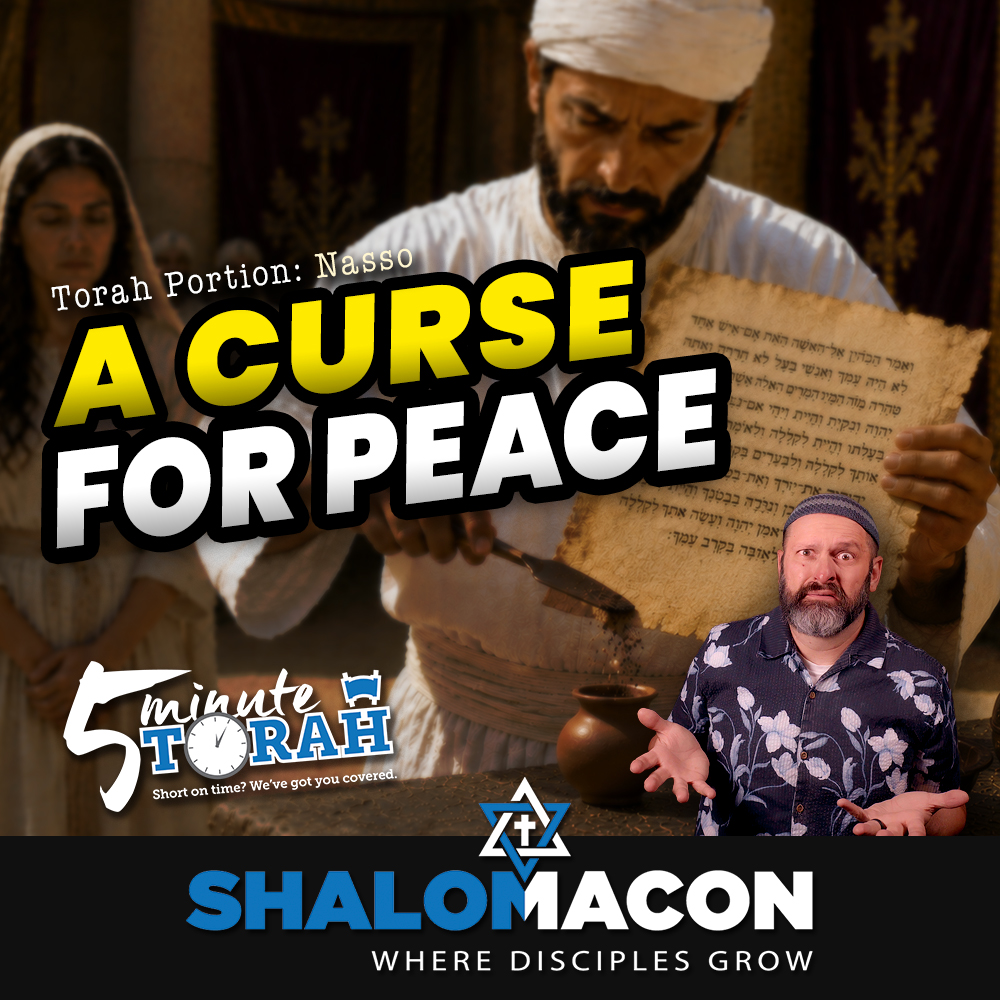
5 Minute Torah - Nasso - A Curse for Peace

5 Minute Torah - Nasso - A Curse for Peace
Shalom Macon: Messianic Jewish Teachings
5 Minute Torah - Nasso - A Curse for Peace

May 28 2026 | 00:08:39

/

Show Notes

What if one of the strangest rituals in the Torah wasn’t really about punishment at all?

This week’s Torah portion introduces the mysterious test of the sotah — a ritual so unusual that it sounds almost unbelievable to modern readers. Bitter water, dust from the Tabernacle floor, erased Divine Names, and a miraculous verdict from God Himself. But beneath the surface of this difficult passage lies something surprisingly beautiful.

Why would God create such an elaborate process? Why would He allow His own Name to be dissolved into water? And what does this ritual reveal about jealousy, suspicion, trust, and the restoration of broken relationships?

The Torah’s goal was not merely judgment — it was shalom bayit, peace within the home. In a world filled with mistrust and fractured relationships, this ancient ritual points to the incredible value God places on reconciliation, faithfulness, and restoring what has been broken.

Could one of the Torah’s most confusing commandments actually contain one of its most profound messages? Discover why in this week’s 5 Minute Torah.

Join Shalom Macon Live! at 11am EST every Saturday (#Shabbat) for uplifting Worship Music and Teachings

If you get value from our work, please
consider Supporting Shalom Macon

https://www.shalomacon.org/give

-- Ways to Support Shalom Macon --

Our Website | https://www.shalomacon.org/give
Tithe.ly | https://tithe.ly/give?c=329563
PayPal | [email protected]
Text "GIVE" to (706) 739-5990

God provides for the work of Shalom Macon through the giving of those who benefit from that work and in turn, give generously to allow it to continue.

Whether you are an in-person or virtual member, your support is vital to sharing the message.

We thank you for joining us, Shabbat Shalom!Join Shalom Macon Live! at 11am EST every Saturday (#Shabbat) for uplifting Worship Music and Teachings

If you get value from our work, please
consider Supporting Shalom Macon

https://www.shalomacon.org/give

-- Ways to Support Shalom Macon --

Our Website | https://www.shalomacon.org/give
Tithe.ly | https://tithe.ly/give?c=329563
PayPal | [email protected]
Text "GIVE" to (706) 739-5990

God provides for the work of Shalom Macon through the giving of those who benefit from that work and in turn, give generously to allow it to continue.

Whether you are an in-person or virtual member, your support is vital to sharing the message.

We thank you for joining us, Shabbat Shalom!

View Full Transcript

Episode Transcript

[00:00:00] Dust from the Tabernacle floor, Bitter water. A curse written with the divine name of God. Scraping ink off of a scroll into a cup and drinking it. This sounds more like an ancient magic potion than instructions from the word of God. And yet, right in the middle of the Torah, we find one of the strangest rituals in all of scripture. Why would God command something so dramatic and what was its real purpose? Discover what it's all about in this week's Amedictura. [00:00:34] Shalom and Blessings from Shalom Macon, the place where disciples of Yeshua learn, connect and grow. I'm Darren and before I get into the five minutes of my five minute Torah commentary, let's cover a few quick facts about this week's Torah portion. This week we are studying the 35th Torah portion and the second portion of the Book of Numbers. We are in the portion of Nassau numbers 421789 and here are the three things that you need to know about it. Number one the test of the Sotah Restoring Trust and Shalom Bite the Torah portion as so describes the test of the Sotah, a ritual used to determine the guilt or innocence of a woman suspected of adultery during the time of the tabernacle or temple. If a husband suspected his wife of infidelity and there were no witnesses, she would be brought before the priest along with a grain offering. The priest would prepare bitter water using holy water, dust from the tabernacle floor and a written curse from a scroll washed into the mixture. [00:01:29] After swearing an oath, the woman would drink the water. If she were guilty, the water would be judgment upon her. If she were innocent, she would remain unharmed, trust would be restored, and the couple would be blessed with the ability to conceive children. Number two the Nazirite Vow A Life of Radical Dedication the Nazirite vow was a special act of dedication in which individuals separated themselves to the Lord for a specific period of time. Those taking the vow abstained from grapes or wine and all grape related products, refrained from cutting their hair, and avoided contact with corpses in order to maintain ritual purity. These restrictions reflected an elevated state of holiness and devotion to divine service. At the conclusion of the vow, the Nazirite completed a purification process involving sacrifices, the shaving of their hair, and burning that hair on the altar. Because the vow is connected to the temple service, Nazirite vows are not encouraged today since there's no temple through which the vow can be properly concluded. [00:02:29] 3. Restitution making wrong Things Right Nassau also outlines laws of restitution that emphasize justice, accountability, and restoration within the community. When a person has committed an offense against another, they were required to confess their sin and make full restitution to the injured party. This included repaying the full value of what was taken or damaged, plus an additional fifth as a penalty if the wrong person had no close relative to receive the restitution, and it was given to the priest along with a ram for atonement. These laws revealed the Torah's concern not only for justice but also for repentance, reconciliation, and the restoration of broken relationships. Are you a disciple of Yeshua? Many people say they are, but few truly understand what discipleship really means. Why? Because discipleship is a distinctly Jewish concept, an intimate relationship between a rabbi and a student. Yeshua called 12 men into that kind of discipleship, and those 12 change the world. So what do they understand about discipleship that we often miss? And how can we make better disciples if we've never truly been one ourselves? Those questions led me to write my book, the Four Responsibilities of a Disciple. While many books focus on how to make disciples, I wanted to understand what it means to be a disciple, because too many disciples today aren't transforming the world the way they should. What I discovered was that every disciple carries four essential responsibilities, and when these are lived out, they can truly change the world. If you want to know what it means to be a real disciple of our Master Yeshua, check out the Four Responsibilities of a Disciple using the link below. This week's Torah commentary is called Shalom Bite and comes from a book, Five Minute Torah Volume One Babies. Isn't that what naturally comes to your mind after reading this week's Torah portion? Confused? Let me explain. This week's Torah reading contains an unusual ritual which we've already talked about earlier, the testing of the Sota, the wayward wife. It's a strange and even fantastical ritual, quite foreign to the modern mind. To the modern ear, it appears to be more akin to alchemy than biblical instruction. It goes like this. If a woman was suspected of adultery and had been warned in regard to certain actions that could lead to inappropriate behavior, she would be brought to the Cohen, the priest in the Tabernacle, to undergo this unusual interrogation. It begins with her bringing a grain offering of jealousy, a grain offering of remembrance, bringing iniquity to remembrance. This is chapter 5, verse 15. The Cohen then takes a clay pot filled with sacred water from the bronze laver of the Tabernacle and adds to it some of the dust from the floor of the Tabernacle. He then uncovers her head and places her grain offering into her hands. He then makes her swear an oath. The oath attests to either her innocence or her guilt. If she's innocent, then the waters of cursing will have no effect. If she's guilty, however, then an awful curse will come upon her that will make her womb swell and her thigh fall away. [00:05:32] After this, the Cohen writes the entire curse upon a scroll. He then scrapes off the ink of the text which contains the divine name of God, into the water mixture. After this, the woman drinks the mixture of water, dust and ink and waits to see if her innards will rot or not. Does this not seem a bit insane? Why would the Creator of the universe prescribe such a strange ritual, filled with such mystical components, to be a test against adultery? Why do we need this exotic ritual? The fact of the matter is that human nature has a tendency to incline itself toward doubt and suspicion. A suspicious and jealous husband will never have peace of mind. And outside of the miraculous, nothing will ease his mind in regard to the innocence of his wife other than a confirmation from the God of the universe himself. Therefore, God created this elaborate procedure by which a woman could either be convicted or acquitted in a case where there was just enough evidence to suspect her impropriety, but not enough evidence to convict her by the traditional means. This trial would settle the case once and for all. There'd be no human witnesses, no jury. But there would also be no doubt. If she suffered an excruciating death, her guilt would be evident. However, if she lived through the process, not only would she be completely released from any suspicion, but she would be rewarded for her endurance. And her reward would be one of the best gifts of all. [00:07:07] Babies. Yes, her womb would be open and she would begin bearing children. Verse 28. So what is the point of this mysterious instruction? The ultimate endgame for the test of the sota is not necessarily the death of an adulteress, but the restoration of a home. Our sages call this ultimate goal Shalom Bayt, or marital harmony, literally, peaceful home. Because a healthy marriage is so important, the God of the universe is created. This elaborate test by which a man and woman could be reunited as one unit. It is so important to him that he is willing that his name be erased and mixed with the dust of the earth in order that husband and wife could be reunited. How important is Shalom Bayt to you? You haven't subscribed to the Shalom Making Kids channel yet. If you have children who love learning Torah in a fun and engaging way, we've created a space and a place just for them. Rabbi Shmiely Socks and all of our Socks on youn Table videos now have a brand new home on the Shalom Makin Kids YouTube channel filled with kid friendly Torah teaching designed to help children learn, connect and grow with the Scriptures. Be sure to head on over, subscribe and turn on notifications so that your little mensches don't miss a new episode. And as always, thank you for making Torah a part of your home. You can check us out right here.

Other Episodes