Episode Transcript
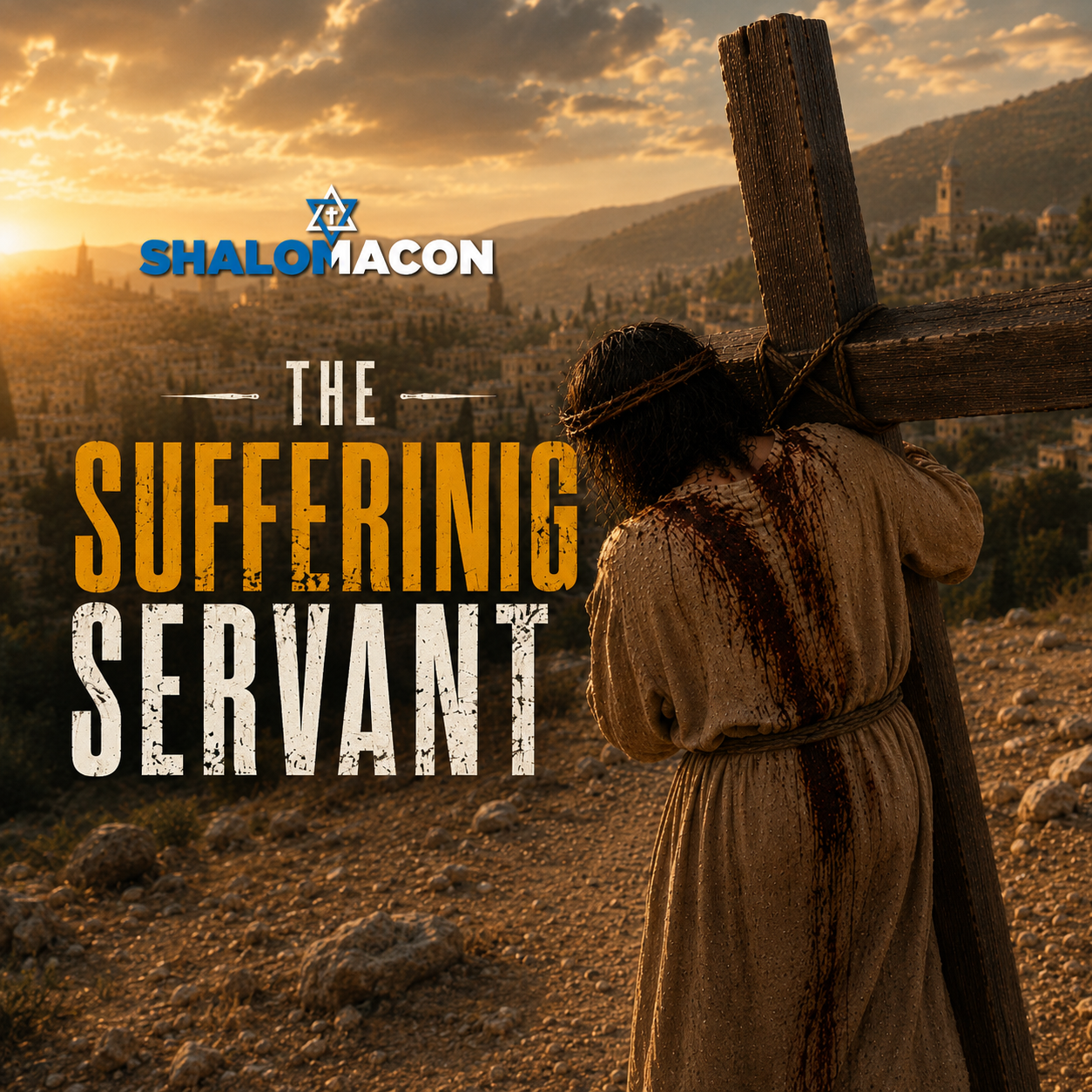
[00:00:00] This is what the cross looks like. Rome saw an executed criminal. The leaders saw a failed messianic pretender. The disciples saw a total, absolute collapse of their hope.
[00:00:17] Onlookers, another cursed man on a tree.
[00:00:24] But God was vindicating the righteous One and making his suffering the very place where death loses its grip.
[00:00:35] That's the actual happening. It appears God is punishing a sinner. In actuality, he's sending the righteous through suffering to save Joseph. Brothers misread it. The crowd misread the servant suffering. The world misreads the cross. The appearance is judgment. The reality is redemption.
[00:01:03] Oops.
[00:01:05] This is the one that any of my critics have been especially waiting for.
[00:01:14] We have borrowed a phrase from the Lamb of the Free book as we've gone through this series that says he goes ahead, not instead.
[00:01:23] It's powerful. And that phrase is going to keep doing work for us today. But there is a text that people probably have been waiting for politely, silently. I've gotten very little pushback as a matter of fact or critique on this series, which has been surprising to me. We had one of the more foul anti Semitic things come up on a Facebook post, but that's been really about the worst of it. So maybe that means something good. People are hearing and they're listening.
[00:01:57] But there is a passage, there's a section of scripture that I think many people would say, well, that pretty much blows up everything you've been saying.
[00:02:07] And it's in the book of Yeshua, Isaiah, chapter 53, the suffering servant. And if someone wanted to push back on this series, that is the question.
[00:02:21] Damien, what about the suffering servant? That's the place I would go.
[00:02:27] And this is probably the strongest text for the position that I've been challenging. There are a number of New Testament texts that we have not gotten to yet. May somewhere along the way. But let me read Isaiah 53 section of it the way most of us were taught to read it.
[00:02:48] He was wounded for our transgressions. He was crushed for our iniquities. The chastisement of our peace was upon him. And by his stripes we are healed. All we, like sheep, have gone astray. We've turned everyone to his own way. And Adonai has laid upon him the iniquity of us all. 5310. It pleased Adonai to crush him.
[00:03:12] Darren, do we have slides now?
[00:03:19] If you grew up in evangelical Christianity or really Christianity at all, that text sounds like one thing and one thing only.
[00:03:33] He was punished instead of us.
[00:03:37] The penalty was transferred. Divine justice. Required that and Yeshua absorbed it. And of course, this is like the text that's used. Used in Jewish evangelism. So I've all my life, traditional Jewish guy or messianic, I've heard it, I've read it a lot.
[00:03:57] A lot.
[00:03:58] And what I cannot do is tell you that the text does not say what it says.
[00:04:04] That's not what I'll try to do. I'm here to ask you to read that more carefully with me. Inside the framework that we have established for the last nine weeks today, we'll walk through Isaiah 53. Not all verse by verse, but mostly. But before we do that, I want to put four tools in your hands, four categories that you need to carry through the chapter. Because without them, the chapter sounds like one thing.
[00:04:33] With them, the chapter says something else.
[00:04:37] Who's heard the term vicarious atonement?
[00:04:43] Vicarious suffering. Isaiah 53 absolutely contains vicarious suffering. The servant suffers because of others. The servant bears something on behalf of the many. The servant carries what they could not carry. We are not pretending ever that that's not there.
[00:05:03] But hear me very carefully.
[00:05:07] Vicarious suffering is not the same thing as penal substitution.
[00:05:14] It's worth pausing just a second on the word vicarious. There are two definitions experienced or realized through imaginative or sympathetic participation in the experience of another.
[00:05:28] 1, 2 performed or suffered by one person as a substitute for another, or to the advantage or benefit of another. Those are two definitions.
[00:05:41] One does not require substitution in any way. The other allows it. The same word goes both ways. It is not surprising that it can be interpreted, however, that should pause us to land specifically on one when there is more than one.
[00:06:02] Vicarious suffering is real. Vicarious suffering is biblical. It is everywhere in the story that Israel has been telling for thousands of years, years before Jesus.
[00:06:18] But vicarious is not the same word as penal substitution.
[00:06:26] Penal substitution is a specific and further claim with four other parts, that 1 God's retributive justice required punishment, 2 that the punishment was legally transferred from the guilty to an innocent substitute, three that God's divine wrath was satiated, satisfied by the transfer, and four that forgiveness became possible as a result of those things.
[00:06:58] You can and should affirm everything that Isaiah 53 actually says about the suffering servant. And you can do that without affirming any of those other four things.
[00:07:14] And it is worth noting, and I haven't said this yet, but the fully formalized version of penal substitutionary atonement, it is credited to Anselm.
[00:07:26] In the late 11th century, the reformers took that and crystallized that a few centuries later.
[00:07:36] So listen, what I'm saying to you, none of this is asking you to stand, you know, to dissent from 4,000 years of biblical solidarity on this idea. There is not unbroken consensus. That stuff is later. I'm asking you to look at a doctrine that became standard only really relatively recently.
[00:08:01] Even though the 11th century is a long time ago, it's not Isaiah's time.
[00:08:10] So the first tool is simply to understand vicarious suffering too. This little word for f O r, a word that we just don't think about it. He was wounded for our transgressions. He was crushed for our iniquities by his wounds.
[00:08:30] When most of us hear for, we hear instead of wounded, instead crushed, instead suffered so we would not have to.
[00:08:42] But for does not automatically mean instead of.
[00:08:48] For can mean because of, on account of, for the benefit of, on behalf of.
[00:08:58] Because if for only ever meant instead of, the New Testament would be kind of a mess to interpret.
[00:09:07] Ephesians 3:1, Paul is a prisoner for the Gentiles, not instead of them on their behalf.
[00:09:15] In 1 Corinthians, the Spirit is given for the common good, not instead of the common good on behalf of the common good. No one reads those that way. The English word for it carries a range.
[00:09:28] The prepositions behind carry a range. And so the question is never about whether or not the servant suffered for the people. Of course he did that. The question is, what kind of for is this?
[00:09:45] It doesn't have to mean. Instead, it can mean on our behalf for our healing to bring us into life.
[00:09:52] Number three. Remember the Joseph pattern. The suffering of the righteous is not novel.
[00:10:01] It's not a foreign concept that Christianity imported and invented and imposed back into the Bible. This category exists long in Jewish thought, the suffering of the righteous. Long before Yeshua, long after Yeshua. The righteous one is bound up with the people.
[00:10:22] His faithfulness matters in this community. His suffering can expose sin, it can awaken mercy, it can preserve life. It can become a means through which God brings redemption to an entire people. Israel already knows that the righteous can stand in the breach.
[00:10:42] You think about Moses at the calf.
[00:10:45] He's willing to be erased. You think about the prophets. They suffer because they carry the word of God to a generation that does not want to hear it mocked, rejected, imprisoned, killed. You think about the righteous sufferers throughout the Psalms. Surrounded, falsely accused, vindicated though by God. In the end of it all, Isaiah's servant is standing in that world. He is the righteous one who is exposing his Suffering is exposing the sin of the many and becomes the means through which the purposes of adonai become realized. That is not foreign to Israel's story. That is Israel's story.
[00:11:33] And if I had to point to the one place in the Torah where that Isaiah 53 pattern becomes clear, it is Joseph.
[00:11:42] Genesis 50:20. You meant evil against me, but God meant it for good. In order to bring about what is happening in this day, to preserve many people alive. So we listen, we notice what that's doing. Did Joseph suffer?
[00:11:59] Yes, he suffered in the pit. The slavery, false accusations, prison.
[00:12:04] The brothers, they really sinned against him. Their evil was not anything theatrical. It wasn't just a show.
[00:12:11] And God really used Joseph's suffering.
[00:12:17] That same suffering that came from human evil became the doorway through which God preserved life.
[00:12:25] But you notice what's not in that story is that God did not author the brothers evil. He did not need their violence. He was not waiting for someone innocent to be punished before he could bless his people. The brothers meant harm. God overcame it and he made that harm serve life.
[00:12:49] Psa. Penal substitutionary atonement. It says that violence satisfies God.
[00:12:57] The Joseph pattern says that God overcomes the violence and turns it toward the good.
[00:13:03] That is the pattern. People do bad things.
[00:13:09] God means it for life.
[00:13:12] And remember what we said about Joseph in the very, very first message. If you could remember that, you know the word chain merited favor. Joseph is a recognized type, a pointer to Messiah in Jewish tradition. So you carry all this with you.
[00:13:28] We're about to read Isaiah 53 and you can just keep Joseph as a memory.
[00:13:36] The fourth is random, but I need to tell you about it. Who has ever heard of ransom? The.
[00:13:46] Ransom is its own atonement theory. It's older than penal substitution. The early church worked on this for centuries before anyone had any of what we're talking about. The basic claim is that Yeshua's death paid a ransom to set us free from the bondage to sin and death. And guess what? The New Testament actually uses that language. Mark 10, first Timothy, Peter. It's in there. It's biblical language. But the question we ask is, to whom was the ransom paid?
[00:14:21] Origen and Gregory of Nyse argued that Yeshua paid off the devil.
[00:14:29] This is early church theology.
[00:14:35] Others argued that he paid off the Father.
[00:14:42] Both readings require that there's a payment made to someone. But that's not how ransom works in Israel's story.
[00:14:49] We read this in Exodus 6:6. He says, I will redeem you with an outstretched arm. I Will redeem you. I will ransom you from slavery in Egypt. How much does Pharaoh get paid?
[00:15:03] Nothing. No payment changes hands. There's no transaction.
[00:15:08] Ransom is the language that we hear for the liberation from bondage. Not some kind of deal struck, not some kind of currency exchange where we have a life for life, blood exchange. So when the New Testament is reaching for that, it is reaching, big surprise, once again to the Exodus pattern where God showed up and redeemed an entire people. We spent a lot of time looking at that.
[00:15:35] That is a pattern you must always hold onto. Now, categories in hand, vicarious, the word for Joseph, ransom. Let's go to Isaiah 53. 4. Surely he has borne our griefs and carried our sorrows. Yet we considered him stricken by God and afflicted. Now, notice where it begins.
[00:15:58] We are not in a courtroom. We're not talking about legal penalties. We're beginning here with sickness, grief, pain, affliction, sorrow. And it begins with a confession.
[00:16:12] It says, we considered him stricken.
[00:16:17] That's important.
[00:16:20] The speakers are confessing. The speaker, how? They read the suffering. They saw the wounds. They concluded that the servant must be under the hand of God. This is divine judgment, affliction.
[00:16:36] But the chapter completely turns around. That's not a correct, complete reading. They thought he was suffering for his own guilt under God's judgment. But then it's revealed that it's tied to theirs. They were falsely assuming some things. Isaiah 53 is structured from the beginning about this perception being overturned of what they thought they saw.
[00:17:01] And when you see that, I think we should also consider whether or not we need to consider overturning some perceptions. But this is what the cross looks like. Rome saw an executed criminal. The leaders saw a failed messianic pretender. The disciples saw a total, absolute collapse of their hope.
[00:17:28] Onlookers, another cursed man on a tree.
[00:17:34] But God was vindicating the righteous one and making his suffering the very place where death loses its grip.
[00:17:46] That's the actual happening. It appears God is punishing a sinner in. In actuality, he's sending the righteous through suffering to save Joseph. Brothers misread it. The crowd misread the servant suffering. The world misreads the cross. The appearance is judgment. The reality is redemption.
[00:18:11] Now, there are two Hebrew words we won't get into it too much. Nassah and Sabal. To bear, to carry, to lift, to take up.
[00:18:22] And in the case of that word, Nassah, very often to carry away the text. It says, he has borne our griefs and carried our sorrows. Nassah Sabal. And listen to what is being borne. Sicknesses, pains, sorrows, grief.
[00:18:48] This is the death dealing conditions that we have spent time talking about that oppress the human body and the human spirit. You should remember that language when we talked about Yeshua encountering the forces of death, walking through the Galilee, the Metsorah, the leper, the woman with the flow, Jairus daughter, Lazarus daughter. In every encounter, impurity does not spread to him. Purity goes out, holiness spreads, life moves outward. Isaiah 53 is a prophetic statement of what the Gospels are going to show you in action. The servant bears the sicknesses and carries them away.
[00:19:40] Matthew, he took upon himself our infirmities and bore our diseases. Matthew quotes Isaiah 53:4 directly. And he doesn't put it around the cross or the crucifixion.
[00:19:53] He puts it right around Yeshua healing a bunch of different people. That's where he quotes Isaiah 53. The Messiah is bearing and bearing and carrying away.
[00:20:08] He himself took our infirmities and bore our diseases. Matthew says, the servant is not absorbing wrath.
[00:20:19] He is entering the realm of death, taking hold of what has enslaved us. And he carries it away. And it doesn't stick to him because his life is stronger than that.
[00:20:33] So everything else we read in light of this. He was pierced for our transgressions. He was crushed for our iniquities.
[00:20:44] This is the traditional phrase. The chastisement of our peace was upon him. By his stripes we are healed. You want the Hebrew thrown in there for chastisement?
[00:20:54] Here's what it says.
[00:20:56] He was pierced for our transgressions. He was crushed for our iniquities. The Musar of our peace was upon him, and by his stripes we are healed.
[00:21:06] Anyone know what Musar is?
[00:21:09] Musar is a study. It's Jewish ethics. But it is also teaching discipline. We have this little word for here, pierced for crushed for I'm going to apply our first tool.
[00:21:22] Each of those can mean on account of. But I want you to look at this and say, the Musar of our peace was upon him. Most English Bibles render this as chastisement or punishment, and that sounds very courtroomish.
[00:21:38] But Musar is a much broader word than that.
[00:21:42] Musar lives in a world literally of Father Son formation.
[00:21:49] We read in Proverbs 3, My son, do not despise the Musar of Adonai.
[00:21:58] In Proverbs. Hear, my son, your father's Musar.
[00:22:03] Musar can include painful correction. But Musar is not the same as a retributive penalty. That's not what it means. And the Greek translators, when they rendered Isaiah 53 into the Septuagint, that verse, they reached for a different word in Greek, paideia, which means training and formation and discipline, the same word that Hebrews 12 is going to use later.
[00:22:33] Hebrews says the Lord disciplines those he loves. And the Aramaic, Targum, this ancient Jewish Paraphrase reads Isaiah 53 like this in Targum. Jonathan, by his instruction, peace shall be increased upon us by his instruction, not by his execution, by his instruction.
[00:23:04] So I'm not saying that musar only means instruction or discipline, but that's pretty compelling. The suffering is real. He's pierced, he's crushed by his stripes. We're healed. None of that goes away. But the controlling word for what the servant is carrying is musar, this discipline that brings peace, the formation that brings shalom, the instruction. Instruction that teaches the many how they should walk.
[00:23:35] Hebrews 5, 8. It says it about Yeshua himself. He learned obedience by what he suffered.
[00:23:45] Same word, world. That's the same logic. Yeshua's suffering is not a penalty. It's the discipline of the faithful son. It felt, it forms him. It proves him. It's that formed faithfulness that we talked about. We are saved by the faithfulness of Yeshua. He becomes the path the people walk. Isaiah 53, 6, all we, like sheep, have gone astray. We've turned away one to his own way. Adonai has laid on him the iniquity of us all. Now, if that's not punishment, transfer, right?
[00:24:22] That's laid on him the iniquity of us all.
[00:24:27] That phrase, word, Hebrew, pagah, it doesn't literally mean transfer, punishment into or onto something.
[00:24:40] Its basic sense, pagah, is to contact something, to meet, to encounter, to reach to, to be in touch with. So Isaiah 53, 6 says that Adonai caused the iniquity of us all to meet him, to converge upon him. It's a different image than transfer. The iniquity comes to where he is and encounters him. Now, the important thing is that we're going to come back to that word pagah and that meeting meaning at the end of the chapter. So I just want you to hold paga. And yes, I'm absolutely overloading you with information.
[00:25:26] I'm going to move through verses seven through nine because they're not really weaponized for penal substitution. They matter. He was oppressed, afflicted, opened not his mouth. He's cut off from the land of the living. His grave was assigned with the wicked. The servant really dies. Nothing I've ever said is intended to minimize the death. This is not some symbolism. We're not pretending anything about the cross. The servant goes down where life stops.
[00:25:55] It's costly, it's genuine.
[00:25:58] Okay, but just hold that.
[00:26:03] In Isaiah 53:10, and this is also technical, so please stay with me.
[00:26:10] The King James says, it pleased the Lord.
[00:26:14] It pleased God to crush him.
[00:26:18] Pleased him to bruise him.
[00:26:22] He put him to grief. To grief when thou shalt make his soul an offering for sin. It says.
[00:26:31] The TLV reads, it pleased Adonai to crush him by disease. When you make his soul an ashamed. What's an asham?
[00:26:40] It's a guilt offering.
[00:26:42] He shall see his offspring. He shall prolong his days. Both of those translations are there on purpose because the King James gives you something really useful here. It's totally wrong, which makes it really useful.
[00:26:57] The King James says, renders that word a sham as an offering for sin.
[00:27:06] That is the natural thing that people hear when they read this. Sacrificial system, the blood carrying the sins away. That's the wrong category. It is sacrificial language. It is the guilt offering. Leviticus 5, Leviticus 7. It's very specific.
[00:27:26] But the Asham cannot import penal substitutionary framework. Guilt offering does not mean God needed punishment and that punishment landed on Jesus and the transaction is complete. That is not how the asham offering works in the Torah. We have talked about this. Let me remind you. It's a reparation offering.
[00:27:52] When someone wronged another, the Torah required two things together.
[00:27:58] Restore what was taken, plus a fifth more.
[00:28:03] Then we bring the ram. And the whole structure of the hashem is built around making the wronged party whole through repair and restoration. There's no penalty.
[00:28:18] The wrong gets repaired.
[00:28:21] So Isaiah 53 uses sacrificial language, but it is not penal substitutionary language, which I've been telling you for 10 weeks.
[00:28:34] It pleased Adonai to crush him.
[00:28:38] What in the world do we do with that?
[00:28:41] How is that?
[00:28:44] Why is that?
[00:28:48] Well, I'll tell you something interesting that you may never know. And you can find this in certain footnotes. The New Revised Standard Version.
[00:28:57] That Hebrew is uncertain.
[00:29:01] It's difficult to translate.
[00:29:06] The Septuagint reads that very differently. Adonai wished to purify him from the plague.
[00:29:14] That's quite different.
[00:29:16] But the bottom line is that's a contested verse.
[00:29:21] You can't build an entire theology ever on one verse. But if you're gonna do not pick one that is incredibly difficult to translate, you can't do that.
[00:29:42] But then it says, when you make a soul in a sham, he shall see his offspring. He shall prolong his days. The will of Adonai shall prosper through him.
[00:29:52] I'm not finding God's wrath being satisfied. This is the language of God's purpose being fulfilled through the servant's faithful suffering. Which takes us right Back to Joseph 50, 20. You meant it for bad. You thought it was bad.
[00:30:11] God meant it for life.
[00:30:13] The servant's death does not satisfy something in God like that. It becomes the doorway through which the will of Adonai will prosper for the cosmos. First. John says, it doesn't end. Isaiah 53.
[00:30:29] With the crushing death of the servant, it ends with his days being prolonged. The will of Adonai prospering in his hand after the anguish of his soul. He shall see and be satisfied. That is not any kind of staying dead, celebrating dead language. That is vindication. He goes down, he's cut off, grave appointed with the wicked, and he's back. Death does not get the word, final word.
[00:31:03] The writer of Hebrews names what is happening here.
[00:31:06] Yeshua holds his priesthood, and Hebrews 7 says, by the power of an indestructible life.
[00:31:15] Indestructible life. The same life Peter was preaching about in Acts 2 when he said, it's impossible for death to hold him down.
[00:31:23] Now put this together. The servant carries our sicknesses. He carries our pains. He carries the forces of death we could not carry. He goes into this wreckage. He goes into this place where sin has done its worst work. He bears it. He dies under his weight, under that weight. And then the life of the servant emerges stronger than the death he carried. That is the center of Isaiah 53. Not God is a punisher.
[00:32:02] And that's not a smaller story than penal substitution. It's much bigger. Now, I told you about this word pagah. Isaiah 53:12. He bore the sin of many and made intercession for the transgressors. Made intercession. That comes from the same word. We met back in Isaiah 6, where our iniquity was caused to meet the servant. Pagah. In verse 12, the servant intercedes for the transgressors. It's the same word, the same root, the same meaning. Meeting, contact, mediation. The servant is not the punishment receptacle. He's the meeting point. This is where the people's iniquity is confronted, carried, brought before God. In later language, this is what we learned about the sonagore, the imagery, the advocate, the defender, the mediator. This is Moses on the mountain, the righteous One standing in the breach. This is the chain bearing tzaddik, interceding.
[00:33:11] So the opening showed us this misperception being overturned in the chapter. The middle shows us the character carrying away of the sicknesses, the discipline, the formation of the Son, the meeting of the iniquity, the real death, the real vindication. And now at the close, the meeting that looked like punishment is revealed as intercession.
[00:33:37] And one more thing. And then we closed.
[00:33:46] The servant entered that place of transgressors. He bore what belonged to many. He made intercession for them. He became the meeting place between God, sin and the people God intended to heal. If everything I've just said is true, what does this mean for us?
[00:34:09] What does this create in us when we read this?
[00:34:13] Isaiah ends with the intercession, the mediator. But the apostles do not sit back admiring that as the endpoint.
[00:34:28] Listen to what Peter does with Isaiah 53. He says, for you were called to this because Messiah also suffered for you, leaving an example so that you might follow in his footsteps. And he quotes Isaiah 53, that is the verse right before he himself bore our sins in his body on the tree. By his wounds you were healed. Here's what Peter says.
[00:34:58] Well, here's what he doesn't say.
[00:35:01] Ready for this?
[00:35:03] Yeshua suffered so you don't have to.
[00:35:13] He says, yeshua suffered for you, leaving you an example that you might follow in his footsteps.
[00:35:24] You know when someone says something real encouraging, there's this line where people say, that'll preach, brother.
[00:35:32] How about this?
[00:35:37] Peter says, yeshua suffered so I would know how to.
[00:35:43] That don't preach penal substitution. Says, yeshua suffered so I don't have to. Peter says, yeshua suffered so I might know how to.
[00:36:00] We are not duplicating Jesus work.
[00:36:04] We are not atoning for the world. We're not creating resurrection life by trying harder. Yeshua's death is unique.
[00:36:13] His death does what only his death can do. But his unique death becomes the pattern for the lives of those bound to him.
[00:36:28] So Isaiah 53 has said, the servant suffered. He bore our sins. He carried sicknesses by, wounds were healed. He poured out his soul to death. He made intercession for the transgressors. All of that is in the text.
[00:36:44] What is not in the text is the claim that God needed someone to punish so that divine wrath could be vented and forgiveness could become legally possible.
[00:37:00] What the text gives us is a bigger, bigger, much bigger story for you.
[00:37:07] That matters to you right now.
[00:37:12] The righteous one entering the death dealing condition created by sin, carrying it faithfully, bringing healing, vindicated by God, an indestructible life, becoming the pattern of life for the people that he saves.
[00:37:26] And now he goes ahead of you not instead.
[00:37:36] This is the calling of Jesus to His disciples.
[00:37:48] And next week we'll make it as practical as it can be as we conclude atonement Explained Shabbat Shalom I'm Darren with Shalom Macon. If you enjoyed this teaching, I want to ask you to take the next step. Start by making sure you subscribe to our channel. Next, make sure you hit the like button on this video so that others know it's worth their time to watch.
[00:38:14] Last, head over to our website to learn more about Shalom Macon, explore other teachings and events, and if you're so inclined, contribute to the work that we're doing to further the kingdom. Thanks for watching and connecting with Shalom Macon.