February 20, 2026

00:08:46

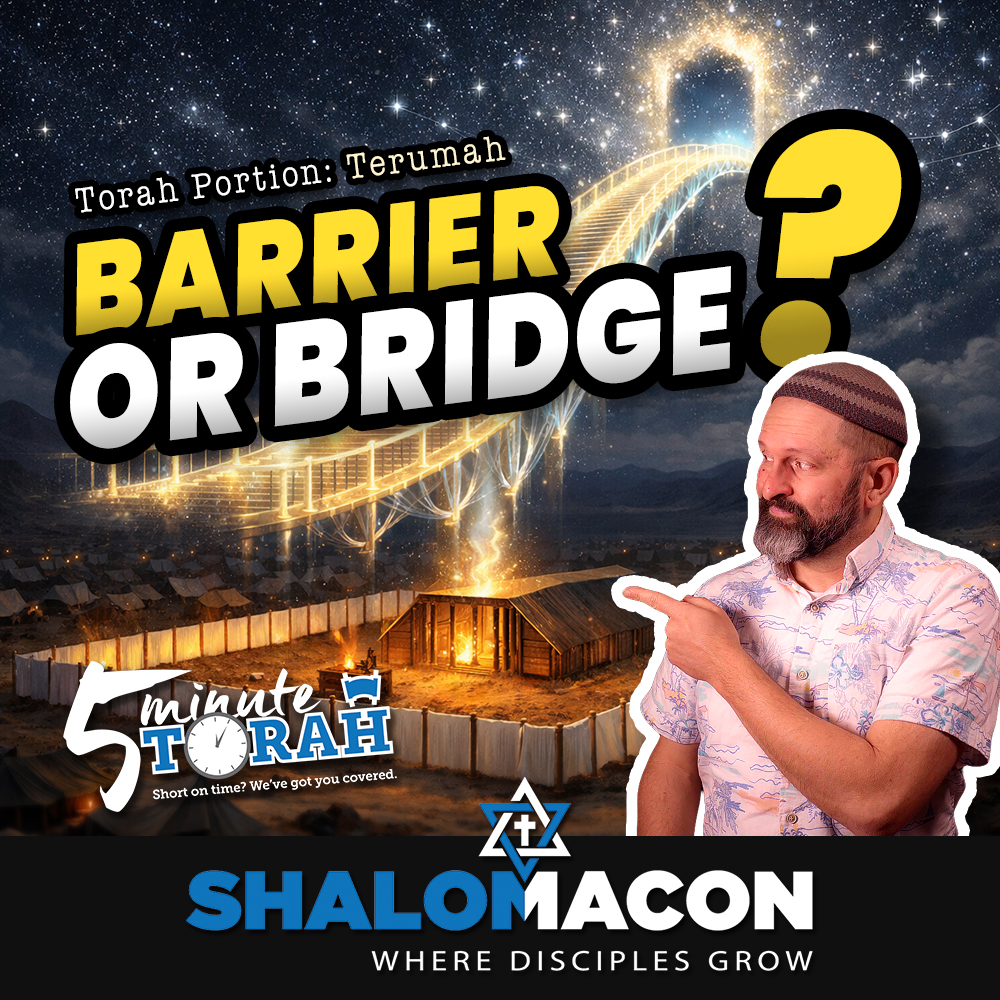
5 Minute Torah - Terumah - Bridge or Barrier?

5 Minute Torah - Terumah - Bridge or Barrier?
Shalom Macon: Messianic Jewish Teachings
5 Minute Torah - Terumah - Bridge or Barrier?

Feb 20 2026 | 00:08:46

/

Show Notes

Is the Torah a bridge… or a barrier?

When God chose to dwell among Israel, He surrounded His presence with boundaries—restricted access, layers of separation, guarded space. That doesn’t sound welcoming. It sounds exclusive.

So what is holiness really about? Does it draw us closer to God, or keep us at a distance? And why would the very structure meant to connect heaven and earth be built with limitations?

In Parashat Terumah, we discover that boundaries may not be obstacles to intimacy—but the very foundation of it.

Let’s wrestle with this tension in this week’s 5 Minute Torah.

Join Shalom Macon Live! at 11am EST every Saturday (#Shabbat) for uplifting Worship Music and Teachings

If you get value from our work, please
consider Supporting Shalom Macon

https://www.shalomacon.org/give

-- Ways to Support Shalom Macon --

Our Website | https://www.shalomacon.org/give
Tithe.ly | https://tithe.ly/give?c=329563
PayPal | [email protected]
Text "GIVE" to (706) 739-5990

God provides for the work of Shalom Macon through the giving of those who benefit from that work and in turn, give generously to allow it to continue.

Whether you are an in-person or virtual member, your support is vital to sharing the message.

We thank you for joining us, Shabbat Shalom!Join Shalom Macon Live! at 11am EST every Saturday (#Shabbat) for uplifting Worship Music and Teachings

If you get value from our work, please
consider Supporting Shalom Macon

https://www.shalomacon.org/give

-- Ways to Support Shalom Macon --

Our Website | https://www.shalomacon.org/give
Tithe.ly | https://tithe.ly/give?c=329563
PayPal | [email protected]
Text "GIVE" to (706) 739-5990

God provides for the work of Shalom Macon through the giving of those who benefit from that work and in turn, give generously to allow it to continue.

Whether you are an in-person or virtual member, your support is vital to sharing the message.

We thank you for joining us, Shabbat Shalom!
View Full Transcript

Episode Transcript

[00:00:00] Is the Torah a bridge or a barrier? The very place where God chose to dwell was surrounded by boundaries, limited access, layers of separation, restricted space. Is that what holiness is about? Is that intimacy or exclusion? Does holiness draw us near or keep us out? Let's wrestle with this concept together in this week's five Minute Torah. [00:00:29] Shalom and blessings from Shalom Macon, the place where disciples of Yeshua learn, connect and grow. I'm Darren and before we get into the five minutes of my five Minute Torah commentary, let's cover a few quick facts about this week's Torah portion. This week we are studying the 19th portion and the seventh portion of the Book of Exodus. We are in the portion of Terumah Exodus 25:1 through 27:19. And here are the three things that you need to know about it. Number one Supernatural Design learning to read the blueprints this week's Torah portion begins with God telling the children of Israel to build a house for Him. It would be a portable house where he would meet with them until they reached the land he had promised them. This temporary dwelling would be called the Mishkan from the root Shahchan, which means to dwell. Some people find this Torah portion to be one of the most challenging to make it through. But our enjoyment of the Torah portion really depends on our perspective. [00:01:22] Number two Tabernacle Furnishings on a Lesson in Holiness after telling the children of Israel to build Him a holy house, God gave Moses detailed instructions for his furnishings. The Ark to hold the Commandments, the table for the Bread of the Presence, and the golden Menorah. Each was crafted with precision by skilled artisans. Yet these sacred objects would never be seen by the general public. Only the priests would minister before them, and the Ark itself would be seen only once a year by the high priest, the so why the intricacy? Why the beauty? Because their design had to reflect the one they served. They were to be holy, set apart just like Him. And that's the lesson for all of us in serving God. We can either try to bring him down to our level or allow ourselves to be refined so that he draws us up to His Number three Outer Courts the Holy Business of God the last thing God instructs the children of Israel to build in this week's Torah portion of were the bronze or copper altar and the partition that would surround the outer courts of the Tabernacle. The bronze altar would be the most used item inside the Tabernacle courts, with multiple sacrifices being burned on it every single day and throughout the nights. It would constantly need to be stoked and cleaned as well. The partitions surrounding the outer courts sets the boundary of the workings of the tabernacle and separated it from the common status of everything that surrounded it. What lessons can we learn from these things? I would love to hear what comes to your mind. Feel free to hit the pause button and tell me your thoughts in the comments below. [00:02:56] What does it really mean to live by the Spirit of the Law and not the Letter of the Law? For centuries, believers have been told that the Law of God is a burden and something Yeshua came to set us free from. But what if that's not what the Scriptures say at all? What if Paul's words about the letter of the law killing were never meant to pit God's Spirit against his own commandments? If you've ever struggled to reconcile law and grace, Spirit of the Law will open your eyes to a richer, more faithful understanding of both. It will challenge assumptions, bring clarity to misunderstood passages, and invite you into a deeper walk of obedience, one that's alive with the Spirit of God. Pick up your copy today and let the Spirit of the Law transform the way you see God's Word and and the way you live it. This week's Torah commentary is called the Bridge and comes from my book 5 Minute Torah, Volume 1. Up until the portion of Terumah, we hear nothing mentioned about a plan to build a Mishkan, a tabernacle. God had delivered the children of Israel from Egypt, taken them to be his alm segula, his treasured possession, and given them his Torah. It seemed like a finished product with the exception of taking them to their land. [00:04:07] Now, however, Moses comes back down Mount Sinai and begins communicating the plans that the Lord has given him to build a portable structure that they would set up and tear down at each of their encampments. The Mishkan would become a holy edifice that would allow interaction between God and man. It would be something like a portal by which the priesthood would be able to enter the presence of the Almighty, similar to what only Moses was allowed to do thus far. But in order to accomplish this momentous task, the children of Israel would have to work together for this common cause. The Torah records for us the Lord's request. The Lord said to Moses, speak to the people of Israel that they take from me a contribution from every man whose heart moves him. You shall receive the contribution for me. Exodus 25:1 and 2 what was the goal? Was it so that God could dwell in a structure? Was it so that they could rival pagan religious practices? No. He gives Moses. The reason he said, and let them make me a sanctuary that I may dwell in their midst. This is Exodus 25:8. The Lord desired the tabernacle to be built for this single reason. He wanted to create a bridge between God and man, an edifice that would cross over both time and space to bring man into union with his Creator. And but in order for this structure to fulfill its purpose, it couldn't be just a structure. It had to be built in such a way that it was a miniature copy of the divine structure that already existed in the heavenly realm. The Lord told Moses exactly as I show you concerning the pattern of the tabernacle and of all its furniture, so you shall make it. [00:05:53] The author of the Book of Hebrews emphasizes this point by saying that the tabernacle was created to serve as a copy and shadow of the heavenly things. This is Hebrews 8, 5. It was to be the closest thing on earth to the dwelling place of God in heaven. Its sanctity or its holiness was unparalleled. But this sanctity could not exist without boundaries. Holiness can exist only within boundaries. Because holiness is defined in terms of boundaries, the tabernacle proper in all its furnishings was strictly off limits to the common Israelite. Only the Levites were allowed access to this holy house, and even they were limited in their access. Portions of it were accessible only by the Kohanim, the priesthood. But if the idea of the tabernacle was to be a bridge between God and man, then why was access to it restricted to a select group of people? Shouldn't it have been freely accessible to everyone? In a marriage, intimacy is not achieved through allowing others equal access to our spouses. Intimacy is achieved only through establishing the proper boundaries in order to protect the relationship between a man and his wife. In a healthy marriage, no one else should occupy the space in our hearts reserved only for our spouse. This is a protection and against infidelity. Why does the Ark of the Covenant alone rest at the heart of the tabernacle? Because it contained the covenant, the boundaries that allowed for God's intimacy with man. True intimacy exists within boundaries. The world wants us to believe that boundaries are barriers to intimacy, and unfortunately, a large majority of the Church has fallen for this line of reasoning as well. However, rather than barriers, those boundaries are what undergird holiness and intimacy. The Tabernacle established boundaries for the children of Israel, but only for the purpose of becoming a bridge by which they could encounter the God of the universe. The Torah establishes boundaries between common man and a holy God. We can view it as either a barrier or a bridge. Which one do you see it as before you click away? Let me ask you something. Are you dropping crumbs of truth to wet people's spiritual appetites, or are you dropping truth bombs and watching the spiritual death toll stack up? If you've ever wrestled with how to share what you've discovered without pushing people away, I recently taught a message called you were a stranger. It's about empathy, returning what was lost and drawing people close to Torah instead of driving them further away. Don't miss out. Just click the link right here to check it.

Other Episodes