Episode Transcript
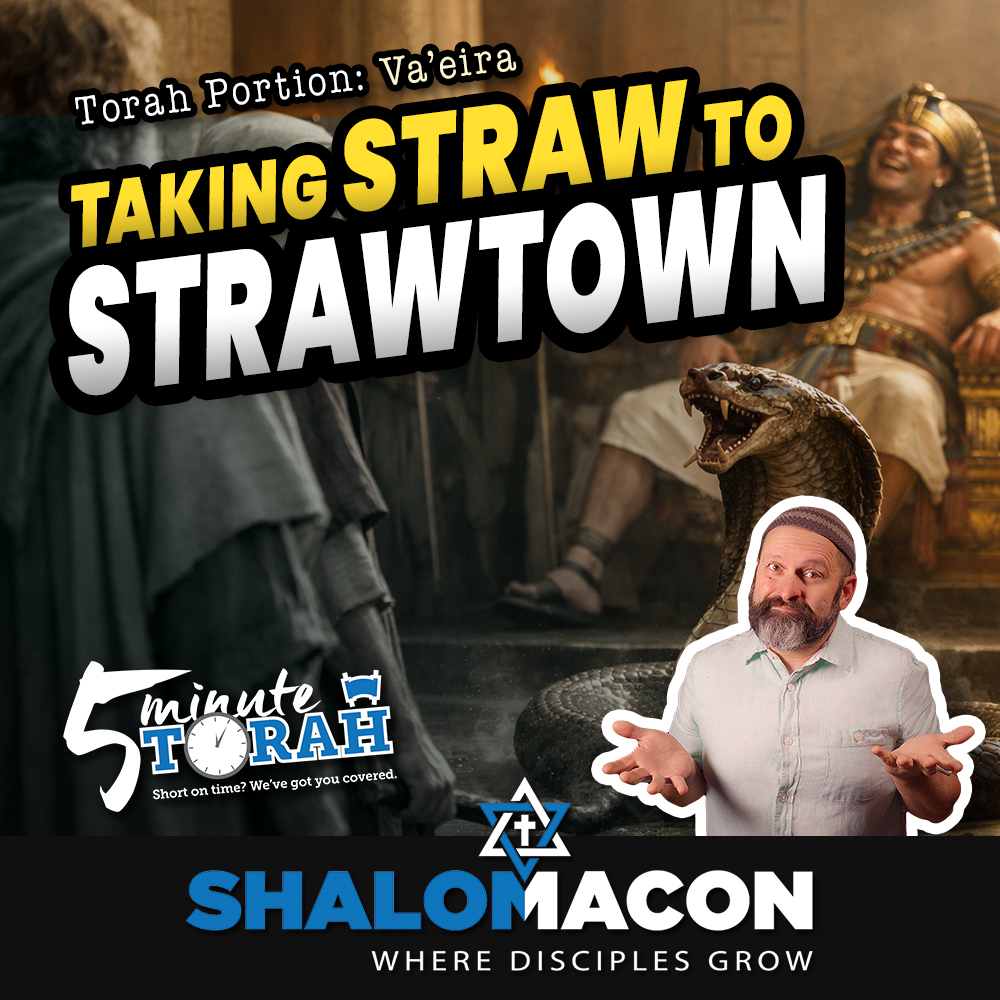
[00:00:00] Why bring straw to a city that's already overflowing with straw? And who would do that? And what could they possibly be thinking? What does this have to do with our Torah portion? Let's explore this idea together in this week's five minute Torah.
[00:00:19] Shalom and blessings from Shalom Macon, the place where disciples of Yeshua learn, connect and grow. I'm Darren and before I get into the five minutes of my five minute Torah commentary, let's cover a few quick facts about this week's Torah portion. This week we are studying the 14th portion and the second portion in the book of Exodus. We are in the portion of Viera. This is Exodus 6:2935 and here are the three things that you need to know about it. Number one uncircumcised lips. Moses doubts his calling again. Just like last week, we once again find Moses doubting his ability to do what God has called him to do. He doesn't believe he can persuade Pharaoh or even even earned the trust of the Israelites based on his God given authority. Despite God's repeated assurances and promises of deliverance, Moses hesitates, convinced that he is inadequate to serve as God's mouthpiece. Questioning his ability to communicate God's commands effectively, he describes himself as having uncircumcised lips. God, however, reaffirms Moses role and reassures him that Aaron will serve as his spokesperson. He tells Moses that Pharaoh will resist even in the face of miraculous signs, but that the ultimate purpose is to reveal God's unlimited power, ensuring his sovereignty is recognized by both Egypt and Israel. In the end, success was never dependent upon Moses. He was simply a tool in the hands of the King of the Universe. Number two. The plagues begin. Seven of ten. In this week's Torah portion, we witness the beginning of God's judgment upon Egypt. Here we encounter seven of the ten plagues that God brings against the land. The waters of the Nile turn to blood. Frogs swarm the countryside. Lice infest both man and beast. Wild animals overrun the cities. A devastating pestilence wipes out the livestock. Painful, unsightly boils afflict the Egyptians and finally fire and ice rain down from the heavens, destroying what little remains. Yet despite all of this, Pharaoh's heart remains hardened and he refuses to let the children of Israel God, exactly as God had told Moses would happen. And number three, the heart of Pharaoh, who did the hardening. After each of the first five plagues, we are told Pharaoh's heart was hardened. But when we reach the sixth plague, the language changes. The Lord hardened the heart of Pharaoh this shift has troubled readers for centuries. The question inevitably rises if God hardened Pharaoh's heart, does humanity truly have free will? The midrash offers an explanation. When God saw that Pharaoh refused to relent after the first five plagues, he declared, in effect, he has already gone too far. Even if Pharaoh wanted to repent, now I will harden his heart in order to exact full judgment. In this view, God did not override Pharaoh's will. He reinforced the path that Pharaoh had already chosen. Pharaoh made his decision. Now it was time for God to be magnified through that very choice. Are you a disciple of Yeshua? Many people say they are, but few truly understand what discipleship really means. Why? Because discipleship is a distinctly Jewish concept, an intimate relationship between a rabbi and his student. Yeshua called 12 men into that kind of discipleship, and those 12 changed the world. So what do they understand about discipleship that we often miss? And how can we make better disciples if we've never truly been one ourselves? Those questions led me to write my book, the Four Responsibilities of a Disciple. While many books focus on how to make disciples, I wanted to understand what it means to be a disciple, because too many disciples today aren't transforming the world the way they should. What I discovered was that every disciple carries four essential responsibilities, and when these are lived out, they can truly change the world. If you want to know what it means to be a real disciple of our Master Yeshua, check out the Four Responsibilities of a Disciple using the link below. This week's Torah commentary is called Offer a Better Product and comes from my book, Five Minute Torah, Volume one. There's a curious set of events that happen when Moses and Aaron appear before Pharaoh and display the signs and wonders of the Lord to him and his court. The first thing they do is to provide him a sign of their authority from the Lord by turning Aaron's sign staff into a serpent. However, Pharaoh's magicians also turned their staffs into serpents. And after the Lord turns the water of Egypt into blood, the magicians of Egypt replicate this miracle as well. It says, but the magicians of Egypt did the same by their secret arts. This is Exodus 7:22. Throughout the course of the Lord's display of the various miracles, signs, and wonders on Egypt, Pharaoh's magicians periodically replicate these signs. Why? In order to convince Pharaoh that the God of the Hebrews was no more powerful than they were, and thus allow his heart to be hardened against the children of Israel. But Rashi has an interesting and thought provoking take on this. He says that the magicians were doing this to Moses and Aaron because bringing signs and wonders to Egypt is like, quote, importing strawberries to Ophrain, a city full of straw. You're bringing sorcery to Egypt, which is full of sorcery. Why would anyone want to bring straw to pedal in a town known for its straw? A person that would have the audacity to do such a thing had better know beyond a shadow of a doubt that his product was ultimately superior to that which was produced in Straw Town. Otherwise he would suffer. The humility of that would follow. In other words, Pharaoh and his magicians were telling Moses and Aaron, why are you peddling your magic here in the capital of magic? We know magic when we see it, and the only way we're going to pay attention to you is if your magic is of far superior quality than our own. Moses and Aaron had more than magic, but Pharaoh and his magicians didn't know that. For a long while they saw Moses and Aaron as trying to compete with with the magic of Egypt. Only in the end did they realize the difference between their own product and what these two Hebrews were bringing to Egypt. The magicians thought they had power. But when the God of the Hebrews poured out his signs and wonders upon the land of Egypt, they realized anything they could do was only smoke and mirrors compared to his power. We must bring straw to Strawtown. We must offer a better quality of product. We can look at this in two ways.
[00:07:00] First, we need to be able to bring the message of the Torah and the good news of our Messiah to the world in an authentic manner. For example, we commonly hear people giving a secular or humanistic interpretation or examination of Scripture. It ranges from Hollywood to our presidents to the History Channel to our next door neighbor. However, they need to hear an authentic interpretation that is built on spirituality and truth. Peter tells us that we must always be prepared to make a defense to anyone who asks you for a reason for the hope that is in you. Yet do it with gentleness and Respect. This is First Peter 3:15. We need to be able to have an answer for the problematic verses others claim to be in the word of God and do it with gentleness and respect. Second, a strong segment of the church knows the Scriptures forward and backward, but they don't understand them in their proper context and therefore the result of their interpret interpretations is that Scripture ends up contradicting itself. In this respect, we need to bring straw to Straw Town by sharing clear and definitive interpretations of the Holy Scriptures with our brothers and sisters in Yeshua in a genuinely loving manner in order to clear up many scriptural misunderstandings. The Torah has not been abolished, the commandments have not been set aside, even the ceremonial ones. Neither has God's covenant with Israel nor His covenant with the Aaronic priesthood as we know. These are merely misunderstandings of the scriptures that have been perpetuated over many centuries, but they have the force of longevity behind them because they've existed for so long. They have the weight of truth in the minds of most believers. The only way to overcome these misunderstandings is to be able to present our case in a clear, understandable manner that seasoned with a heavy dose of gentleness, patience, humility and respect. The sentiment is changing, but we need more workers in the vineyards. You've got the straw that Strawtown needs. Are you brave enough to share it with them? If you were blessed by this video, please take a second to like it and subscribe to our channel so you won't miss what's next. At the end of this video, you'll see a recommended teaching. Go ahead and watch it and keep building your faith. And please help us spread the message. Share these messages on your social media platforms. The more people that watch, the better they'll understand Yeshua from a Messianic Jewish perspective and together we can begin transforming our world. And hey, join us live at Shalom Making every Shabbat every Saturday at 9am and 11am Eastern. We would love to grow with you.