Episode Transcript
[00:00:00] Let's go back to true disciples. Unfortunately, sometimes we can forget our own identity, even as true, sincere disciples of Yeshua, which in turn makes us forget our purpose.
[00:00:15] And when does that happen? It's usually when life starts getting out of focus, okay? When we see things that don't make sense to us, it happens when the temporal things of this world become sharper and more vivid than the image of the kingdom that lay somewhere beyond the haze of the distant future.
[00:00:37] This is where we should need to look at our master Yeshua, because we're supposed to be imitating him. And he never lost his focus, right? He was hyper focused. Some might even say that Yeshua had tunnel vision, that he was obsessed with this single concept. What's that concept? You guys know it.
[00:00:57] The kingdom.
[00:01:02] Shabbat Shalom.
[00:01:05] I want to tell you guys a story. Start out this teaching here.
[00:01:13] When I was growing up, one of the local television channels did something called picture puzzle. I don't know if they did it anywhere else, but in Arkansas, the local channel did that.
[00:01:25] And let me tell you how that worked. They would start by showing a puzzle where all the pieces of the puzzle were the same color. It was just a blank puzzle, but you could see the shapes of the puzzle pieces.
[00:01:39] And if I remember correctly, There were about 10 pieces of the puzzle, and beneath that puzzle was a photograph of a famous celebrity.
[00:01:48] The object of the game was to guess who was on the photo below the puzzle. The prize money started at $1,000.
[00:01:57] And each day they would remove a piece of the puzzle to reveal a little bit more of the picture underneath and drop the prize money by a hundred dollars each day. Okay, so when I was about 12 years old, I saw the daily picture puzzle on the television.
[00:02:20] And I can't remember the exact circumstance, but I know that I was leaving for church camp, like, immediately, like the next day or maybe even that day or whatever. May have seen it that morning before I left for camp.
[00:02:35] And I do remember that I was away from my dad because I had to call him. I made a phone call to my dad. He was at work.
[00:02:44] And I said, dad, have you seen the picture puzzle today? He said, oh, yeah. He goes, there's no way anybody can figure that out. You know, it's just two pieces out, and all you can see is a little portion of the guy's hair or the person's hair. I said, I knew who it is. He said, you do not.
[00:03:03] I said, yes, I know who it is. I said, but I don't know his name. I need you to tell me what his name is, because I don't know his real name. I said, what is the manager's name? And in the movie Rocky, what's Rocky's manager's name? And he said, burgess Meredith. I said, that's who it is. And he said, there is no way. He said, I've seen it. There's no way you can get that from that. He said, there's two pieces missing. Just a little hair. He says, I don't even think it is. And I said, I know it's him.
[00:03:29] And I said, but I can't.
[00:03:32] At that point, you had to actually write it on. Write your answer on a postcard and mail it in.
[00:03:40] Okay, I'm showing my age here.
[00:03:43] You didn't enter contests online.
[00:03:46] And so I said, I know it's him, and I need you to write that on there. I think I was actually at my grandmother's house now, I think about it, my great grandmother's house. And I said, I needed that name. I'm going to write it on a postcard and I'm going to stick it in the mail.
[00:03:59] He said, okay, good luck.
[00:04:02] So a few days later, I was at church camp about a couple hours away from home, and one of the staff members came up to me and said, you got a phone call. I was like, okay. Said. I said, what's going on? It says, your dad, he needs to talk to you.
[00:04:20] And so I went to the wherever we go to get a phone call at camp. Pick up the phone, and dad's on the phone, says, hey, you remember that postcard that you sent in? I said, yeah. He goes, well, you won $800, okay? And so I was like, whoa. He's like, you were right. You know?
[00:04:45] And so somehow I connected and saw that person in that little speck that was visible in that picture, right?
[00:04:58] And so why was I able to see what nobody else saw, including my very own father and who is a bigger Rocky fan than I am?
[00:05:08] What advantage did I have over others to the exact same image? But I understood it in a way that was different from everybody else. I want to show you guys this image. If you guys can put that first image up.
[00:05:22] Does anybody know what this is?
[00:05:25] What is it?
[00:05:26] It's a. What you call it a magic eye or the common. The non branded name or whatever it's called a stereogram. A stereogram. Okay. And so this stereogram, you can go back out, babe, you can step out for this part. This. We'll get in a fight over this.
[00:05:47] Okay?
[00:05:50] So this Is a stereogram. I used a free online thing to create it. Okay, but what do you see?
[00:06:00] What?
[00:06:02] No.
[00:06:03] Okay, but right, if you just look at it, it's just a mess, right? It's just a random bunch of dots and colors and all that kind of stuff. But embedded within this is a 3D image. Has anybody been able to see it yet?
[00:06:22] That's okay.
[00:06:24] Of an airplane.
[00:06:26] Okay, so what is a stereogram? It's a flat two dimensional image designed to create the optical illusion of a three dimensional scene or a hidden object. And how does it work? Okay, we have what's called binocular vision, bi, meaning two. We have ocular sensors. We have eyeballs that look and our eyeballs see something slightly different. Okay. Because they're at different positions. Now you have to have binocular vision and you have to have depth precession to be able to see this.
[00:07:05] A stereogram tricks your brain by repeating patterns or presenting slightly offset visual information.
[00:07:14] When you relax or refocus your eyes to look through the image rather than directly at the surface, each eye focuses on a different part of the pattern. And then your brain merges them, making a hidden 3D shape appear to float. You guys can take that off?
[00:07:32] Okay, so.
[00:07:34] But the problem is not everybody can see stereograms. Okay. I grew up with a brother that lost vision in his right eye at the age of 4.
[00:07:46] Had an accident with some dogs, and it wasn't good.
[00:07:52] And so he has no way of ever seeing this. Okay.
[00:07:58] But a relative gave him one of these books, not thinking about it when he was a teenager, and he's like, oh, great. Thanks. I really appreciate that.
[00:08:12] Why don't you give me a paper cut and pour lemon juice in it? Right?
[00:08:17] And so. But some people can't see these images because their brains struggle to separate their focus.
[00:08:27] Because your eyes are automatically adjusting to try to make sense of what you're seeing and focus together. And this can be caused by a number of reasons, including conditions that have long names crossed or lazy eyes, or a condition which the brain heavily favors a dominant eye and shuts off the other to prevent these things. Things like an astigmatism also can prevent someone from being able to see things like this and see the picture within the stereogram. So, in short, if you have two healthy eyes that allow accurate depth perception, and if you're able to control the focus of your eyes, in theory, you should be able to see the 3D images within the stereogram.
[00:09:15] But still, there are times that it just can't be Done.
[00:09:21] A stereogram is an extreme example of focus and depth perception that I presented to you. But there's a connection between seeing a stereogram and seeing the world around us that I want to connect here for you. With a stereogram, we have to look beyond the surface of the image in order to see what's hidden within it.
[00:09:45] We have to adjust our focus and train our eyes to see something that's not immediately obvious.
[00:09:52] And sometimes life requires us to do the same thing.
[00:09:55] We have to learn to look beyond what is directly in front of us so that we can see the deeper reality hidden beneath the surface.
[00:10:04] Okay, so that was an extreme example. But have you ever seen what's called extreme macro photography?
[00:10:13] This doesn't rely on any kind of tricks of the eye. Okay. So I'm going to show you guys some images. But what we're doing, we're going to zoom in on these pictures that are super zoomed in on, on things that end up looking like alien landscapes or something. And they're common images, common items, common objects that you guys may know. So let's take a look at number one.
[00:10:35] Any guesses what this is?
[00:10:38] Okay, I hear carpet. Anybody else?
[00:10:43] What?
[00:10:45] I can't hear.
[00:10:46] Say it loud if you're one.
[00:10:50] Anybody besides carpet?
[00:10:53] Okay, this is actually the pages of a book.
[00:10:58] Pretty crazy, huh? Okay, let's go to number two.
[00:11:03] What is that?
[00:11:06] Okay, salt. That's a good guess, huh?
[00:11:13] Crystal of some sort, right? Okay, you're close with the salt. This is white sugar.
[00:11:19] Okay, next slide.
[00:11:22] This may be. You may be able to catch. Get this one.
[00:11:25] Yes. This is soap bubbles. Very good, very good. Next one.
[00:11:31] That's a little dark for this, but maybe you can get a little glimpse. It's really hard to see. I'm sorry it's so dark.
[00:11:38] Any guesses?
[00:11:41] An iron chair. It looks something like that, right? It looks like iron patio furniture or something, but it's actually steel wool.
[00:11:49] Okay. And the last one looks like what you find at the bottom of your shower right now. What is this?
[00:12:00] Sponge? That's a good guess.
[00:12:03] Looks like hair, maybe? No, this is actually a really close picture of a tea bag.
[00:12:12] Okay, you can take those down.
[00:12:14] Okay. You've heard the expression sometimes you can see the. You can't see the forest for the trees. Have you ever heard that?
[00:12:22] Can't see the forest for the trees.
[00:12:24] Think about these images that we just saw.
[00:12:27] There were no trails.
[00:12:29] There were just pictures of ordinary, familiar objects taken from a perspective that we normally don't see.
[00:12:40] And what I want to Emphasize with all this is Hashem's perspective is different from our perspective.
[00:12:49] Most people only see their lives from a single, very limited perspective. They live day to day, focused on their immediate needs or desires. And we don't give as much thought to the future that we should, unless it's related to our financial goals. Or we may actually never even look at the past, hardly, especially beyond our own lifetime. But Hashem wants us to have a different perspective and look at life from a different vantage point. In this week's Torah portion, which is Kitavo, the Israelites are given instructions regarding bikorim. Bikorim is the first fruits of the produce once they've entered the land. And this is where our Torah portion comes into play. The name of our Torah portions, it says, kitavo, when you come into the land, Haaretz, into the promised land, you are to take the bikarim, the first fruits, in a basket, up to the tabernacle or temple or whatever is in your day.
[00:13:46] And you were to give the basket to one of the kohanim, to the priests. And then we read about the details. And let me read the details of what is supposed to happen.
[00:13:57] You shall make response before the Lord your God. A wandering Aramean was my father. And anybody recognize where this, where we use this quite a bit. This is repeated, what, Passover, right? Exactly. It's in the Haggadah. And he went down into Egypt and sojourned there, few in number. And there he became a nation great, mighty and populous. And the Egyptians treated us harshly and humiliated us and laid on us hard labor.
[00:14:28] Then we cried to the Lord, the God of our fathers, and the Lord heard our voice and saw our affliction, our toil and our oppression. And the Lord brought us out of Egypt with a mighty hand and an outstretched arm, with great deeds of terror, with signs and wonders. And he brought us into this place and gave us this land, a land flowing with milk and honey. And behold, I now bring the first fruit of the ground which you are, O Lord, have given me. Okay, so this is a declaration that the Israelites were supposed to make. They were supposed to do this process, take the first fruits of their produce, put it in a basket, bring it to the Cohen, and then repeat these words it's formulated. Okay, but why? Why these words? Why not say, hey, here's the first of my produce, it's yours.
[00:15:22] Why recount the history of Israel?
[00:15:27] Why the history lesson?
[00:15:29] Why not just say, this is what this is for?
[00:15:33] So, Jonathan Sacks, Rabbi Jonathan Sacks, of blessed memory, Has a great commentary on this. He says this declaration is well known from its inclusion in the Pesach Haggadah, the Passover Haggadah.
[00:15:47] Its significance is revolutionary, more than we may first realize. The ancients saw the gods in nature. So this talking about other people groups other than the Israelites. Whereas natural time is cyclical. The seasons, the planets, the birth, death, and new life, the first fruits declaration is not about nature but about history.
[00:16:13] It paints a picture of the events from the days of the patriarchs to the Exodus and the conquest of the land, keeping hold of our history, something Judaism values greatly. And then he goes on later, he says, this history was not academic or only for scholars. It belonged to everyone. The declaration was recited by everyone. And importantly, it was said in the first person.
[00:16:40] Okay, think about this. Hundreds of years later, this was repeated. And it says, my father.
[00:16:47] Was it literally my father that generation previous? No. Okay, but it's a connection to that identity. My father, then the Lord brought us out of Egypt.
[00:17:02] Hundreds of years later. They weren't the people who were literally physically brought out of Egypt. Right.
[00:17:07] He brought us to this place. The rabbis therefore taught in each generation, every person should see himself as if he personally came out of Egypt.
[00:17:20] This is the calling of Israel.
[00:17:26] This is history transformed into memory. He says to be a Jew is to be a part of a story that extends across 40 centuries in almost every land on the face of the earth. Memory is essential to identity. We do not come from nowhere, nor does our story end with us. We are leaves on an ancient tree, chapters in a long and still being written story. A letter in the scroll of the book of the people of the Book.
[00:17:58] Judaism sees the individual as connected both horizontally with those around us, family, community, and fellow Jews, and vertically to those who came before us. To be a Jew is to be a link in the chain of the generations. A character and a drama that began long before we were born and will continue long after our death. That's powerful. Okay, and this Rabbi Sax says something so simple, yet so profound.
[00:18:29] He said, memory is essential to identity.
[00:18:34] Although these instructions and this commentary is specifically geared toward the Jewish people, it has implications and application for all of us. Okay, so let's talk about that. Let's talk about this perspective for a moment.
[00:18:49] Because Rabbi Sacks also brought up the idea of looking back and seeing and hopefully understanding where we came from so that we can have a deeper and a proper understanding of our identity. So if you're Jewish, you can look back at the Exodus and have a deep sense of identity. You were chosen by God, you were delivered by God, and you were given a covenant by God. You have an identity forged in the fires of biblical history.
[00:19:21] But what about us who are of the nations?
[00:19:25] What is our identity? And what perspective are we supposed to have?
[00:19:31] Paul, I think, gives us a good perspective on this. He says, therefore, if anyone is in Messiah, he is a new creation. The old has passed away and behold, the new has come. This is Second Corinthians, chapter five.
[00:19:45] He also says in Philippians, and you were dead in the trespasses and in sins in which you once walked, following the course of this world, following the prince of the power of the air. But God, being rich in mercy because of the great love with which he loved us, even when we were dead in our trespasses, made us alive together with Messiah by grace, you have been saved and raised up with him and seated with him in heavenly places. In Messiah, Yeshua, remember that you were at that time separated from Messiah, alienated from the commonwealth of Israel, and strangers to the covenant of promises, having no hope and without God in the world. But now in Messiah, Yeshua, you who once were far off have been brought near by the blood of Messiah. And I need to correct that. That was not Philippians, that was Ephesians, chapter 2. So if. If you have pledged your allegiance to the King of the Jews and you've surrendered your life to the God of the universe, then you have a new identity.
[00:20:55] No, we may not be able to say that our ancestors were slaves to Pharaoh, but we know for a fact that we ourselves were once slaves to sin.
[00:21:06] This is our redemption story, or at least it should be.
[00:21:12] But there's an inherent problem with those who are professing to be believers or disciples today.
[00:21:18] In a lot of places, rather than denying ourselves, many merely tack on faith to all of their other social identities.
[00:21:30] It just becomes a label.
[00:21:33] And then they do this.
[00:21:36] And when they do this, they can't figure out why life is still out of focus.
[00:21:42] It's because someone told them the lie that simply believing that Yeshua had died for their sins is the end game plan. Play for life. Their old man is still alive and kicking.
[00:21:54] They are still living in Egypt, but are under the delusion that they have been released.
[00:22:02] Let's go back to true disciples. Unfortunately, sometimes we can forget our own identity, even as true, sincere disciples of Yeshua, which in turn makes us forget our purpose.
[00:22:17] And when does that happen?
[00:22:19] It's usually when life starts getting out of focus. Okay. When we see things that don't make Sense to us. It happens when the temporal things of this world become sharper and more vivid than the image of the kingdom that lays somewhere beyond the haze of the distant future.
[00:22:39] This is where we should need to look at our master Yeshua, because we're supposed to be imitating him.
[00:22:44] And he never lost his focus, Right? He was hyper focused. Some might even say that Yeshua had tunnel vision, that he was obsessed with this single concept. What's that concept? You guys know it.
[00:22:59] The kingdom. Okay.
[00:23:02] In Matthew 4:17, we actually read it in our Gospel portion this morning.
[00:23:08] It says, Yeshua took up the message of John and began at that time preaching what? Repent, for the kingdom of heaven is at hand. Or as our translation read, which is the best translation I've heard. The kingdom of heaven is on the brink of arrival.
[00:23:27] Mark 26. He said the kingdom of God is as if a man should scatter seed on the ground. So he begins telling these parables.
[00:23:36] And if you haven't watched The First Fruits YouTube video, I'm trying to think what the context was is the Messiah podcast, and it was Jacob Fronczak interviewing Daniel Lancaster about this upcoming Torah cycle. And the narrow way, right? Narrow path. Narrow way. What is it?
[00:24:01] Narrow path. Okay.
[00:24:04] And so in that they talk about parables and why Yeshua taught parables, and we have really got that backwards in a lot of cases. We think that parables. He told parables to obscure what he was saying and to make it where people can. Can't understand. I like to say Yeshua used paragraph parables like we used to use flannel graphs in the Sunday school. Okay? It's to make it as simple as possible, to make as visual as possible. I mean, we like. Like I did earlier with the visuals, those are sermon aids, right? Sermon illustrations or whatever. They make things clear and accessible. The problem is we don't understand the parables because we don't have the proper context or framework or point of view. Reference, focus.
[00:24:47] So Matthew, excuse me, Mark, chapter 4, verse 30. Again, he. And he said, with what can we compare the kingdom of God, or what parable shall we use? For it is like a grain of mustard seed. So again, was the kingdom like he gives another parable in Matthew 13, he says, the kingdom of heaven may be compared to a man who sowed good seed in the field. So here's another parable about the kingdom. The kingdom was like this. And he continues, he told them another parable. The kingdom of heaven is like leaven that a woman took and hid in three measures of flour until it was all leavened.
[00:25:22] And again, the kingdom of heaven is like treasure hidden in a field. When a man found it, he covered it up. And yet again, these are all right there together in the same passage. The kingdom of heaven is like a merchant in search of fine pearls, who, on finding one pearl of great value, went out and sold all that he had and bought it. And again, the kingdom of heaven is like a net that was thrown into the sea and gathered fish of every kind. And finally, in this last section here In Matthew, chapter 13, Yeshua says, this is one of my favorite passages, quotes of Yeshua, by the way. And I often jot it down when I'm signing things or whatever it says. Therefore, every scribe who has been trained for the kingdom of heaven is like a master of a house who brings out of his treasures what is new and what is old.
[00:26:15] So the kingdom, if we know about that, we can have, in a sense, the best of both worlds. Yeshua was constantly looking ahead. He could see that future reality as clearly as he saw the person next to him. And because he saw it, because he saw it so clearly, he lived his life with the mindset of taking hold of this future kingdom as his top priority. He made it clear to his disciples that believing in him wasn't the golden ticket.
[00:26:48] That belief in him had to be coupled with preparing this world for his father's kingdom. Matthew 7:21 says, not everyone who says to me, lord, Lord will enter the kingdom of heaven, but the one who does the will of my Father who is in heaven. And rabbinic literature reinforces this imagery of toiling. Now for that future reward, in Perke a Vote, chapter four, Rabbi Yaakov says, this world is like a hallway of the future to the future world. Prepare yourself in the hallway that you may enter into the banquet hall. And if you saw my five minute Torah yesterday, you know that I'm using parts of that from here, it's the same concept.
[00:27:33] And so our current Torah portion, Kitavo, bears witness to this. Okay, we have this concept just a few chapters in that the Lord tells Moses to tell the people, blessed are you when you come in, and blessed shall you be when you go out. And so normally we think of a person's coming and goings. We think of them coming, going out and then coming back in. That's the way we normally frame it. Like think about if you're going out for something, going out to dinner, going out for a movie, going out, whatever, you go out and then you return. But this frames it as you come in and then you go out. And so this reference is from a different perspective. And so Rabbi Yohanan interprets this to mean that our coming in and our going out are points by which we enter the world and then we depart from the world. He says, blessed are you when you enter and blessed are you when you leave. May your departure from this world be like your arrival, just as you entered it without s. Sin. May you leave it without sin as well.
[00:28:43] But how do we do that if we've forgotten our purpose in this world? That's the question. What if all we can see is getting the kids to school or getting to work on time? What if we can only see to the next paycheck or the next crisis?
[00:28:58] What can we do to regain that vision and see our mission and our purpose in life clearly once again?
[00:29:07] So sometimes we just have to admit life gets out of focus. The only things that are in focus are the things right in front of us. Our jobs, school, houses, relationships, cars, finances. Whatever crisis we're dealing with at the moment. Everything else, especially the things that our soul longs for, loses definition, clarity, and it suddenly fades into the background. We lose sight of our mission and our purpose.
[00:29:39] However, if we recognize that our. That our focus has shifted and we have become short sighted, then we have the wonderful opportunity to correct the problem. Because you can't correct anything unless you recognize the problem, right?
[00:29:57] So that's a part of what makes the month of Elul so important that we're in right now. We have one.
[00:30:06] We have two weeks left in Elul, and we have two weeks. That means we have two weeks that we can really do something. We can make a difference. We can make a change. Elul is the season of preparation, a time to begin turning our attention away from the distractions of the present world and and back toward Hashem, his kingdom. And the return of our master, Yeshua, our king, reminds me of Lord of the Rings, that final book, Return of the King, Right?
[00:30:42] The sound of the shofar is meant to interrupt our spiritual complacency.
[00:30:47] It calls us to wake up, turn around, regain our focus, and remember what truly matters.
[00:30:55] And tradition. We recite Psalm 27 every day, and this helps us even focus more. It says one thing. Have I asked of the Lord that will I seek after that I may dwell in the house of the Lord all the days of my life to gaze upon the beauty of the Lord and to inquire in his temple. And in this psalm, David didn't say there are lots of things I want, but, you know, this one's somewhere up top of the list. He said one thing, one thing. This is everything that I desire. He had learned to bring everything else into focus by fixing his eyes on the purposes of the Lord.
[00:31:40] This is what teshuva does. This is what repentance does. Teshuva, repentance. Teshuvah is not merely feeling bad about the past.
[00:31:48] It's a deliberate turning of our hearts and our attentions back toward the Lord.
[00:31:56] It's recognizing that our focus has been on the wrong things.
[00:32:01] And seeing things with clarity once again.
[00:32:05] Is the goal to see our identity, our purpose, and our future in clear, uncertain terms.
[00:32:14] So I want to ask you today, have you lost your focus?
[00:32:19] Has your identity or purpose been blurred to the point of no recognition?
[00:32:26] If so, it's not too late to readjust that lens. You know, have you ever seen it use telescope or binoculars or even a microscope, right? You have to really focus and make that adjustment on that lens.
[00:32:40] So it's not too late to adjust that lens. But guess what?
[00:32:43] We have to do the work.
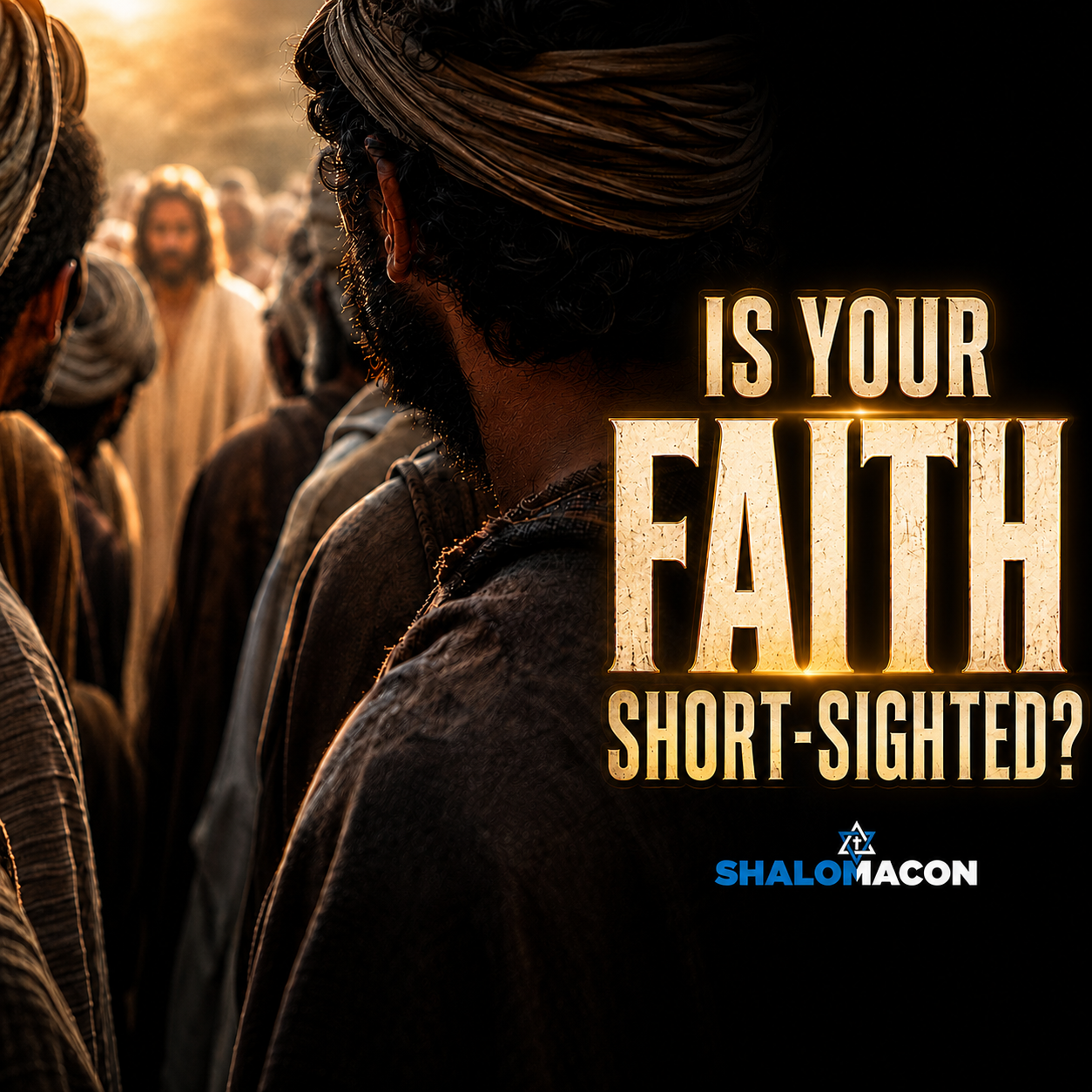
[00:32:45] We have to do the work. We have to make the time to examine our lives, listen to the sound of the Shofar, return to the path, and fix our eyes once again on the coming kingdom. I don't know if you can see in this image here, but the point of the image for this message, this teaching is that Yeshua is the one. He's there and he's teaching. But where's the focus?
[00:33:16] Focus is on the people in between them.
[00:33:19] Yeshua is out of focus, okay? It's almost like these people are the most important thing and he is not.
[00:33:27] And sometimes that's the way we treat life.
[00:33:34] And when we turn our eyes to heaven, heaven will help us see clearly.
[00:33:42] The world will continue to demand our attention. That's inevitable. The problems of daily life will not disappear, but they'll no longer be the things that we see and focus in on. We'll begin to view them in the light of something greater, the coming Kingdom, the return of Yeshua, and the purposes for which we were created. So as we're well into this season of teshuvah, we need to ask ourselves, are we living only for what is right in front of us now, or are we living for what is yet to come?
[00:34:19] Is our faith focused on the temporary, or does it have a clear view of eternity?
[00:34:27] Is your faith shortsighted or your spiritual vision hazy?
[00:34:34] Because if it is, recognizing the problem is just the beginning.
[00:34:38] Now you get to go spend time with your heavenly ophthalmologist.
[00:34:44] Shabbat Shalom I'm Darren with Shalom Macon. If you enjoyed this teaching, I want to ask you to take the next step. Start by making sure you're subscribed to our channel. And next, make sure you hit the like button on this video so that others know it's worth their time to watch.
[00:34:59] Last, head over to our website to learn more about Shalom Macon, explore other teachings and events, and if you're so inclined, contribute to the work that we're doing to further the kingdom. Thanks for watching and connecting with Shalom Macon.