Episode Transcript
[00:00:00] Speaker A: The shofar can't do anything that sounds heretical in some Jewish circles.
It's a supernatural sound, no less. But the shofar can't make God king over you.
It cannot change a relationship that needs attention. It cannot make an apology.
It cannot turn your memory into wisdom. It can call you, and then you have to hear and respond.
So today you're here, tomorrow I ask you to hear, Hear the call of the king, hear the reminder of God Rambam's wake up call, the announcement that there is, as we said last week, still time to come back.
And then pay attention to what happens over these next 10 days. Because tomorrow we hear the shofar, and then nine days later, we hear it again. A hundred opens and one big one closes. At Nilah, at the end of Yom Kippur, the shofar sounds. What happens in between, well, that's up to you.
Last week on the final Shabbat of Elul, I asked you to open those books a bit early.
We spent the morning with who last Shabbat, Ebenezer Scrooge, Looking backward, looking honestly at the present and looking toward the future that's going to grow out of the life that we're living right this very moment. And I asked you at that time to deal with one thing. Maybe before Rosh Hashanah arrived, one account that you already knew needed attention.
And now Rosh Hashanah has arrived and the books are open, and there is always this sort of strange mixture. In the day of Rosh Hashanah, we wish each other a sweet year, right? We eat apples and honey, we dress well, we gather with the people that we love. There's some real joy that's supposed to be a part of any new year celebration. And at the same time, most of us arrive carrying some weight from the year that just ended. Because a lot happens in a year.
Some of what happened in 5786 was exactly what you wanted to happen, what you prayed for.
And some of those things that happened, we never saw coming.
And there may be someone that you celebrated with last year who is no longer beside you.
There may be something that you feared last year that turned out to be absolutely nothing.
And there may be something that you never even thought about that changed everything.
So there's a lot swirling.
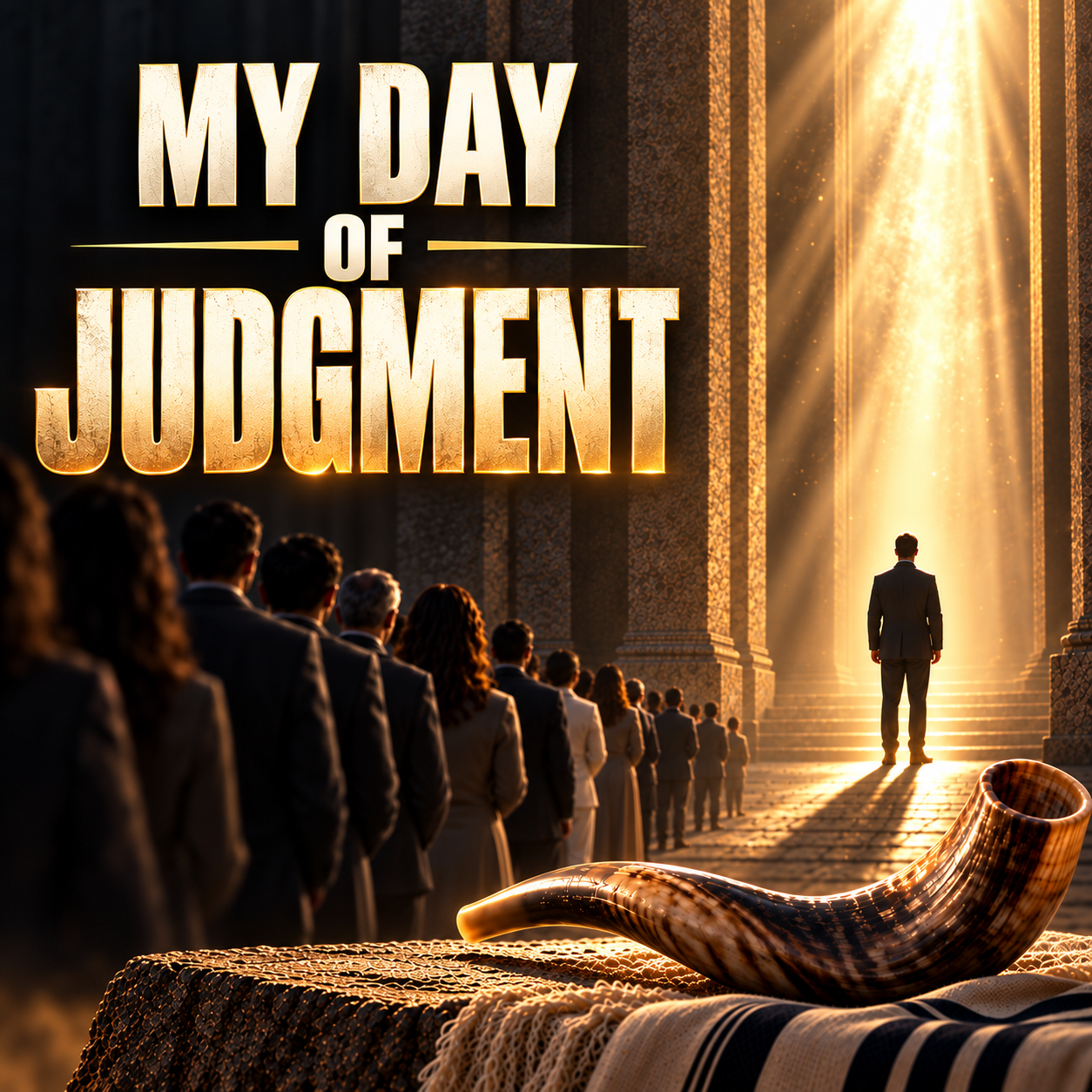
And the air around Rosh Hashanah and into all of that Jewish tradition comes along and gives it this nice, mellow, uplifting name, Yom Hadin, which means the Day of Judgment.
If you weren't already thinking about some important things, we have that foreboding concept.
Now, the Torah never calls Rosh Hashanah that.
So where in the world do we get that? Well, Leviticus, of course, calls it Zichron Truah, a remembrance of sounding numbers calls it Yom Truah, a day of the sounding. But that explicit language for Yom Hadin and a day of judgment comes from somewhere else. The Mishnah says that on Rosh Hashanah, everyone who enters before God passes before him. Kivnei Maron.
Kivneh maron. The Talmud offers us a lot of, well, several pictures for this phrase. Kivne maron.
All of which signify us passing individually before God. One analogy, sheep passing through a narrow opening. Another analogy, soldiers passing one at a time before their commander.
People crossing a narrow mountain path. The images are different, but the concept is the same.
Individually, we are passing before God, which changes a little bit the way I think about the Day of Judgment, because really, most of our lives are lived in groups.
We are members of families and communities, and we have generations that shape us and our experiences, our culture. There's usually people around us. And yet, when the Mishnah pictures Rosh Hashanah, eventually, there is one person standing before God.
I come before him as Damian, and only Damian. You come before him as. As you and only you.
God considers a particular life lived by a particular person.
With particular gifts and with particular opportunities to either use them or squander them, and particular responsibilities.
And the Mishnah connects this Back to Psalm 33, which speaks of the one, the God, the one who fashions hearts individually, and he understands us individually down to the deed. He knows the life he is judging because he knows you individually from the inside outward.
And this is a time between you and Him.
And that is incredibly beautiful and comforting and at the same time, very unsettling in some ways, because he knows it's not Santa Claus. This isn't the old Christmas thing about knowing when you're sleeping.
He knows.
He knows the circumstances that surrounded our choices, and he knows the motives behind why we did things and the opportunities that we used and the ones we wasted.
Nothing before him is hidden, and that is Yom Hadin.
God judges, and it's pretty heavy. And then in just a few minutes, as part of the Rosh Hashanah liturgy, we just amp that up a little bit more with the prayer Unatane tokev.
And we'll get to that, where we talk about the seriousness and ways to die.
Who will live, who will die, who will reach the fullness of their days. Who will not, who will find peace, who will not, who will know suffering?
We say those words because I said in the beginning of this message, a new year contains a lot of things that we cannot predict.
We stood here last, Rosh Hashanah, not knowing what 5,786 would contain. And we stand here with the very same limitation as limited knowing human beings trusting in an all knowing Creator.
We don't know what's waiting for us in 5787.
But right in the middle of all this language of judgment comes the familiar response that I talked about with you when discussing Scrooge and his three moments. We come in this liturgy momentarily to these words that say ut shuvah, ut philah, ut sakah, prayer, repentance, charity.
These come after these heavy moments of consideration. Repentance, prayer, righteous giving. It averts the evil decree. It says the Day of Judgment, gives us something to do.
Instructions. There are lofty spiritual concepts in that for sure, necessary repent, pray, righteous giving. But as I pondered the Day of Judgment this year, I paused to ask this question and to consider it. This is God's day of judgment. But do we have a part to play in this as well?
What I mean is, could it be that we are also supposed to render some of our own judgments on this day?
Because we can spend the entire morning and the entire holiday thinking about God rendering judgment over us. The books are open. God sees it all, he remembers, he decides. And all of that's part of Rosh Hashanah. But surely standing before judgment should cause me to render some of my own judgments.
I have to decide something about my life, the life that is being judged individually as I stand before the King of the Universe.
It is such a simple consideration, but I never really like, thought of it too much, as it's my day of judgment too.
I have judgments to make. God's judgment on the Day of Judgment is offered to point me to make judgments about my life on the Day of Judgment. Man, that's a lot of judgment.
And this is where I think that the sages of Israel gave us something extraordinary, beautiful, extraordinarily beautiful. In the structure of Rosh Hashanah, there are these great themes that we're getting ready to explore over the next couple of days. These special Rosh Hashanah themes of Malchuyot Zichronot and Shofarot, Kingship, Malchuyot Zichronot, the remembrances and the shofarot, the sound of the shofar, and we'll say some of them in just a minute. And there are a lot of words there in what could possibly consider be considered as the boring liturgy of Rosh Hashanah and the high Holidays. But I Man, these are the things that people can so easily skim past or tune out. I want it to be more than that for you. I always want it to be more than that for you. These words, they become familiar.
They become a gloss. We work through this Rosh Hashanah service. We turn the pages, we stand up, we sit down. Melodies we may or may not know. And we say, oh, that's pretty. Or, oh, he missed that one. Read verses about God as king. We read verses about remembrances, and eventually we hear the shofar. And after enough years, it's just what you do.
It's what you're supposed to do, because God wrote it down and said it's a good idea.
There's more to it than that, obviously. And I want us to pay some attention to those three themes today, because each one begins with something very true about the judge God.
And then it turns to us and asks us to be the judge of our own life.
The Talmud ties these themes together when it says, recite before me on Rosh Hashanah, Malchuyot, so that you make me king over you, Zichronot, so that your remembrance rises before me for good. And with what?
With the shofar. That's the instruction for the holiday. Okay, great. God is king. God remembers. God tells us to hear the shofar. God is king.
Great. That's deep. Fine. What are you going to do with his kingship?
God remembers.
Excellent. That's good to know.
What are you asking him to remember for good?
What will become of everything you remember as you enter into another year? The shofar sounds great. We do it a lot. A hundred times.
Will you hear it? Even one of them?
Not to hear, but to hear.
And what will happen because of you, because you heard it. And so even these themes that we can read through, they are personal. God renders judgment. And I have judgments to make, too. Whose authority will I accept? What do I do with the year I remember behind me? What will I respond to with this call?
And they turn all of Yom Hadin and this idea of judgment, something happening in heaven, into something that's happening to you right here standing on earth, Kivneh, moron, as you walk individually before the king.
That's heavy, man.
Our sages in Israel say we proclaim God's kingship on Rosh Hashanah. So that you make me king over you. Those words matter a lot.
Over you. That matters a lot. The images that I talked about, sheep and soldiers and all that, whatever. God is already king. I'm gonna let you in on that.
That is not actually the deal.
God is already king. We are not making that decision this morning.
That's not really the declaration. The judgment concerning us is to the extent at which his kingship reaches into your own life.
Tomorrow, when we say Avinu Malkeinu, we call him Father.
King.
Our Father, Our king. It's so easy for most people to call Father Father.
Mercy, love, compassion. King introduces a different word, a certain kind of authority that moves beyond Father. A king has a right to rule, and that becomes very, very important. Wherever God's authority runs into something that I don't want to let go of.
It may be money, it may be anger, it may be relationship, ambition, sexuality, habits, problems, bad things. The way I use my time. Something God has been telling me. I know, I know, I know, but I just.
And sometimes I see so often I'm praying for guidance. You already have enough guidance.
You know the course.
We would simply prefer another answer than the one we're getting.
And this is where the kingship becomes real. I can affirm God's sovereignty for the next six hours.
Forever, actually, I can do that.
He's King, God, sovereign over the entire universe. But this little part of me, I'm keeping that from me.
That's mine. That's my territory. That's where I rule.
And no one I know saying these words. People are like, gosh, he's dramatic. And I don't really think like that, but the truth is we all do.
We all do.
It's not an accusation, it's a realization.
If God is king over my life in 5000, 787, what will I surrender or accept? What will actually change? There ought to be an answer to that question somewhere in the life I live after leaving this sanctuary. The word I say, malkeinu, our king over me should matter.
Then come the remembrances. And the Talmud says that we recite them so that our remembrance will rise before him. And this is a beautiful biblical Torah thing, thing theme. We're asking God to remember us. And the biblical idea of divine remembrance is very powerful. You know why? Because when God remembers something, something great happens.
He remembered Rachel and her womb was opened.
He remembered Abraham and Lot was saved. He remembered Abraham, Isaac and Jacob. And the covenant was maintained for Israel to go into the land.
He remembers the past toward the future.
Thank you, Rabbi. Sacrifice.
That is what makes the language of remember us for good, remember us for good God. That's what makes it beautiful. Today. We ask God to remember his mercy, his promises, his people. That's us.
And bring that remembrance into what's going to happen for us next year in the future.
And so much of Jewish prayer looks toward the future because of what God has established in the past. Remember Israel. Remember Jerusalem. Remember us for life.
But I think there's something in the way that God remembers that can teach us how to enter the new year with remembrance. We have our own remembrances from 5786. We talked about this. Some are beautiful. Some are painful. Some are still very, very confusing. But they are part of our lives for the presumed worse or better. But either way, either way, they're coming forward with you.
Remember the past.
Render a judgment on those things, your life, your choices, and ask God to use what happened.
Let the blessings become incredible gratitude. Let the mistakes become wisdom. Let something painful make you more compassionate to those around you and more awake to the world. Let the things that you learned last year affect the decisions you make next year. And here's a big question. What did 5786 teach you that 5787 should not have to teach you again?
You should have an answer. That one answer may be the reason you're here.
God remembers the past toward the future, and we can learn to do the same, asking him to remember, to use the things that we remember that we render a judgment on so that what has already happened can somehow serve God and serve us as we go forward.
Then the shofar sounds. And this year, there is something very unusual about Rosh Hashanah that happens periodically. Guess what?
Not happening today.
There is no shofar today. Rosh Hashanah falls on Shabbat. So we wait till tomorrow to fulfill the central Mitzvah, Lishmoah Kol Shofar. You shall hear the sound of the voice of the shofar. But I actually think there's something really great about this, something powerful in having this first day without the sound.
Because today we can think about what we intend to hear tomorrow.
What in the world does that mean?
The Mishnah speaks about someone who passes behind the synagogue during the sounding of the shofar. They hear the shofar being blown. The sound reaches his ear. Does it fulfill the mitzvah of Lishmo Hakol Shofar?
We couldn't possibly know, but probably not. Why? Because the intention matters. It's not just the Sound, the intention matters.
Simply being within range does not tell us what's happening inside the person. And that makes sense to me because as a male, married male, I very much understand the difference between I hear you and I hear you.
I really do. I'm listening with intention. Kelly. I got it. I'm focused on what you're saying.
I hear you, my intention.
That's what it means to hear the sound of the shofar. It's fitting for the day of judgment because it demands a response. It demands a judgment from the person being judged. Malchuyot asked me to render judgment about who will rule my life. Zichronot has asked me to render judgment on the things of the past and bring them forward. Let God reward my review of the past, my judgments of my actions. May he reward it for good in this year. And then comes the sound. And what do we do? Oh, that's pretty. Ooh, neat.
A hundred sounds.
You wake up and you do the thing.
That's what it is.
The shofar can't do anything that sounds heretical in some Jewish circles.
It's a supernatural sound, no less. But the shofar can't make God king over you.
It cannot change a relationship that needs attention. It cannot make an apology.
It cannot turn your memory into wisdom. It can call you, and then you have to hear and respond.
So today you're here.
Tomorrow I ask you to hear, Hear the call of the king, hear the reminder of God Rambam's wake up call, the announcement that says, there is, as we said last week, still time to come back and then pay attention to what happens over these next 10 days. Because tomorrow we hear the shofar, and then nine days later, we hear it again. 100 opens and one big one closes at Nilah. At the end of Yom Kippur, the shofar sounds. What happens in between, well, that's up to you.
And that's where the mahsour and these themes and whatever sermons, they can go out the window, or you can say, yep, I gotta answer at least one question and I gotta take at least some action. And maybe you finally make a decision that you've delayed, or you have a conversation that must happen, or you make peace where peace can be made, whatever, because we're going to go from here to Yom Kippur, and the sound will sound. And what happens is the opportunity. So what we see now is the value of Malchuyot, of Zichronot, of Shoferot, that becomes so beautiful on the day of Judgment.
It begins With God's judgment, we pass before Him. He sees, he knows, he renders judgment. And standing there, the sages place these three themes in front of us that will require your participation and your own judgment.
There is so much coming that we can't control.
Unatane tokef.
Make sure that we remember that.
But there are also things that God has placed in our hands.
We can return, we can repair, We can make him king.
We can remember. And finally, when the shofar sounds, we can hear it. It is the sound of kingship. It is the sound of remembrance. And it is a supernatural sound of judgment. But it is one more thing that you must pay attention to.
It is also the sound of hope.
Hope.
That 5787 does not have to be a repeat of 5786 in the ways in which you need to change.
Hope that can change a course to go in a different direction. Hope that because the book is open, the pages can be different in the future. Better, more fulfilling. So you come back tomorrow and you hear the sound of hope.
And when we arrive at Nilah and the final shofar fills the room, please God, may something have changed in us and for us before you, great King, rule more fully.
Remember us for good and may we hear the call while the gates are open.
May you be inscribed and may you be sealed in the book of life for a good and sweet year.
Here is 25787 Shabbat Shalom I'm Darren with Shalom Makin.
[00:29:46] Speaker B: If you enjoyed this teaching, I want to ask you to take the next step.
Start by making sure you subscribe to our channel. Next, make sure you hit the like button on this video so that others know it's worth their time to watch.
Last. Head over to our website to learn more about Shalom Macon, explore other teachings and events, and if you're so inclined, contribute to the work that we're doing to further the kingdom. Thanks for watching and connecting with Shalom Macon.