Episode Transcript
[00:00:00] Speaker A: We don't merely believe that Yeshua is the Messiah. We bind ourselves to him as his disciples.
And in the messianic world, sometimes we can become so smart that we begin to miss the essence of who Messiah actually is.
And in these last days, the world is trying to sever our connection with Yeshua. Whether through materialism, through technology, or or even theology, it continues to try and pull you away from the true Tzaddik, the true righteous one, the King Messiah Yeshua.
So will you continue believing and become a flourishing branch, or will you become stagnant and become a withering branch on the vine whose fruit has become rancid?
And it is time for us all, including myself, to demonstrate unwavering devotion and and full allegiance to Messiah Yeshua and not another, both theologically and internally.
We must train ourselves to be devoted to our rabbi and king at every moment of our lives. We must memorize and learn and become transformed by the depths of his teachings, his words, his deeds, but also by his death, his resurrection and eternal life.
Imitating him and growing into the full, complete stature of Messiah, we raise more disciples in his name, and we do all of this, even if it costs us something, even if it costs us everything.
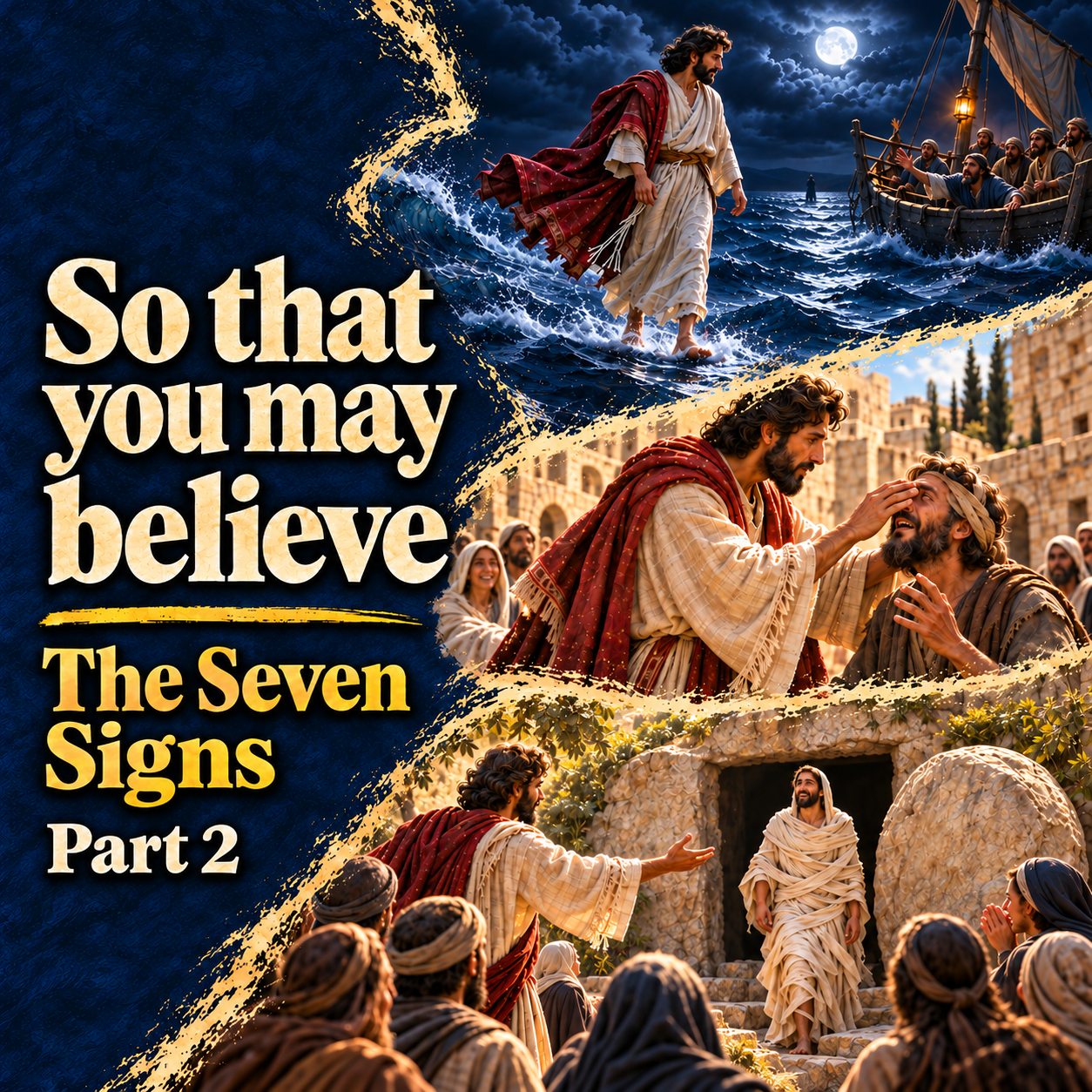
Two weeks ago, we began this series on the seven signs of Yeshua found in John.
And we sought to see that this is more than just Yeshua performing random miracles or displays of supernatural power, but they were windows into the mission and identity of the Messiah of Israel.
And if you also remember, I told you about the parable of the kernel of wheat and the bread and the cookies and the king's food needed with oil and honey. And so I hope that two weeks ago you were able to taste something a bit sweeter and more filling than what you're used to. Okay? And so we covered the first four signs, which was water into wine, healing the nobleman's son, healing the lame man, and the feeding of the 5,000.
Right? And I asked you to consider, what do these signs mean for you as his disciple?
And I want you to continue to reflect upon that as we move into these last three signs today. And just remember, I'm only giving you, like, an aspect of these signs. There's so much to go into that we do not have time.
If we had all day and all night, we might, might, could touch on a little more, but just too much to get into. So let's jump right into sign number five, walking upon the sea. All right? And we're going to be looking at John 6, 15, 21. So let me remind you, this miracle occurs on the night after the feeding of the 5,000, and it's near Passover.
And that will become a clear theme later here.
But this sign is also discussed not only in John, but in Mark and Matthew. So we'll look at a few verses from them as well. And so after the feeding of the 5,000, John says that Yeshua sends the disciples away on a boat across the Sea of Galilee. He escapes the large crowds who want to make him king, and he gets away to pray alone at night on a mountain overlooking the sea.
And this is his first real time to pray, mourn, and process the death of his cousin. If you remember from a couple weeks ago, John the immerser, and he's probably contemplating that a similar fate may be awaiting him in the future.
And John includes in chapter six, verse 19, that they, the disciples, had rode about 25 or 30 stadia. And this is about three or four miles. Okay, and that's an important detail. These seemingly insignificant details in John are very important.
All right, and this is because, as the other gospel writers note, the boat was in the middle of the sea, because the Sea of Galilee is approximately seven miles wide. All right? Both Mark and Matthew state that the boat was in the middle of the sea. So I want to focus here on this phrase in the middle of the sea, because we see that in another place in the Torah, in the place you would expect to find this in the Torah, Exodus 14:29, where it says, but the children of Israel walked on dry land in the middle of the sea.
So now remember, when did the crossing of the Red Sea take place or the sea of reeds take place? Excuse me. The seventh night of Passover.
And John notes that this sign happens when Passover is near. So the Israelites go into the sea of reeds during the night during. And Exodus 14 states that they are in the middle of the sea. And then it gives us another time stamp.
When was this miracle of the crossing of the sea fully realized? And it came about in the morning watch that Hashem looked. So Exodus 14:24 says.
So the sages understand this to mean that the passage goes on to show that it was in the last watch of the night, right before dawn, that Hashem confuses the Egyptians, saves the Israelites, and the seas come back together and drown the Egyptians.
But this is interesting because Mark in his Gospel says the following. In 6:48. Then he saw them straining at rowing, for the wind was against them, against them. Now, about the fourth watch of the night, he came to them.
So it was during this same last watch of the night when the darkness is greatest, before the dawn, that Hashem confounded the Egyptians as they pursued the Israelites in the middle of the sea. And it's at this exact same time of night, during this great darkness, when Yeshua sees the 12 disciples straining where he comes and walks to them in the middle of the sea.
And we see Moses walks through the sea, But Yeshua is going to walk upon the sea.
But, you know, that's. This is nice, but this is too surface level. I got. We got to go a bit deeper here. Okay, so what's happening? What is this? What is the raging Sea of Galilee really represent here? And why does Yeshua need to walk on it? What's the point? Why couldn't. If he had just split it. Split it like Moses.
So, building on this idea of the splitting of the sea, I want to look at the passage in Exodus 15:8 at the song of the Sea. And it says here, the depths congealed in the heart of the sea.
So we have this idea that in the heart or in the middle of the sea, the depths congealed there.
And this actually this phrase, the depths. Okay, that made me look. Okay, where do we see this word first in the Torah? The depths or the deep?
And this brings us to the first time in the Torah, we see this word, which is in the second verse of the Torah itself.
And it says here, now, the earth was chaos and void, and darkness was upon the face of the deep.
That Hebrew word there for deep or the depths is tehom. And that's going to be important moving forward. And the spirit of God was hovering over the face of the water.
All right, so in Jewish mystical thought, the tehom, this, the deep. Okay, we've read this verse before. I'm sure everybody's read this verse before. But it's like, what is this weird water and deep in the abyss, nothing's even been created yet. Well, this is what. This is what the sages understand it to be, or some of the. From a more mystical perspective, okay, this is much more than dark, gloomy waters.
The abyss itself is understood as the root of the demonic realm, the place of utter chaos and what could be described as a cosmic graveyard in sorts. And this cosmic graveyard is not still, but rather it seeks and it rages to devour, swallowing up any life it possibly can.
In fact, the sages make a connection that the word tehom, meaning the abyss or the deep, when its Hebrew letters are rearranged. And I think I have this up here.
When you rearrange the Hebrew letters, it spells Hamavet, the death.
Right? So the rabbis note that there's a connection between words when you can rearrange the same letters.
So when the disciples are in this boat, rowing against this adversarial wind, this is much more than just a storm or raging tempest.
The Sea of Galilee has been transformed into the Tehom incarnate.
They have entered into the primordial chaos itself, into the mouth of death.
And we must realize, we read it, it's like three verses. We must realize that they were about to die, like they were not getting out of that situation.
And just as the Egyptians stated, I will pursue and I will overtake the Israelites, So this sea too is trying to pursue and overtake the 12 disciples.
But there is one thing that the sages note that keep this primordial sea, this raging chaos, this Tehom at Bay.
Genesis 1:2. And it says, and the Spirit of God was hovering over the face of the water.
Now here is where the sages of Israel state.
Here's what the sages of Israel state about the Spirit of God found in this verse. In the midrash in Genesis Rabbi 2:4, it says, and the Spirit of God was hovering.
This is the spirit of the King Messiah.
So it is the spirit of King Messiah that hovers above and holds back the primordial waters of chaos. The Lubavitcher Rebbe, speaking on one of the teachings from the altar, Rebbe says the the Messiah has a certain superiority even over Moses on the phrase at the beginning of the Torah and the Spirit of God hovered. He says, the sages teach this alludes to the spirit of King Messiah. And it says the verse continues over the surface of the waters. This means it intimates that. Intimates that he has a higher level than that of Moses, who was called Moses because he was drawn from the water below.
But King Messiah is above the waters.
So we see that Moses level is below, but Yeshua's level is above the waters. So when Yeshua is walking upon the waters, he is not only demonstrating that he is greater than Moses and can lead his people above the sea, but that he is the Messiah, the Son of God, who does not walk through the waters, but upon the waters, because his spirit has been hovering over the waters since creation.
In Psalm 77 it says, Your way was in the sea, and your path in the mighty waters, and your steps were not known.
In Job it says, who treads upon referencing God or the Mashiach who treads upon the high places of the sea.
And in John 6, verse 20, it says they saw Yeshua walking on the sea, drawing near the boat, and they were afraid.
But he said to them, it is I do not be afraid.
So it is Messiah Yeshua who treads and trample upon the great Tihom, the place of death itself and the place of our greatest fears.
Not only does he hold back the death and the raging chaos that seeks to consume us both outside of us and inside of us, he stills the tumultuous storm and brings it and us to peace.
And there's so much more I want to talk about in this miracle and this sign.
How Peter walked on the water, how Yeshua was even able to do this, or how John states that they were miraculously transported immediately to the shoreline when Yeshua got in the boat.
But I do want to mention one idea that I had when I was studying this.
If we are in the end of days, known as the footsteps of the Messiah, then we should expect to touch, come face to face with the Tehom.
But just as Messiah did, we will trample upon it and overcome it.
So I want to move on to sign number six here.
This is my favorite one.
So go ahead and get ready. Okay. I feel like we're a little right now. Okay. Buckle up. We're about to really.
I don't think you're ready for this one. All right, so first of all, I need to give you a little bit of biblical criticism real quick. Okay? This is what we learn about in a little bit in college, right?
So in John 7, this. This healing occurs in John 9, but in John 7, verse 37, it says it was the last great day of the feast. Talking about Sukkot. Talking about the seventh day of Sukkot, Hashanah, Rabba. Okay, now that's important. And I'll let you know why in a second.
In John 7, 53 through 8, chapter. Through chapter 8, verse 11 is the. Is the story about the woman caught in adultery. Okay. If you look at your Bibles, most Bibles will have a footnote there and say that this passage wasn't in the original Greek manuscript. All right, Now, a lot of biblical scholarship there. Most people think it was probably either earlier in John 7 or maybe in a different place in John, but it wasn't in that specific place in the original Greek John. Does that make sense? Okay. Okay, that's important because if you take that and you move it back up into earlier in the week during Sukkot and just let the story and the narrative flow from there.
It seems that John 7:37 through halfway through John 10 is all occurring on the same day. One long narrative flow on the last day of Sukkot. And that's important because it'll make a lot more sense as to what's happening in leading up to this, this miracle. So does that make sense? Everybody understanding this is. Even if it's not, it's like the next day after Sukkot, point being Sukkot themes. Okay, so it was. This is, I believe, is occurring on the last day of Sukkot.
And during the Temple, Temple time, Jerusalem literally became the light of the world.
Because in Jerusalem, during Sukkot, they put up four 75 foot tall menorahs in the women's courtyard. All right? And the Talmud states that there was not a courtyard in all of Jerusalem that was not illuminated by its light. Meaning that all of Jerusalem, even at night, had become like the day and had become a light to the world during Sukkot.
And so within Jewish understanding, there's other things that are called the light of the world. The Torah, the Temple, and even the sages.
But there is something even greater that is here now. As Yeshua says in John 9. 5, I am the light of the world.
But why is he saying this? And who does this blind man represent that he is going to heal?
So I want to suggest, and if you'll just follow me here, just stay with me, that the blind man, while he himself is a Jew, allegorically represents the nations, many of us Gentiles. And I want to support it here. In Isaiah 42, verse 7, it says, I Hashem made for you the Jewish people a people's covenant to be a light to the nations, to open blind eyes, to bring prisoners out of a dungeon, those who sit in darkness, out of a prison.
Matthew 4, 15:16, quoting Isaiah 9, says, the Galilee of the Gentiles, the people who sat in darkness, have seen a great light. And upon those who sat in the region of the shadow of death, light has dawned.
So the lights of the world within the Jewish understanding, those lights, we have to be honest, did they really become a light to the world in a way that transformed the nations?
The sages wisdom was not expounded to the nations. And then they became transformed.
The Temple, as incredible as it was, did not draw the nations and fulfill the prophetic promise to be a house of prayer for all nations.
And frankly, this may be uncomfortable for a lot of us in here, but the Torah in its totality was not given to The Gentiles.
The Torah never led us to Hashem, did it not in mass.
And therefore it was a covenant for the Jewish people.
Most of everybody in here didn't come to the God of Israel because they heard about the Torah, did you?
And therefore the Gentiles, like this blind man, sat in darkness, the darkness of idolatry, immorality, and despair.
But there was one light that was greater than all three of these. And his name is Yeshua of Nazareth.
And it is through him and him alone that we Gentiles especially are not only connected to the God of Israel, but to the Torah and to the Temple and to the wisdom of the sages.
And it seems that this blind man, who is Jewish but represents the Gentiles, the. During the Feast of Sukkot, the Feast of the nations, is healed of his blindness, pointing to a future Sukkot when the blindness of the nations will be completely healed and the whole world will encounter the ultimate light of the world.
But I told you to buckle up. That was like. That was, you know, a little test run because there's much more happening in this chapter, okay? As I told you, chapter eight and nine, I think, are all happening on the same day. And that's important because in chapter eight, guess what's going on.
The Pharisees and the Jewish elite are arguing with Yeshua about who is whose father. Okay? Yeshua is like, God's my father. They're like, no, he's not. You know, you're essentially a. You're demon possessed. And Yeshua is like, no, I'm not. If you. If God was your father, you would believe in me. And they're like, no, no, absolutely not. Abraham's our father. And Yeshua is like, no, Abraham's not your father, because you would believe in me if Abraham was your father. In fact, your father's the devil. Okay? So there's a lot going back and forth. And then they want to pick up stones and stone him, right? And he passes through. And then that's the end of chapter eight. And then chapter nine picks up and it says, as he passes by, so he leaves the temple. And then it seems like as he leaves the court of the women, maybe he's in the court of the Gentiles or out of the temple completely. Then he encounters the blind man. So we need to understand that there's been this debate around whose father is who and all of this stuff. Does that make sense before we get into this? Right.
So in John 9, 6 says when he had said these things, he's going to heal the blind man when he has said these things. He spat on the ground and made clay with the saliva, and he anointed the eyes of the blind man with the clay.
Okay? It's incredible miracle. We know the story. He anoints the blind man. He's going to send him to the Pool of Siloam. He's going to come back. Who's going to wash, come back. He's going to be healed. All right?
But it's weird, okay? It's strange. Why is he spitting into the ground? Why is he making mud and clay and wiping it on his eyes? What's going on here? All right, remember what we just looked at in chapter eight.
Now, this miracle occurs on Shabbat. And most of chapter nine is about how the Pharisees state that Yeshua cannot be from God because he's violating the Shabbat for healing his blind man. There's plenty of resources to go in and look at all the halakhic implications of healing on the Shabbat. That's not what we're going to do today. I want to look at the way Yeshua heals this man. Why would Yeshua spit into the mud to heal this man's blindness? Right.
There is something amazing written in the Talmud about this. Are you ready? This is in Bhavabhra Tractate Bhavabatra. The context here is how to determine the firstborn son of a father compared to the firstborn son of a mother. So an example you've got Joseph was the firstborn son of his mother, but he was. But Reuben was the firstborn son of his father. Does that make sense? Okay, so there's issues there with birthright and so forth. So this is what the Talmud states the Gemara relates, There was a certain man who came before Rabbi Chanina and said to him, I know that this man is a firstborn. Rabbi Chanina said to him, from where do you know? He said to Rabbi Hanina, because when people would come before his father to obtain a cure for their ailing eyes, he would say to them, go to my son Shichat, as he is a firstborn and his saliva heals this ailment.
The Gemara asked, but perhaps he is his mother's firstborn. The Gemara answered, it is learned as a tradition that the saliva of a father's firstborn heals this ailment, being ailing eyes, but the saliva of a mother's firstborn does not heal this ailment. Okay, all right. So there's A Jewish tradition here that in order to determine the firstborn of the father, somehow the firstborn son's saliva can heal ailing eyes. Right. But the firstborn of a mother cannot. Right. So this is actually really incredible. Okay. And we're going to dive deep into this, but I wanted to pull some more commentaries about this passage from the Talmud.
So, speaking on this week's Parsha, right. On Jacob and Esau, this is a commentary about the Midrash, right? Says the Gerebi, who's a Polish Hasidic rabbi who's alive today, says this.
There's a wondrous midrash talking about Genesis Rabba, where Resh Lachish states, in the Midrash, Esau began dripping saliva, meaning he was ejecting spit from his mouth. And the Emre amet, another rabbi, explained, according to this, that Esau was legally the firstborn, and. And his saliva should have healed. And since Isaac's eyes had become dim, Esau planned to spit into his eyes so that he would be cured, thereby proving that he was the true firstborn. But when he saw that Jacob had taken the blessings and he wished to test if the power of the first of the birthright still remained with him, he began dripping saliva to see if his spit would heal. And when he saw that his saliva no longer healed, he finally understood that the birthright had departed. Departed from him completely and was given to Jacob.
You didn't know saliva was discussed this much in the Talmud, did you?
When they say that they quote the Talmud and so forth, just ask them if they read the part about the spit. Okay? All right.
But now I want to go into something even more incredible. The Chida, the famous Rabbi Chaim azulai of the 18th century. I don't have the quote up here for you because it's a mystical quote. It's very dense. The. The language is terse, so I am paraphrasing it. Okay? And I ask that you trust my paraphrase. All right?
This is what he says.
A firstborn son of his father was believed to possess healing properties in his saliva. For this reason, the connection to the firstborn is that the father's first drop of seed spiritually contains the highest wisdom of. Of the Father.
The idea is that the light of this wisdom flows from the father into the brain of the son and toward the eyes, eventually overflowing into his saliva. Thus, the saliva of the paternal firstborn was understood to carry healing properties, particularly for ailing eyes.
So, in short, the wisdom of the father overflows into the Son's mind, toward his eyes, and ultimately even into his saliva.
So what are we learning from this miracle?
That Yeshua of Nazareth is the firstborn son of his Father.
But who is his father?
That's Hashem himself.
This is going to probably upset some other people too, as the Gospel of John is very clear throughout that Yeshua is the Son of God. So of course, as maybe as strange as it seems that somehow, in some way, Yeshua's own saliva spiritually contains the highest wisdom of his Father, thus having the ability to not just heal ailing eyes, but having the ability to heal blindness from birth, while proving Yeshua's paternal firstborn status as the only and unique Son of God to those who had challenged him the chapter before.
And this is why Paul writes in Colossians 1:15, he is the image of the invisible God, the firstborn over all creation. He writes in First Corinthians 1:24, Messiah is the wisdom of God.
And then in John 1:18, at the beginning of his Gospel, no one has seen God at any time.
The only begotten Son who is in the bosom of the Father, he has declared him.
So once again, while there's much more sitting in this miracle, ultimately this man's life was changed forever because while he was blind, from the day that he was born, sitting in darkness, he states, I was blind, but now I see.
And his life changes on that day because he met the true, only begotten Son of God, the light of the world, who healed his physical blindness and who is the one who can and will heal all spiritual blindness.
All right, let's move to our final sign here, the resurrection of Lazarus. We're going to look at John 11. So this is a lengthy chapter. We'll kind of touch and go a little bit.
But Lazarus has died. Okay. And the text notes that he has been dead for how many days?
Four days. By the time Yeshua and the disciples get to him. Right. John 11:17 says that. And this is significant because why wait until four days?
Would have not just been incredible as incredible to do it after two or three, like Yeshua, you know, or you know, why four? Okay, what's significant?
So Jewish thought is going to offer a fascinating approach to this. So we're going to look in the midrash in Genesis, Rabbi 100, verse 7, and it says, bar Kippara Tolt, the most intense time of mourning is on the third day. For three days, the soul is hovering over the grave, believing that it will return to the body when it sees that the radiance of the face has changed, meaning the beginning of decomposition has occurred. It goes and it leaves. Okay, so let's break this down.
So this is speaking about the seven days of sitting Shiva, when a close relative passes away. The midrash states that the first three days are the most intense time of mourning, culminating on the third day.
This is because it's believed that the outside of, like, really holy tzadikim. It was really holy, righteous people. It was believed that the soul was, or at least a piece of the soul was sort of hovering over the grave within those first three days, hoping to return into the body. Okay. However, after the third day, once it sees the body as decomposing, it finally ascends.
And.
Excuse me. Yeah, so it finally ascends. And so, although extremely unlikely returning to the body within the first three days, but once you've hit the fourth day, there's no. No coming back. Okay. That was the viewpoint. That's the understanding within the Jewish world, right?
The soul moves on to Ghanaian.
So Yeshua waits until the fourth day when Lazarus is dead.
Really, really dead. No coming back dead. Nobody's thinking he's able to come back dead. Okay?
And Yeshua tells them to remove the stone, and he states, lazarus comes forth. And Lazarus comes forth from the grave, bound and grave clothes from the tomb. So this is utterly remarkable, right? He. He has literally just resurrected someone from the dead. But he did it four days of him after he was dead, which is even more incredible than Elijah and Elisha, because everybody that they resurrected had just died, like that same day. Okay?
So once again, Yeshua is displaying himself as someone greater.
But while that is really cool, and it's like, okay, this is impressive, Yeshua just resurrected this guy who is four days dead, there's something deeper going on here as well. If you pay close attention to John chapter 11, you will notice striking parallels between this chapter and Torah portion Hukkat, which is in numbers, chapter 19, 1, 22 1.
This portion Hukkat begins with one of the most mysterious commandments in all of the Torah, the ritual of the red heifer.
And what is this ritual concerned with?
Death.
Exactly. Death.
So the section describes how to ritually purify oneself from the impurity of death by using various elements, such as the ashes of the red heifer and living waters, amongst other things, that are sprinkled onto somebody who has contracted corpse impurity, meaning they've either been inside a room with a dead body or they've touched a dead body. There's Various scenarios. Okay? And there is a deep mystery here with the ritual of the red heifer, because the priest who performs the service has to be ritually pure.
And through performing the service, the priest becomes impure. Right?
But the person who is contaminated and impure, contaminated with death.
When they go through the ritual of the red heifer, they are made pure. So the one who is pure is made impure, and the one who is impure, made pure. Okay, So I want to continue. Oh. And so anyways, in numbers 19, the red heifer ritual must be carried out by the priest.
Now, we would expect this to be done by Aaron. Literally every commandment found in the Torah that's given to the priest is given to Aaron. Okay?
Except this one.
Right?
In numbers 19, 1 4, it says this Hashem spoke to Moses and Aaron, and you shall give it the red cow or the red heifer to Eleazar the priest.
Eleazar the priest shall take from its blood. Eleazar is the one who is specified here.
So the red heifer ritual is carried out specifically by Eleazar the priest Aaron's son.
Now, why is that important?
I told you that there were major connections between John 11 and this portion.
And so who is the man who dies in John 11?
Lazarus, whose Hebrew name is Eleazar.
Okay, so consider the irony here. Eleazar, the priest who was specifically appointed to perform the ritual that purified Israel from corpse impurity has an apparent counterpart in John 11. Lazarus, who has himself become a corpse, the one associated with the purification from death, has now entered death himself.
The red heifer ritual could purify someone from the ritual contamination of death, but it could not restore the dead person to life.
But once again, something and someone greater than the red heifer and the priests who oversaw it is now here.
Yeshua does not merely cleanse someone from death's impurity, but he calls forth the dead from the grave.
While the red heifer could be spiritually viewed as pulling someone from out of contamination of death into purity and life, Yeshua tells Martha, I am the resurrection and the life.
He who believes in me, though he may die, he shall live.
And then later, says Yeshua, he cried out with a loud voice, lazarus, come forth. And he who had died came out bound hand and foot with grave clothes, and his face was wrapped with a cloth. And Yeshua said to them, loose him and let him go.
So Yeshua possesses something greater than the power of the ashes of the red heifer and greater than the priest performing the service. He is the agent of Resurrection himself, not merely purifying the flesh from corpse contamination, but transforming the dead into life.
As he says, whoever lives and believes and me shall never die.
And here is another remarkable parallel.
The priest who performs the red heifer ritual becomes ritually impure through the very act by which he brings purification to others.
And so what happens immediately after Yeshua performs this seventh sign, bringing Lazarus from death to life?
John 11:53 says, then from that day on, they plotted to put him to death.
So the one who brings life to Lazarus becomes the one whom the authorities now seek to put to death.
So there is a profound reversal here. The one who gives life becomes the target of death itself.
Unlike the priest who becomes richly impure through the red heifer service, Yeshua does not contract corpse impurity, but rather he willingly moves toward death through giving life to others.
So this is the seventh sign that Yeshua is the Messiah, the Son of God, who has the ability to bring you, and frankly everyone else who is dead into life, meaning those who have no hope, those who are beyond dead. Four days dead.
Allegorically, four days dead.
So much so that your soul no longer hovers over your body, that there's no hope for you, so to speak. That he has the power to speak and raise you from death to life.
Even those who do not believe in the resurrection of the dead. And if you read the passage, it's Caiaphas, the high priest, who gets involved there at the end of the chapter. And what was he, Sadducee, who didn't believe in the resurrection of the dead.
Even if you do not believe in the resurrection of the dead, those who have become the ultimate manifestation of death itself, even you can hear the voice of the Son of God and arise from your graves, if you will believe in him.
So I've told you that these are not just miracles, okay, but windows into the identity and mission of Yeshua Messiah. I spoke about the first four signs earlier, and now we've gone through the final three.
Yeshua, turning the water into wine, revealing the abundance of the glory of the Messianic age, and bringing forth the secrets of the Torah from the six days of creation. He heals the royal official son miles away, at the exact same hour that Hashem breathed a soul into the lifeless body of Adam, he heals the lame man of 38 years, revealing himself as the restorer of Israel, who leads his people to the Messianic era. He feeds the 5,000, revealing himself as the latter Redeemer and a prophet like Moses. Then, in sign number five, Yeshua walking upon the sea, he reveals himself as the Messiah who is above Moses, even greater than Moses, who stands above the primordial waters of chaos and death, who possesses the authority to hold back the abyss and lead his people safely through the storm.
In his sixth sign, Yeshua reveals himself as the firstborn Son of God, the true light of the world, whose divine wisdom brings sight to the physically and spiritually blind. And then his final sign, the seventh sign, he reveals himself as the resurrection and the life greater than the red heifer and the priesthood, possessing the power to bring even those beyond death into eternal life.
So John, chapter 20, verse 30, 31. This is what the whole two parts were based off of, is John states, and truly, Yeshua did many other signs in the presence of his disciples which are not written in this book. But these are written so that you may believe that Yeshua is the Messiah, the Son of God, and that believing you may have life in his name.
So the question becomes, now that you have tasted the sweeter foods, the royal delicacies, and no longer just kernels or even plain bread, do you believe?
Because the purpose of these signs, as I said, was never to amaze us with what Yeshua could do, but to reveal who he truly is.
So do you believe in him?
Because remember the Greek word I told you here that John uses in his Gospel for belief, all 98 times is in action verb form.
Not once is it used as a noun, which means believing is an active, continuous trust and commitment, not a passive belief or one time mental assent.
So what does it mean? And I'm wrapping up here, what does it mean to actively believe in Yeshua?
There is a concept in Hasidic philosophy called hit kashrut, meaning binding attachment or connection.
So not just to have the mental declaration that he is the Messiah, but to actively connect and bind myself to him.
Hit kashrut encompasses what we understand as discipleship. So I have a couple of questions.
Do we intentionally attach ourselves to him daily through prayer?
Do we study his teachings daily, learning to understand the Torah in light of his words?
Do we submit our minds, speech and actions to his teachings?
And do we allow our minds and hearts to become vessels for his words?
We don't merely believe that Yeshua is the Messiah. We bind ourselves to him as his disciples.
And in the Messianic world, sometimes we can become so smart that we begin to miss the essence of who Messiah actually is.
And in these last days, the world is trying to sever our connection with Yeshua, whether through materialism, through technology, or even theology.
It continues to try and pull you away from the true tzaddik, the true righteous one, the King, Messiah Yeshua.
So will you continue believing and become a flourishing branch? Or will you become stagnant and become a withering branch on the vine whose fruit has become rancid?
And it is time for us all, including myself, to demonstrate unwavering devotion and full allegiance to Messiah Yeshua and not another, both theologically and internally.
We must train ourselves to be devoted to our rabbi and king at every moment of our lives. We must memorize and learn and become transformed by the depths of his teachings, his words, his deeds, but also by his death, his resurrection and eternal life.
Imitating him and growing into the full, complete stature of Messiah, we raise more disciples in his name. And we do all of this, even if it costs us something, even if it costs us everything.
And the final thing I want to tell you is that we also have to fall deeper in love with Him.
We have to speak to him and ask him for help and ask him for advice.
You know he's alive.
I think we forget that he's not just some historical figure whose teachings we study. And he's not just a Messiah, as some would assert, but he is the Messiah who is living with whom we are called to have an intimate relationship with.
So we must be intentional and ask him to intercede on our behalf, to uplift our broken thoughts, emotions and prayers and to clean them and present them before our Father in heaven.
Are we allowing his soul to enter ours? And for our mind to be consumed with His?
So we must hear his voice because His Spirit lives in us.
But if we are not actively believing, if we are not actively cultivating that relationship, then it will wither away.
So again, what do these signs mean for you?
With deeper knowledge and understanding of these signs, it necessitates a deeper responsibility, allegiance and love for Yeshua. And John says that by believing, you will have life in his name.
Life in his name is waiting for us.
But the sobering question we must all answer is this.
Are you believing in Him?
Shabbat Shalom.
[00:45:33] Speaker B: I'm Darren with Shalom Macon. If you enjoyed this teaching, I want to ask you to take the next step. Start by making sure you subscribe to our channel. Next, make sure you hit the like button on this video so that others know it's worth their time to watch.
Last, head over to our website to learn more about Shalom Makin, explore other teachings and events, and if you're so inclined, contribute to the work that we're doing to further the kingdom. Thanks for watching and connecting with Shalom, Macon.