Episode Transcript
[00:00:00] Speaker A: This is why one of the weirdest verses in the entire New Testament can now be understood.
John 6 stops sounding like Yeshua asking everyone to become cannibals.
Amen. Amen. I tell you, unless you eat the flesh of the Son of Man and drink his blood, you do not have life in yourself. He who eats my flesh and drinks my blood. That's weird, isn't it?
I mean, people have wrestled and worried about this.
It's strange. It was strange then, it's strange now. The disciples were certainly a bit confused about it.
But after the supper, after seeing Yeshua as the Shelamim, as the Passover lamb whose meal the people share, as the tzaddik through whom God's life is given to people. John six looks, it's the same logic that Yeshua is going to give at this table.
But he gave it in advance in John 6. Now it's being realized at the table. His people are participating in his life. They receive it. They abide in him. He abides in them.
[00:01:23] Speaker B: The point is union, communion, participation in
[00:01:30] Speaker A: the life of the Son. The Lamb gives life to the people and the people receive life.
[00:01:41] Speaker B: Last week. But we're going to start there again, where John starts in 1:29.
I told you that we would come back to this. When John sees Yeshua walking toward him and he says, behold the Lamb of God who takes away the sin of the world.
A few verses later, he says it again. He's standing with two of his disciples. Yeshua walks by, John says, behold the Lamb of God.
[00:02:08] Speaker A: And the majority of the world to
[00:02:10] Speaker B: that responds, yeah, so what?
Everybody knows Jesus is the Lamb of God. Everyone knows that. We move past that, though.
It's so familiar that people move past it without even recognizing, stopping to understand really what John is doing and maybe just simply do not have the information to know what he's doing. So I'm going to give you that today.
When John says lamb of God, he's taking us somewhere very specific. He's taking us to the Exodus.
He's taking us to Passover. He's taking us to the Lamb, to the doorposts, to the blood, deliverance from death, freedom from slavery, and the birth of a redeemed people.
That is where John is pointing. That's what he's invoking. And he does it a lot with Passover stuff.
He keeps connecting Yeshua to Passover all the way through this gospel.
[00:03:15] Speaker A: John 6.
[00:03:16] Speaker B: The feeding of the 5,000 happens, you know, when Passover is near. In the same Passover setting, Yeshua says, that really weird thing about eating his flesh and drinking his blood.
And later, when John's telling the story of Yeshua's death, he gives all kinds of Passover details in that. The hyssop at the cross, the timing, the imagery, the language. Because John wants you to see Yeshua as the lamb.
[00:03:49] Speaker A: So when we come to the final meal, when we come to what we call the Last Supper or the Lord's Supper, we really should not be surprised
[00:03:57] Speaker B: to see that it occurs at Passover.
[00:04:02] Speaker A: Yeshua's most climactic moment on earth is not at Yom Kippur, which has often,
[00:04:10] Speaker B: to me, made the most sense.
[00:04:12] Speaker A: It's not staged here with the imagery
[00:04:15] Speaker B: of the Holy of Holies.
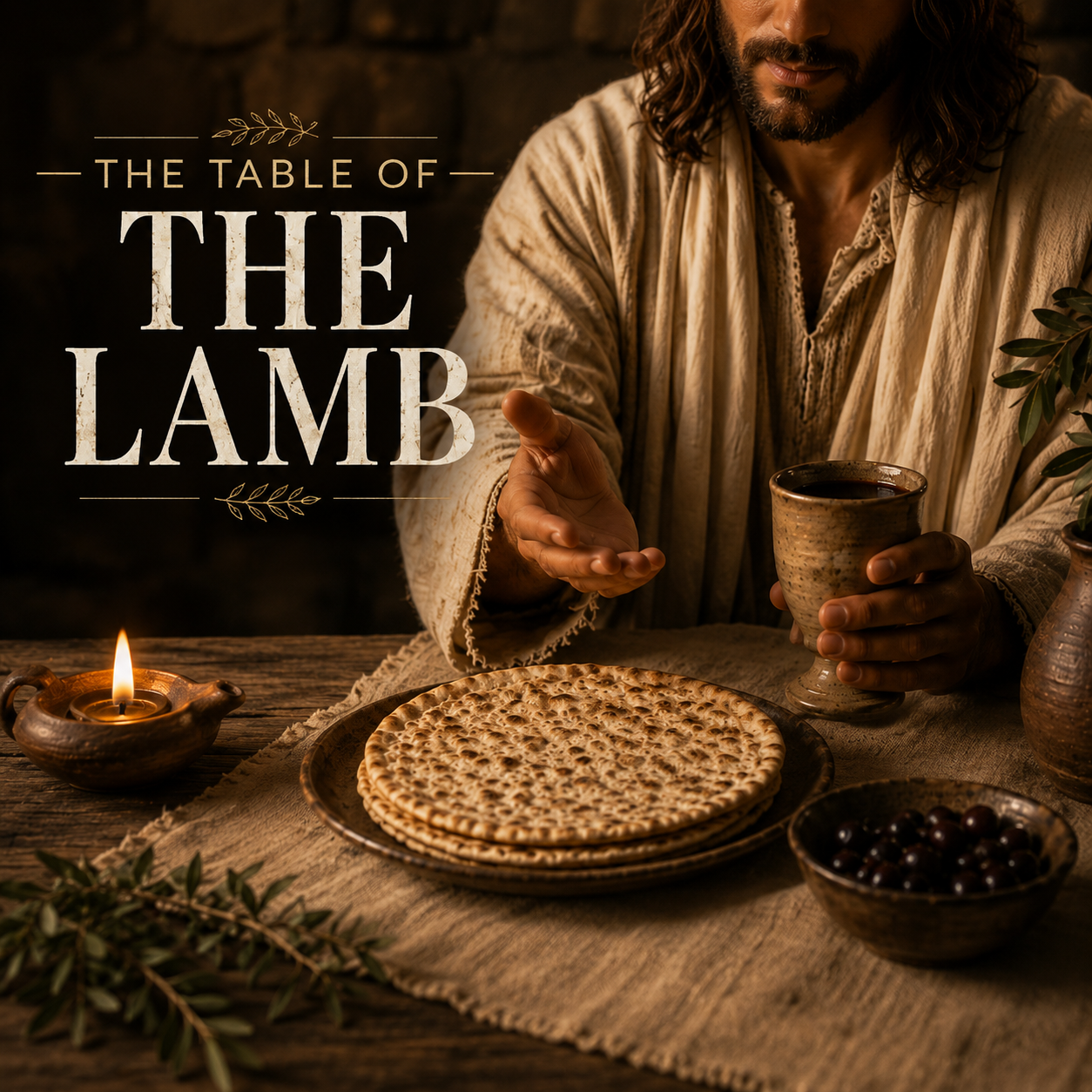
[00:04:17] Speaker A: It does not have the blood of the Hattat being applied to a sanctuary. It's at a table. It's staged at a table at Passover with bread, with wine, a meal, with remembrance, with covenantal language.
[00:04:36] Speaker B: That's what's happening. And that means we have to pay very, very close attention to what we'll
[00:04:42] Speaker A: call the sacrificial grammar that Yeshua himself gives to us.
[00:04:50] Speaker B: Before we rush on to the later
[00:04:54] Speaker A: theological interpretations and categories that have been
[00:04:58] Speaker B: back overlaid to this, let's start with his words at the table and a restatement before we do that from last week matters.
Yeshua's death matters.
Of course it matters. The question is, how does Yeshua teach us to understand that death at this table, at the table of the Lamb, the Lamb of God, what imagery does Yeshua choose? What story is he putting himself inside?
[00:05:40] Speaker A: What ritual practices is he drawing from and why?
By this point in our series, I
[00:05:48] Speaker B: really hope you know some things about the Passover lamb.
[00:05:54] Speaker A: It is not a sin offering, it is not a chatat, it is not a purification offering. If you don't remember these things, go back and listen. If you have no idea what I'm talking about, go back and listen to
[00:06:08] Speaker B: the earlier sessions in this series.
[00:06:11] Speaker A: The Passover lamb, the Pesach, is also not a Yom Kippur goat, either one of them.
The Passover lamb is tied to deliverance, redemption, protection from death, remembrance, the birth of Israel as a redeemed people, and in its later sacrificial life. After the first Passover took place, its later sacrificial life, the Pesach, the Passover sacrifice, became a memorial meal, functions as
[00:06:49] Speaker B: a memorial, a sacrificial meal that is
[00:06:51] Speaker A: eaten by people, accompanied by wine, celebrated by the story of God's great deliverance.
[00:06:58] Speaker B: This is all familiar to you, right?
[00:07:01] Speaker A: And as we've learned, all of that belongs much more naturally within the well being offering the Shel amiman than in
[00:07:12] Speaker B: the world of the sin offering the
[00:07:15] Speaker A: chatat, the shelamim, a shared meal, communion, peace, fellowship, celebration, thanksgiving, covenant, bonding.
[00:07:24] Speaker B: It is a sacrifice.
[00:07:26] Speaker A: But the focus is not on death and payment for guilt.
[00:07:33] Speaker B: The focus is on a shared meal in the presence of God.
And that matters because Yeshua is not
[00:07:42] Speaker A: taking these elements into the holy of holies.
[00:07:46] Speaker B: Here he takes the elements of the table.
I want you to remember that Passover begins the Exodus, but Sinai is the fulfilling of that, the completion. In some, you can use that word, but fulfilling is a little better.
[00:08:07] Speaker A: Passover is the beginning of Israel, Israel's liberation.
The lamb is slaughtered, the blood marks the houses, Death passes over Israel, leaves Egypt.
But that is not obviously the end of the story. The goal of the Exodus is not simply to escape from slavery, right?
The goal is covenant with God. The goal is to become God's people. The goal is presence. And that journey reaches a point of climax. Where? At Mount Sinai.
At Sinai, in Exodus 24, Moses reads the words of the covenant to the people. The people answered, all that Adonai has spoken, we will do and obey. Then Moses takes the blood. Where does he apply it?
To the people and the altar. And he says, behold the blood of the covenant which Adonai has cut with you. Behold the blood of the covenant. Now we're talking about the Lord's Supper. That phrase should really now ring in your ears.
Because when Yeshua takes the cup and says, this is my blood of the
[00:09:29] Speaker B: covenant,
[00:09:31] Speaker A: he is not reaching for anything related to Yom Kippur, sin, sacrifice or death. He's reaching for Exodus 24.
Passover begins the deliverance. Sinai seals the covenant. The lamb begins the journey. The blood of the covenant binds God and his people. And Yeshua is placing his death inside that story of covenant inauguration.
[00:10:04] Speaker B: Are you with me?
I'll make it clearer.
At the Lord's Supper, he brings these together.
[00:10:14] Speaker A: It is tempting to hear blood of the covenant or new covenant in my blood and immediately think atoning, sacrifice. But the phrase from Exodus 24 is Covenant Inauguration language.
Yeshua is not saying my death is a sin offering like a chatat. He's saying something much, much deeper and broader and more covenantal. My death, he says, will be the event through which God brings the promised deliver.
My death will be the event through which God brings forgiveness, cleansing spirit, and the renewal that the prophets promised you.
And this meal.
This meal will become the way my people remember Those things participate in those things and renew their covenant identity in me.
[00:11:28] Speaker B: Now there is a question that is certainly on people's minds, because in Matthew's
[00:11:35] Speaker A: account of this, he adds the phrase, for the forgiveness of sins, this is
[00:11:42] Speaker B: the blood of my covenant for the forgiveness of sins.
[00:11:45] Speaker A: And the question is that people would ask, doesn't that prove that this is the sin sacrifice? This is Yeshua's sin saying the sin, the chatat. Doesn't blood for forgiveness mean substitution, penal substitution, penalty paid? This is transactional language.
No, it doesn't mean that.
[00:12:16] Speaker B: It's Jeremiah language.
[00:12:19] Speaker A: It's Jeremiah 31, the very passage that Yeshua just invoked when he talks about the new covenant. And he new covenant is where God promises in Jeremiah, I will forgive their iniquity, their sin. I will remember no more.
[00:12:43] Speaker B: Matthew is pointing us to the prophetic promise of new covenant forgiveness. We will come back to this because it will change how we see John 1:29.
[00:12:56] Speaker A: So, to borrow from the scholar Jonathan, the Lord's supper becomes a sacrificialized ritual.
This is important even though suffering, blood, death are all in the background.
The table's focus is never on death as a payment. It focuses on covenant participation, the life made available through Messiah's life giving blood.
There is no altar there. There's no slaughter at the table. The disciples are not sprinkling wine on one another.
But Yeshua takes elements from the Passover meal, invests them with sacrificial meaning that would resonate with the people who were there at the table, his disciples who understand the Pesach, who understand the Passover lamb and all of its associations. And so the bread becomes body, the cup becomes blood, the meal becomes the way in which followers remember, participate, memorialize the meaning of his death and resurrection. And yes, Yeshua ritualizes his blood.
He's giving them a cup, though not a corpse.
He gives them participation. It's not the focus on the spectacle of violence which will occur tomorrow. He gives them a meal of remembrance that will carry the meaning of his death and resurrection to this day to every one of you.
[00:14:47] Speaker B: There is a strange reference at the table, and I mentioned it in John.
[00:14:53] Speaker A: Yeshua does not say, look at this wine.
[00:14:58] Speaker B: He does much more than that.
[00:15:03] Speaker A: He does not say, here is the wine. Remember it. Look upon it from a distance and remember me.
He says, drink it.
Drink. The wine is obviously symbolic, but the covenant transformation it signifies is just as
[00:15:22] Speaker B: real as the blood from Sinai.
Now to see again why Yeshua chooses this image.
[00:15:32] Speaker A: We go back to Exodus 24, when Moses reads the words of the covenant. The people respond, takes the blood of the offerings. He splits it on the altar. The people, we covered this. Both sides are marked with this blood. But the blood is doing something very important. And we've talked about it. It is bonding both sides.
Bonding both sides. The same life, substance and blood. In Exodus 24, it touches the altar, which represents God. It touches the people, which represents the other part of the covenant. They are joined, they are bound. They are made one in covenant. That's what the blood is doing there. It's not really paying for sin. It's not absorbing any kind of wrath. It's bonding the people into a single covenant.
Now we bring this to the table. He takes the cup. He hands it to the disciples. He says, this is the blood of my covenant.
24 Exodus 24. Why? He is the covenant mediator.
They are receiving the cup. The bonding is happening again, but in a deeper mode. Moses sprinkled the blood from the outside. Yeshua hands them this cup of symbolic blood and tells them to internalize. Internalize it, to put it inside. The drinking is participatory.
It's a participatory form of sprinkling.
The same covenantal function as bonding, but it's internalized.
And drink.
It's not just a casual word. He could have said, look, here's the blood. Think about this when you look at it.
He could have said, why don't dip your finger in here and put some on your forehead?
[00:17:23] Speaker B: And remember,
[00:17:26] Speaker A: he said, drink.
[00:17:31] Speaker B: It's an elevated bonding ritual inside this covenant. The drinking, it joins them.
[00:17:38] Speaker A: The drinking makes them participants in an even deeper way. The writer of Hebrews reads the Lord's Supper table the same way in Hebrews 9. He goes back to the ceremony again from Exodus 24. He says that even the first covenant was not inaugurated without blood. Covenant requires blood inauguration. Blood is life that is given over. For covenant mediation, death is the access point.
Death is necessary, but not because sacrifice glorifies death. We've learned this time and again. Death releases the lifeblood through which covenant access will be established.
Blood is the operative covenantal medium. And Hebrews insists blood inaugurates the new covenant. But it's not animal blood.
It is the blood of the Son. And that distinction is the entire reason the new Covenant can do what the Old Covenant could not do.
Animal blood could mark. It could bond. It could inaugurate the first covenant at Sinai.
It could purify the sanctuary. It could ordain priests. Animal blood could do all kinds of Things, covenantal work.
But it could not finally accomplish what the prophets promised.
It could not write the Torah on the heart. It could not give the Spirit. It could not forgive grave sin. It could not bring the new covenant that the prophets promised. Why not?
Why?
[00:19:31] Speaker B: Because animal blood is not the life of the tzaddik.
We go back to part one of this series, the Cheyn of the Righteous One. The merit of the faithful mediator.
[00:19:45] Speaker A: The standing before God that is earned through demonstrated faithfulness and binding connection to the people.
[00:19:56] Speaker B: Moses had that chain.
[00:19:57] Speaker A: The high priest had it functionally when he was worthy. But Moses died, the high priest died.
Their chain was never going to be
[00:20:08] Speaker B: able to do this.
[00:20:08] Speaker A: Yeshua's merited favor. His chain is different. His standing before God was demonstrated through his perfect life of complete faithfulness.
In Paul's language, the fullness of deity dwelt in him bodily.
[00:20:28] Speaker B: His blood.
[00:20:30] Speaker A: His blood in the language of this series, is the life of the chain
[00:20:37] Speaker B: bearing Tzaddik, through whom God and his people meet.
The new covenant required something beyond animal blood.
And remember, of course, there's no actual
[00:20:53] Speaker A: blood in the cup. Leviticus 17 prohibits that.
[00:20:57] Speaker B: It would have been very strange.
[00:21:01] Speaker A: But this is why one of the weirdest verses in the entire New Testament can now be understood.
John 6 stops sounding like Yeshua, asking everyone to become cannibals.
Amen. Amen. Amen. Amen. I tell you, unless you eat the flesh of the Son of Man and drink his blood, you do not have life in yourself. He who eats my flesh and drinks my blood. That's weird, isn't it?
I mean, people have wrestled and worried about this.
It's strange. It was strange then, it's strange now. The disciples were certainly a bit confused about it.
But after the supper, after seeing Yeshua as the Shelamim, as the Passover lamb whose meal the people share, as the Tzaddik through whom God's life is given to people. John 6 looks different. It's the same logic that Yeshua is going to give at this table.
But he gave it in advance in John 6. Now it's being realized at the table. His people are participating in his life. They receive it. They abide in him. He abides in them.
[00:22:27] Speaker B: The point is union, communion, participation in
[00:22:34] Speaker A: the life of the Son. The Lamb gives life to the people, and the people receive life.
They live by receiving that life. The cup
[00:22:47] Speaker B: was not the cup of divine rage.
The cup is the cup of covenant life.
And Paul says this exactly.
[00:23:01] Speaker A: The cup of blessing that we bless, isn't it A sharing in the blood of Messiah. The bread which we break, isn't it a sharing in the body of Messiah. The word sharing, koinonia, participation, communion, fellowship, shared life.
[00:23:22] Speaker B: Paul does not say that the cup
[00:23:27] Speaker A: reminds us that blood existed. He says the cup is the participation in the life giving blood of Messiah.
[00:23:36] Speaker B: Present tense, active, real, right now, today, still.
[00:23:42] Speaker A: That is the world of the Shel Amim.
[00:23:45] Speaker B: Which is what? The Passover.
[00:23:49] Speaker A: The worshiper shares the holy meal. The table bonds the worshiper to God and community. You know this.
[00:23:54] Speaker B: I've already said it.
[00:23:56] Speaker A: It's not just mental recollection. It means something. You're supposed to do something. Covenant participation. That's what the Lord's Supper is. It's a covenant meal. Joining God to people through the Son and joining people to one another. Listen to all that bonding
[00:24:21] Speaker B: and I'll
[00:24:21] Speaker A: bring back a phrase that we've used through this metaphysical transformation.
[00:24:30] Speaker B: It's a real change.
[00:24:33] Speaker A: It's supposed to be a real change of status and of access and of identity and relationship before God at Sinai. The blood marks Israel as covenant people. It's the ordination of Aaron and his sons. Blood is applied to them. They're marked for priestly service in the restoration of the Metzorah, the leper, the one afflicted with scale, disease. The blood is applied as part of his movement from almost dead to life.
And in each case, the blood is not communicating punishment, it's communicating life.
It's communicating access, belonging, consecration and a transformed status.
Something changes. A person who could not enter now can enter. They can re enter. A people who were slaves now become covenant people. A man who was not functioning in any kind of priestly service now becomes ordained to enter the holy space of God.
That is metaphysical transformation.
[00:25:53] Speaker B: And that is what the Lord's Supper announces over you.
[00:26:00] Speaker A: Us.
In Messiah.
[00:26:07] Speaker B: We are a new creation.
We are redeemed from death.
[00:26:11] Speaker A: We are washed with water. We are forgiven of grave sins. We receive the Spirit. The Torah will be written on our hearts. We are marked as covenant people. Every time we take the bread and the cup, we are not re crucifying Jesus.
We are remembering and participating in the covenant reality that his death and resurrection have brought to you to transform you.
And yes, it is proleptic.
It is proleptic. We taste now what will be complete then.
[00:26:52] Speaker B: We participate now in the life that will one day fill up creation wholly again.
[00:27:01] Speaker A: Now we come back to John 1:29. Because John does not only say, behold the Lamb of God. He also says, who takes away the sin of the world. And that raises this very question. If lambs do not remove sin in the sacrificial system, what is John saying?
Why is he saying that?
Because John knows that John is not confused. John knows lambs are not the animals that are used at Yom Kippur. John knows the Passover lamb is not a Hattaat, it's not a sin offering. John knows the Lamb does not function as some kind of purification offering for the sanctuary. So why does he say it?
Because John is doing what prophets do.
He's bringing multiple streams together in a power packed statement. The Lamb of God I've just spent
[00:28:01] Speaker B: this time draws us into Passover, Exodus, deliverance, the birth of a redeemed people
[00:28:06] Speaker A: who takes away the sins of the world draws us into the prophetic promise that God himself would remove sin. Exile washes people, give them a new heart, pour out a new spirit. Those are not competing ideas. What he's saying is, behold the Lamb of God. Where these ideas converge in Yeshua speaking from within the stream, in the prophetic stream. He does not say that Yeshua forgives or merely forgives, I should say, individual
[00:28:51] Speaker B: sinners, though he certainly does that.
[00:28:53] Speaker A: He says that Yeshua takes away the sin of the world, the whole corruption, rebellion, exile and the death that has marked creation and humanity. Yeshua is the lame because he brings the new Exodus. Yeshua takes away the sin of the world because through him God can do what only God can.
Forgive grave sin, cleanse moral impurity, defeat death, give the Spirit, renew the covenant from the inside out. This is why we have to be careful with the takes away sin thing. Because many people hear John 1:29 and they immediately, immediately go to John saying, behold the Lamb of God, the sacrificial victim whose blood substitutes for your punishment.
[00:29:53] Speaker B: But that's not how blood works in the Torah.
Blood doesn't substitute for sins.
Blood does not function as a moral detergent to scrub rebellion out of the human heart.
Blood purges sacred space. Blood consecrates, blood marks status. Blood carries life.
[00:30:15] Speaker A: But we have said this, and I'm
[00:30:17] Speaker B: going to say it again so you hear it.
[00:30:19] Speaker A: Grave sin, deliberate rebellion. The kind of sin that defiles the land and brings exile and the land vomits out its people. It requires something beyond the ordinary sacrificial remedies.
It requires God to act.
It requires God to forgive, to cleanse, to give a new heart. It requires God to pour out the Spirit. That is what the prophets promised. Ezekiel 36, Jeremiah 31.
[00:30:56] Speaker B: This is the hope.
And John says, behold, the hope has arrived in Yeshua, Peter's words in Acts 2.
[00:31:11] Speaker A: He stands up in Jerusalem, the temple standing, sacrifices still being offered. Peter is not set apart, set against any of that. He's announcing Yeshua's death and what his resurrection has accomplished. And the people say, brother, fellow brethren, they're cut to the heart. The text says, what shall we do? And Peter does not say, go, offer a sacrifice, do something with blood. What does he say?
Repent.
And let each of you be immersed in the name of the Messiah, Yeshua,
[00:31:48] Speaker B: for the removal of your sins.
Water, Washington.
[00:31:54] Speaker A: And you will receive the gift of
[00:31:56] Speaker B: the ruach Hakodesh, that is Ezekiel language.
The washing, the forgiveness, the spirit. That is the promised cleansing. You remember, washed by water, taking away sin. In this sense, that's God's prerogative. So let me be very clear and say.
[00:32:16] Speaker A: I am not saying that Yeshua's death
[00:32:20] Speaker B: is unrelated to atonement.
What I am saying is that atonement is bigger than punishment transfer.
In the biblical world, atonement includes cleansing, consecration, covenant, restoration, access, and the defeat of forces that keep humanity enslaved. Yeshua's blood matters because Yeshua's life matters.
[00:32:49] Speaker A: His death matters because his faithful life
[00:32:53] Speaker B: is carried into death and vindicated in resurrection.
[00:32:58] Speaker A: His resurrection matters because it opens the way to the Spirit. This is how the Lamb takes away
[00:33:07] Speaker B: the sins of the world.
You should be happy right now.
That's good news.
So what are we doing when we come to the table?
We are remembering the Lamb.
We are receiving the life of Messiah. We are renewing covenant loyalty. We are participating in his blood.
We are tasting the new creation in advance.
We are being reminded of our metaphysical transformation. Think of all that.
Now, I want to say this part very carefully.
Because many of us were trained to come to the table primarily through guilt.
My sins nailed him there.
My punishment fell on him.
[00:34:16] Speaker A: It should have been me.
Those are my nails. He had my face before his eyes when he suffered.
[00:34:28] Speaker B: I understand why people say this, and I do not in any way question the love of Yeshua. Behind that, people are trying to express gratitude. They're trying to say he loved.
He gave himself for me. He rescued me. Yes, but the table is bigger than guilt.
The table is life and covenant and participation and transformation.
[00:35:00] Speaker A: And when I take the cup, I
[00:35:04] Speaker B: don't need to imagine God's wrath being poured into.
Into Yeshua instead of me.
I need to remember that Yeshua carried God's life into the heart of death, and death could not hold him.
The life in his blood was stronger than the forces of death. I receive that life, I abide in him.
[00:35:40] Speaker A: I become the kind of person who
[00:35:42] Speaker B: looks like the one whose life I'm taking into myself.
That's what the table's supposed to do.
It's not supposed to push you down into self condemnation.
It's supposed to say, you have been redeemed, you have been washed, you have
[00:36:03] Speaker A: been forgiven, you have received the Spirit, you belong to the land, now live from his life.
[00:36:11] Speaker B: There's a quote in the Lamb of the Free.
It's a paraphrase of what Yeshua is saying to the disciples at the table.
And Rillera puts this in Yeshua's voice. It's an interpretive expansion. I want you to imagine that you are there at the table.
You are his disciple.
He's speaking to you at this, the table of the Lamb.
And he says, I want you to understand.
My murder, rather than being just yet another innocent murder of a prophet, will turn out to be the event that delivers Israel and thus the world from the covenant curses of exile.
My murder is for the sake of that promised moral purification, the forgiveness of grave sins, including the very murder that
[00:37:14] Speaker A: they will commit tomorrow.
[00:37:19] Speaker B: This is why we're going to celebrate this event.
We're going to relate it to thanksgiving and well being, sacrifices. I am inaugurating and sealing the new covenant.
[00:37:31] Speaker A: And this is what the prophets have
[00:37:33] Speaker B: promised you, the forgiveness of sins, the washing of water, and the fullness of the Spirit.
This is for you.
And that changes how we come to the Lord's Supper. Because we're not coming to relive a transaction inside the heart of God. We're coming to the table of the Lamb, to the Passover, the new Exodus, to the blood of the covenant. We're coming to the meal where Yeshua gives his life to his people. And yes, Yeshua suffered.
We're not avoiding that.
[00:38:13] Speaker A: We're not softening the cross. We're not pretending that his death was only symbolic or inspirational or some tragic misunderstanding. He suffered.
The righteous one was rejected. The servant bore the weight of Israel's sins. The Messiah entered the place where sin, death, violence, exile, corruption, they had all done their worst. But the suffering is not the mechanism that makes God forgiving.
Suffering is what happens when perfect faithfulness is walking in a world ruled by sin and death.
So next week we go to suffer
[00:38:58] Speaker B: in Isaiah 53, and the suffering servant,
[00:39:03] Speaker A: we go to the wounds, the grief, the healing, the bearing. But after today, I want us to come into that text with wider open, clearer, bigger eyes, clearer vision.
[00:39:17] Speaker B: The story is not we're not minimizing sacrifice.
[00:39:22] Speaker A: It's not smaller, it's bigger. Yeshua's death is central to taking away sins, but it's central as part of the whole all covenant event. His faithful life, his murdered innocence, his covenant blood resurrection gift of the Spirit that is so much bigger than punishment transfer theory.
[00:39:50] Speaker B: It is Passover.
It is covenant. It is life in blood. It is the Lamb at the table. It is the Son giving life to people so that his life becomes ours.
[00:40:02] Speaker A: He goes ahead not instead.
[00:40:06] Speaker B: And as we'll see, he expects you to participate in that and that we too would pick up our cross even in suffering.
Stay with me.
[00:40:27] Speaker C: Shabbat Shalom I'm Darren with Shalom Macon. If you enjoyed this teaching, I want to ask you to take the next step.
Start by making sure you subscribe to our channel. Next, make sure you hit the like button on this video so that others know it's worth their time to watch.
Last head over to our website to learn more about Shalom Macon, explore other teachings and events, and if you're so inclined, contribute to the work that we're doing to further the Kingdom. Thanks for watching and connecting with Shalom Macon.