Episode Transcript
[00:00:05] Speaker A: Who in this room went to Malchut?
Okay, you've heard this message already.
Some version of it anyway. Some version of it.
Some of you heard a version of this previously at Shalom Makin, prior to Malchut. Different context, similar content. And I'll be honest with you, I very, very rarely revisit something.
I debated whether to do it or not. I don't like to repeat myself. I think you deserve fresh teaching all the time.
But something happened this week, just recently actually, that made it clear that this message isn't just helpful, it's actually necessary.
This is something that was posted by this week on Facebook by a guy named Robert Solberg. He runs a podcast, an apologetics platform called the Biblical Roots. He has a relatively sizable audience.
Pastors listen to him. Church leaders listen to him. His content shapes how a lot of Christians think.
And here is how he describes his recent mission in his words.
He and his organization are working to identify, map and help churches seek out and find Torah observant movements that he believes are undermining the Gospel.
I want you to let that sink in.
At the top of the list is First Fruits of Zion.
He previously posted his dire warning to all churches, stay away from the ministry of First Fruits of Zion. It's dangerous.
Dangerous in his view, because they teach Torah as the foundation of the Bible.
He wouldn't say it that way.
Because they present Jesus as a Torah observant rabbi who encouraged his disciples to live accordingly.
And because they encourage believers in God to continue to model their lives after the Torah's instruction for righteous living.
Can you get more dangerous than that?
He doesn't think so.
Now, beyond the historical echoes here, beyond the very, very, very uncomfortable parallels, we could draw to other moments where religious authorities or governmental authorities decided what people were allowed to believe about God and went looking for those who believe differently to mark them, flag them, segregate them, silence them.
Beyond that, there's a deeper issue being exposed here. And it's bigger than First Fruits of Zion because it also touches Shalom Makin, it touches Messianic Judaism. And it touches you because I'm afraid you've been misled. And I'm sorry, because early in my career I was a part of this. Misleading. I probably said it to you. I apologize. Many of you have heard this, some of you believed it, some of you still do. And it is that this idea, these words, gesher in Hebrew, kesher in Hebrew, there's an idea in Messianic Judaism. It's an old phrase usually offered with kind of A romantic reverence, because you can say things in Hebrew and they just sound better.
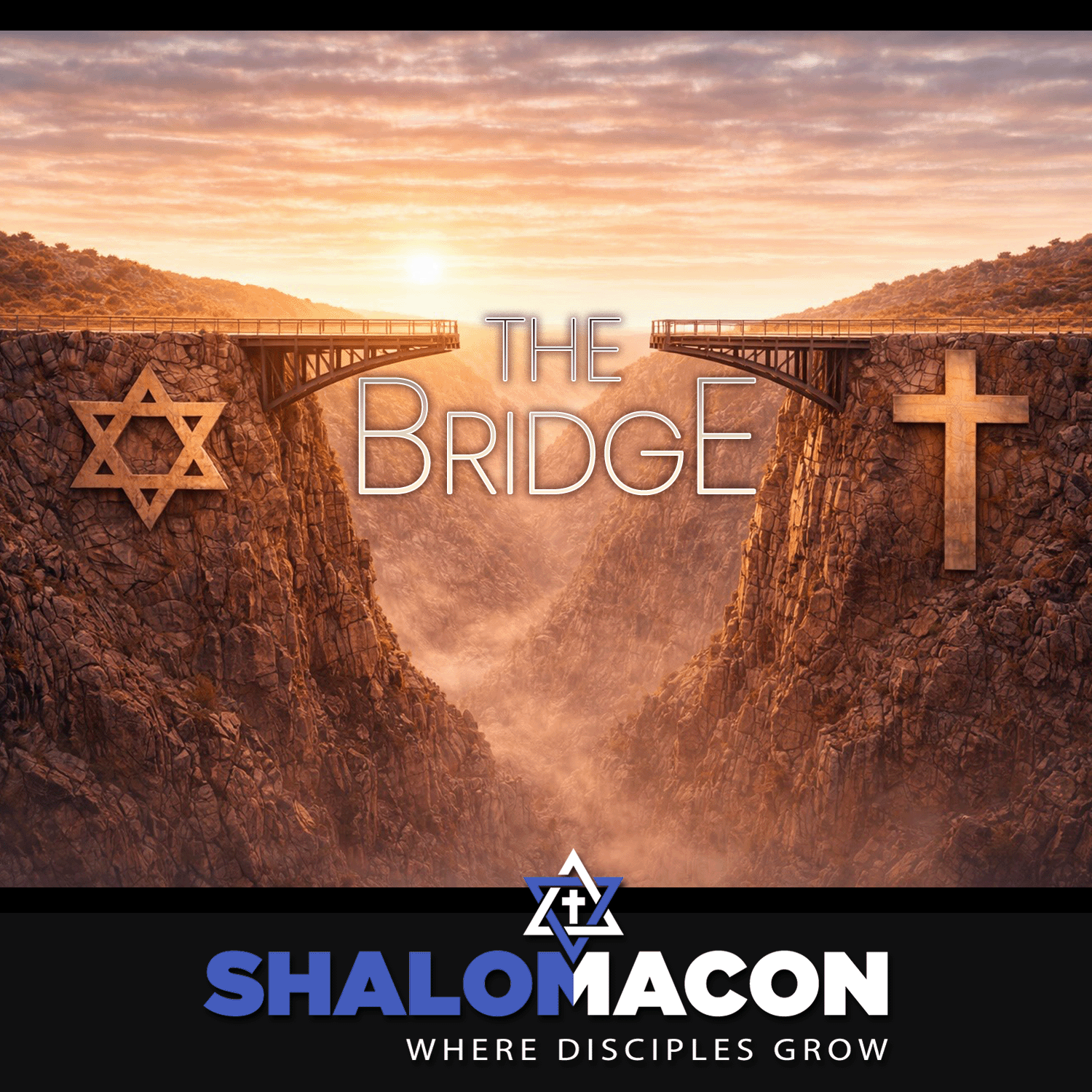
Messianic Judaism is a geshur. It's a bridge.
Messianic Judaism is a kesher. It's a connection.
The idea is about building a bridge between Judaism and Christianity, connecting the ancient wisdom to modern faith. And we're gonna bridge the gap between the beauty of Jewish tradition and the revelation of Yeshua. We're gonna help people understand how they really should worship. We're gonna take them back to the first century and all that good stuff that's meant to inspire you, to help you feel that if you're a part of this thing, you're part of something grand, something historic, and that you're standing in the middle divide and bringing two worlds together in perfect harmony.
But that's not right.
And I know that sounds negative. There is.
There is a geshur, a bridge. There absolutely is a connection.
Just not that one.
Because this is the problem. And we need to be honest, neither side of that bridge is lining up to cross it.
Judaism, institutionally, organizationally, a religious structure, is not waiting at the edge of the gorge. They're not hoping that we'll connect them to Christianity.
They don't see a gap that needs crossing. Jews don't see Christianity as the fulfillment of anything that needs fulfilling. If anything, they see the bridge as unnecessary and worse, unsafe.
That is dangerous in their eyes to their children, to the traditions, to the distinct identity. Christianity, Christianity and Messianic Judaism. Well, Christianity likes the idea of Jewish roots.
Maybe we'll play a shofar. We'll have the guy who plays three shofars at once come in and play the Star Spangled Banner or something. Or maybe the pastor will teach from something Hebrew, because, like I said, you can say anything in Hebrew and you can draw whatever meaning out of it you want. Maybe we'll put a mezuzah in the church lobby or something that really connects us to the ancient faith. But to reconnect to Judaism on Judaism's terms, to accept the accountability of the Torah's instruction, to embrace the ongoing validity of the Torah, to embrace God's biblical calendar, the covenantal framework.
No, not that.
Not interested in that. Jewish roots, okay, that's fine.
But not Jewish restraint.
Not going under the law.
And my introduction today regarding Robert Solberg is a clear illustration of that.
So if Messianic Judaism is the bridge, which is what we've been told, then, frankly, both sides have looked at that bridge with confusion at least, or suspicion. And now, based on a post like That a broader part of the world is looking at it with disdain and negative intention.
Intention to destroy, actually.
Brothers in Christ.
We've been told, though, that's our mission.
That's our mission, you know, our identity. Gesher V' kesher Bridge and connection through Messianic Judaism. But here's the truth.
Ideas inspire. They may inspire, but they don't build bridges.
People do that.
Leaders do that.
And more than ever, there is a bridge that must be built. I want to tell you what it is, what it means, how it impacts you, how important it is to you, because it's your job.
And I'm not going to sugarcoat it. It is a hard job. I'll tell you what it takes to build an actual bridge by example.
The golden gate Bridge took four years to construct 80,000 miles of steel cable, 400,000 almost cubic yards of concrete.
Eleven men never went home to their families building it because you can make the connection. It was dangerous.
But before any of the stuff, before the cables, before the concrete, before anything really, like, reached up to the sky, they went way down.
Why?
Because they had to sink foundations 100ft below the surface of the water in San Francisco Bay in very dangerous currents. They had to hold back hundreds of thousands of gallons of water, millions of gallons of water, to get down there, to dig deeper, to reach the bedrock. Because every engineer knows you must have a solid foundation upon which to build anything that can bear real weight. The foundation determines everything.
And the foundations here were built in the dark, underwater, unseen.
And when it was finished, everyone looked at the bridge and they said, oh, wow, that's beautiful. It's a work of art. The graceful curve.
But before, it was beautiful. It was a brutal task.
Before anyone could cross it, people had to descend into the depths. And you can't build bridges from the shoreline. You gotta get into the mix. You have to go down into the gap. And that's where the work happens.
Down there is where bridges build the foundation.
So it's hard work, dangerous work, costly work. And I told you that for a reason. Because while messianic Judaism as an idea, as an institution, may not be, if you have picked up my point by now, may not be the bridge and connection between Christianity and Judaism. There is a bridge, and you're building it.
And just like the story of the Golden Gate Bridge and how they had to go down and build foundations, I want to show you how. I think that represents your journey, whether you've been on it, on it, or completed it.
We're gonna revisit a Familiar slide. Now, you're familiar with this curve because I talked about it in a previous message at Shalom Makin about the life journey curve, right? Going through life's business and personal things. This graphic representation of what anyone who faces a difficulty is really going to face toward real growth and real challenge and emotionally and spiritually. It's very accurate. But I updated a version for our purpose as Messianic believers as well, and it works really well.
Many of you first encountered Messianic Judaism because something was missing.
This is the tagline. This is what I hear from so many people over hundreds of Torah club interviews and thousands of conversations. I'm here because I read my Bible and something was missing.
You were standing on the side of the valley of something's missing.
You could see across that valley. And on the other side you saw something that made sense, something that felt true, something you had been looking for without even knowing knowing it. Someone may have handed you a book. Someone may have mentioned Shabbat. Someone may have pointed to a teaching from the Torah, some Jewish interpretation. Someone may have even just said, did you know Jesus was Jewish?
It can start that simply.
And you started looking and you found questions and you found answers and you thought, oh, this is it.
This is what's been missing. And you looked across the valley of something's missing and you could see answers. And you'll remember from our previous discussion, you had a case, though, of what the curve calls uninformed optimism.
The first phase. You got excited, buddy, didn't you?
Interested. You started reading. You started asking questions. You look, you understood more. The excitement grew. It wasn't a nice idea. It was becoming truth. It made sense. This was biblical. And you thought, perfect, I have found the answer. I will step across this valley to the other side of fulfillment.
Negative.
No, you go down.
Where do we go?
It doesn't work that way. We go to informed pessimism. And suddenly you heard something that challenged your theology.
Someone gave you a different interpretation of Galatians.
Someone told you that Paul was actually a Pharisee and a Torah keeping Jew.
Someone reminded you, though loudly, insistently, that Jesus died so you wouldn't put yourself under the law, that the Torah, that grace means freedom from the Torah, not to go and try to live it out.
Or your family started asking questions, why are you doing this? Do you not believe in Jesus anymore? Are you becoming Jewish now? What?
Or a church you had attended made it clear that maybe you weren't as welcome there. Your pastor called, Called.
I'm concerned. He said they Stopped inviting you to certain functions because you're weird about food now.
And what's the deal with this Saturday thing? Why are you so weird about that? If you're Jewish and you came to Messianic Judaism, it's a whole different set of issues, but the trajectory is the same.
You run into this curve, and at some point you thought, wait a minute, I may have made a mistake.
Maybe I should go back.
You're hearing all this.
It's informing your pessimism, and you're saying, wait, am I? But you didn't. You kept going. You pressed on something, said, keep going. And that's when you found yourself in this wonderful favorite place. The ultimate title for any encouraging message. Where did you find yourself?
The Valley of Despair.
I've already used it as a message title, so I couldn't do it again in that place. You said, oh, my goodness, what have I done?
I had no idea this was going to be difficult. I had no idea this would cost me something. I had no idea there could be loneliness associated with this myth. Friends don't understand me. My family doesn't. I'm not at that church anymore. I can't go to a synagogue. I try to share this with people. They don't want to hear it. They think I'm misled, legalistic, confused, deceived, possessed.
I'm losing relationships, community. And I'm losing, most certainly, my certainty.
Maybe I was wrong.
Maybe this doesn't work. And this is the point, my friends. Most people, even though we're down, this is the place.
Pull the rip cord, I'm out.
And you might hear people say, you know what?
It's not me.
Those people, crazy, theologically misguided.
Their way of thinking is wrong. It's a mistake. The people are wrong. Teaching is wrong. I was deceived. Thank God. He opened my eyes to the truth. Now you know what they do?
They go find something else.
The next path, some other teacher, some other system that promises an answer. And you know why they do that? I told you this before with the other things, but it takes them right back up the hill to the uninformed optimism place. They climb out of the valley into the dream world where they can say, oh, yeah, this new thing that I found is the right thing. And believe me, man, I've seen it happen with people.
Now.
Now, I thought it was that, but that stuff was whack messianic Judaism. Now I found the real answer, and they reset the curve and they get to feel the excitement again, and they're onto a New spiritual journey and the sense of discovery. But they didn't grow an inch.
They didn't build anything. They just found a new valley to eventually quit in.
But you didn't do that.
You stayed in the valley.
You did the work. You wrestled. You wrestled with scripture, with tradition, with interpretation, with your own doubts, your own fears. And you pressed through, and thank God you did, because they. Then you get to the next phase and you begin the elevation, and it's this wonderful place of informed optimism where things begin to shift. You're not that interested in what people think about you. You're not trying to convince anyone of anything because you don't need them to validate their choices. You're learning, you're growing, you're building. And then it happened. You crested, you came through. Up out of the valley of something's missing. And there it was. Was. You arrived on the other side. A deeper relationship with God, a better understanding of the Bible, a connection to Jesus that you did not have before.
You could see, you could breathe, and you knew, man, my spirit is at rest.
It feels right.
You found God and Messiah in a way that invigorated your soul. Now, here's my question. Has anyone in here ever been through that journey?
Of course. You have been through that journey because you're here. Almost everyone hearing this message has been through it to some degree, and you've committed. Everyone would likely prefer in their journey to just jump across.
Everyone wants to go from informed optimism to fulfillment. You can't do that. Can't you just give me the answers? I wanna skip all that. No, it doesn't work like that. You know why? There is no bridge yet.
There is not a bridge yet.
You can't escape it. We talked about it with our emotional elevations. You gotta go through the process.
Leaders, pioneers, builders, they know this.
They either knew it or they learned it along the way. And this is what leaders do. They press on. They face opposition. They descend into uncertainty. They fight through doubt. They go through the valley. But here's the thing, and it's most important, that while you were down there, at every stop along the way, you were were building something. A bridge. You say, no, not yet.
You were constructing pillars.
You were sinking supports into the bedrock of your belief.
Every Shabbat that you observed alone, festivals that you celebrated when everyone thought you were weird, when you chose to uphold Israel, defend the Jewish people, explain the Torah when the cost was something real, those were the times you couldn't see it. But you were building. Down there in the Valley of Despair, and pessimism and all of these things. It was from there, from that depth, from the pressure, from the difficulty that you learn to build the pillars that can support the weight. And when you came to the other side of the valley and breathed and turned around and looked back, you could see what you built. And it was another level of clarity.
And you could say, thank God.
But now, now you can build the bridge, the bridge over the valley of something's missing. Because you did the work in the valley to build the pillars. You are not going to build a bridge between Judaism and Christianity.
You're not going to build a bridge between institutions and movements or theological systems that don't even actually want to be connected.
I know it's hard to hear it, and many would disagree with me, but you're building a bridge between where people like you are and where they want to be.
A way to help the person who is standing where you once stood, looking across the valley.
You can now walk back across your bridge, not down into the valley. I've done that work and I will come over here and I will meet this person here. Not so that I can take their hand and across the bridge, because it does not work that way. They still have to go through it. It is their foundation. But what happens as they descend? You're walking beside them from above, looking down, brother, I'm with you, sister. I know where you are. I know what it feels like. I'm here. I'm with you. And you're encouraged, encouraging, and you're bringing them along through the valley and you're giving them strength to persist the way that you did.
That's your bridge.
You are the bridge.
And you know what you do then, after they go down and they come up and you, you're waiting there and you meet them and you celebrating them. You know what you do next?
You go back across the bridge and there's another person there. And I'm not going to lie to you and tell you that there will be thousands of people waiting on either side of the bridge. But there's going to be some, and they're going to be waving and they're going to be looking across that valley if something's missing. And they're going to be looking for someone who will guide them and take them and you walk back across and you do it again and you guide them and you walk with them and you encourage them and you bring them to the other side.
They need a guide, someone who's been through the valley.
That's you.
I want to Help you be the guide. First fruits of Zion that labors to help you be the guide.
Darren Hucky creating weekly video content. Darren and Lance and Olivia Rogers creating Shmuley socks weekly content.
Everything that we're doing, all of us, is to empower you to be the bridge building guide that the world needs.
You are the bridge.
But you see, that's what makes you dangerous. Apparently, according to Robert Solberg and his ilk, who want to warn churches and pastors, you'll cause people to question things they've been taught. You'll cause them to think outside a very small box. You'll cause them to think. And because you've been there before, you may provide answers that open doors for them. You may connect people to God in a meaningful way throughout their journey that changes their lives and allows them to impact the world in a way that they never would have before. You may cause them to see Yeshua in a new amazing light and step into a new, new level of faith as they walk out their belief. Oh, the horror.
But there's a secondary component of your bridge.
As you've walked, as you've built, as you've learned to hold both of these worlds in tension with confidence, you as a bridge, serve as this sounds like I'm negating what I said, but you do serve in some way as a connector, as among the people I mentioned at the beginning. Jews and Christians who actually have no interest in going into the Valley of Despair, they're not actually on the journey. They don't even see that something's missing. They're not looking for that. But you know what? They still need a guide in this day and age. They need a guide in this moment when antisemitism is skyrocketing, when misunderstanding is widening, when hatred is getting louder, when Christians are wanting to map out and flag communities like ours because of what we teach, someone has got to speak up the truth. When religious leaders are searching out Torah keepers to tag them, you can carry correction on your bridge. You can carry reconciliation, as I said, not between institutions, but between people who desperately need to understand each other people.
You become a voice that can correct harmful theology. You can go into the church and say, no, that's not what the, the Torah even means.
That's not what we say. That's not what Jews believe. Let me show you. And you have credibility because you built the foundations and the bridge. And you can go into a synagogue or Jewish friends and you can say, no, not all Christians believe that.
They're not trying to convert or erase Your identity. Let me show you the difference. And they might listen to you, because you built the pillars and a bridge, and you have credibility.
That is not a small thing. That's a part of your mission as a bridge, as a kesher and a gesher, which, of course, brings to mind I can't ever get away from this axiom as hard as I try.
Every descent is for the sake of a future.
In those valleys, you people who refuse to quit build the foundations. You ascend, structural things built, and the descent was for the future ascent of you, but also for them.
Because the thing is, everyone who you help through will also become a builder of their own bridge.
And they will help. That takes boldness. It takes chutzpah. It takes perseverance. Rabbi Nachman of Breslov said, the whole world is a narrow bridge.
The main thing is to have no fear at all. Your bridge is not fragile. Sometimes it feels like one of those scary rope bridges across the huge chasms, swinging in the wind. You know, you've seen these. They're like, sometimes it feels like that. I know leadership tests, people test, but it's not fragile. It just requires focus. It's built on bedrock. It's not one of those swinging rope bridges. You've paid too high a price to build what you've built.
The essence, he says, is not to fear Facebook posts and zealous protectors of religious orthodoxy. Whatever it is, we have no fear. I'm reminded of Acts where Gamaliel says, you know what? You might find that you're fighting against God himself. When they're talking about trying to take Yeshua out, you remember that section.
I pray that this guy comes to his senses and everyone like him and realizes the truth. But that's not my task.
They are not my task. You are my task.
I'm helping you be bridge builders. Now, at Shalom Macon, we have a saying, Builders, not bystanders.
It's not just about raising money to build things.
I hope it means that we're actively involved, not just in theological discussions or sharing our beliefs, not in convincing, but actually connecting people to beautiful, beautiful ways of living for God. We're called to be builders.
So have you built a bridge?
I'm certain if you've been through the valley, you have the pillars. But have you built a bridge? Are you willing to build one?
That's important.
Maybe you're newer to this. Listen, if you've been at this for a while and you're on the other side and you're enjoying the scenery, but you haven't built a bridge. Your mission is not complete.
You have work to do. Maybe you're new in all this and you know, not anyone in here really that maybe Alicia, but not new.
Maybe out there, new people are tuning in.
Maybe you're in the curve in the valley, in the place of informed pessimism or the valley of Despair. Great, excellent. Celebrate it.
Celebrate what you're building down there.
Laying foundations, building pillars. Keep going. The journey is incredible.
Incredible.
Every dissent is for the sake of a future ascent.
Your dissent to those folks is building something. You can't see it, but you got to trust that process. So listen, I'll bring this home. You've been misled.
It's not malicious, it's just inaccurate.
The error that Messianic Judaism is a bridge between institutions, between Judaism and Christianity.
The truth.
Messianic Judaism is a people.
And interestingly, that people is comprised of Jews and the nations.
A people on a journey together, building things, foundations in the dark, raising things up, not quitting. And those people are you.
You are the bridge between people, where they are, where they could be. And those people will be Christians, they will be Jews.
God only knows who else. You, as a guide, will guide through the valley.
You have built something with your journey, something strong and permanent. The columns are there. The foundations are solid. And your mission is now to use it. And I believe that God has given us that mission. It's not for the masses. That's obvious.
You know, very rarely do we have to bring new chairs into the sanctuary for our weekly Shabbat celebrations. This isn't for the masses.
It's okay. It's special, actually. It's unique. Now you know what it feels like to be the chosen ones.
The misunderstandings that cause people to want to map out areas where Torah observant Christian movements are influencing or disrupting mainstream Christian congregations and families. Listen to that wording. Now, that may be happening among radical Hebrew roots. Super weird things. But on the whole, have you ever, ever once thought about disrupting mainstream Christian congregations and families?
Is that something you wake up saying, I'm a messianic believer coming to you church, I'm going to take you out and destroy the whole thing. And probably beat the crap out of the pastor in the alley just for fun.
It's ridiculous. It's ridiculous and it needs to be called out.
And that's what we're doing here.
That's not our concern, though.
Our mission is to walk back and forth across the bridge we've constructed to find the one standing, looking with that spark of informed optimism in their eye and say, Come, brother, I'll show you the way.
It's down there.
I'll be with you and I'll meet you over there.
That's a mission.
It's a good mission.
And you are the bridge.
So may God inspire you to build well, to walk boldly, to guide faithfully. May the bridges you build inspire others to build bridges that will carry generations. And may you never forget that every descent you've experienced is for the sake of a future ascent, both yours and theirs.
[00:36:06] Speaker B: Shabbat Shalom I'm Darren with Shalom Macon. If you enjoyed this teaching, I want to ask you to take the next step. Start by making sure you subscribe to our channel Next. Make sure you hit the like button on this video so that others know it's worth their time to watch.
Last, head over to our website to learn more about Shalom Macon, explore other teachings and events, and if you're so inclined, contribute to the work that we're doing to further the kingdom. Thanks for watching and connecting with Shalom Macon.