Episode Transcript
[00:00:00] Speaker A: In Exodus 25, he says there,
[00:00:04] Speaker B: I
[00:00:05] Speaker A: will meet with you,
[00:00:08] Speaker B: and I will speak with you from above the kipporet,
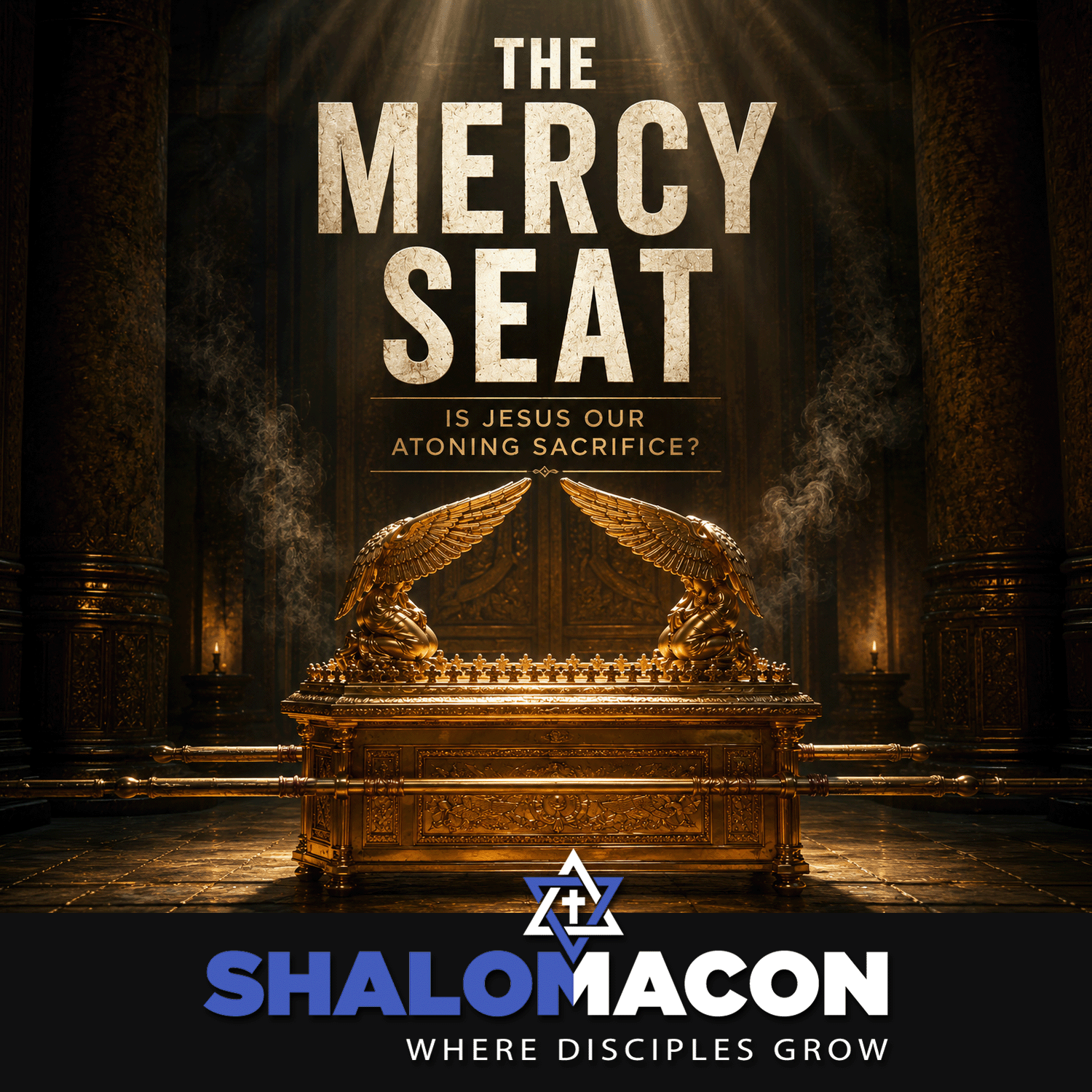
[00:00:11] Speaker A: from between the two cherubim. This is the mercy seat.
There.
[00:00:19] Speaker B: That is an address.
That is a location of all the square footage in God's creation.
That location. He pins his presence to that one spot, this mercy seat, where heaven and earth come together.
[00:00:38] Speaker A: It's a meeting point. Now, we're going to tuck this away for just a second.
[00:00:43] Speaker B: We met the importance of the meeting
[00:00:46] Speaker A: place in our series in Isaiah 53. So hold on to this for one second. For me, it's going to come up again. But for now, the mercy seat is a meeting place. The helasterion is a meeting place.
[00:01:00] Speaker B: Now, notice what does not happen at the mercy seat.
[00:01:05] Speaker A: Nothing is killed on the mercy seat.
[00:01:07] Speaker B: The mercy seat is not an altar. The altar is outside in the courtyard
[00:01:13] Speaker A: where the animals are slaughtered in the temple.
[00:01:15] Speaker B: The mercy seat is sitting deep in there, past the veil.
Once a year, day of atonement, the high priest, the Cohen Gadol, carries in blood that was shed somewhere else. He brings it into the room and he puts it on the mercy seat. Now, Paul's sentence, whom God set forth as a helasterian by his blood, a mercy seat, the place, the blood that is carried to this place. Paul is not pointing to the altar where the victim dies. He's pointing past the veil to the room where the blood arrives and where God meets his people. So when someone hears by his blood and says, see, it's a sacrifice, a death to satisfy God. That is the backwards geography.
The blood on the mercy seat was never punishment.
The blood brought inside is doing something else. It cleanses, it covers, it carries life into the presence of God. So the meeting can happen at all. The mercy seat has nothing to do with death.
[00:02:42] Speaker A: Okay, so I knew this was coming, of course.
Well, I figured it was coming. We made our case. We made this whole series on atonement, on Jesus, blood, sacrifice, all of it. And so now, without a doubt, every question is answered, right?
Not quite. And I knew I would have to answer a little bit of criticism.
But you know what? I use that word lightly because the series generally has been very well received. But this is the first of what I'll call two bonus sessions. Epilogue. Epilogue, part one. And they exist for this one reason, because here's what's going to happen.
You leave this series, you have some insight, some excitement you challenged, maybe even some relief that the story of atonement is different and hopefully bigger than what you might have inherited.
[00:03:51] Speaker B: But then at some point you share
[00:03:54] Speaker A: that with someone, you try to communicate. You say some of this out loud to another believer and within about five seconds they're going to open their Bible and point to verse after verse. But at the top of that list, I think is probably Romans 3, 3, 25.
So there are a handful of verses that people treat this way.
Someone opens up the Bible and says, heresy.
[00:04:21] Speaker B: It's right here. It's right here.
This is the one that says everything
[00:04:28] Speaker A: is wrong about what you believe. Now this is one verse we're gonna tackle this week. Next week we'll tackle the entire book. That gets used the same way in one 30 minute epilogue.
You won't believe it, but it can be done.
[00:04:43] Speaker B: Today I'm giving you Romans 3:25.
[00:04:46] Speaker A: And there's a reason. You'll see, even with translations that I usually trust, there are some confusions.
We look at Romans 3, 24, 25. It says they are now justified by his grace as a gift through the redemption that is in Christ Jesus, 25,
[00:05:05] Speaker B: whom God put forward as a sacrifice of.
[00:05:09] Speaker A: Of atonement by his blood, effective through faith.
[00:05:14] Speaker B: If you set out to prove that
[00:05:16] Speaker A: Jesus died as a sacrifice to satisfy the anger of God, Romans 3. 25 is certainly a good one to reach for the smoking gun, if you will.
So let's look at it. And let's start with a problem, because here in Romans 3:25, it's the same Greek. Whichever Bible you're looking at in this room, however many Bibles, you can probably find a different translation in each one.
[00:05:45] Speaker B: The NIV presents this as presented Christ
[00:05:49] Speaker A: as a sacrifice of atonement. The new living translation says a sacrifice for sin.
[00:05:57] Speaker B: The King James.
[00:05:58] Speaker A: Right.
I've told you about the big cross, the back of the truck windshield, bumper sticker that I once saw that said,
[00:06:05] Speaker B: if it ain't King James, it ain't Bible.
What does the King James says, whom God has set forth to be a propitiation through faith? Who knows what a propitiation is?
It's a pretty fundamental idea in Christian
[00:06:28] Speaker A: thought that he was put forth as a propitiation.
[00:06:30] Speaker B: What does that mean? It's familiar. It means appeasement.
It means an offering made to turn away the anger of a God.
If that is the right word, then Jesus is the thing offered up. In King Jimmy's translation, he is the victim and God is the one being calmed down. And that propitiation thing is not just
[00:06:55] Speaker A: in the King James, it's in a lot of others.
[00:06:57] Speaker B: And it is absolutely why this verse becomes the. The antidote, they would say, to all
[00:07:05] Speaker A: the false teaching you received for the last 11 weeks.
[00:07:08] Speaker B: Now, is that true?
[00:07:12] Speaker A: There's a Greek word in there, and the various translations are importing a lot of different meaning into it. The Greek word underneath all of that,
[00:07:22] Speaker B: you can say it with me, is helasterion.
Helasterion.
[00:07:29] Speaker A: Okay.
[00:07:30] Speaker B: Helasterian.
And those translations diverge so widely because
[00:07:39] Speaker A: that one word is hard.
Most of them make the same mistake with it. They turn it toward a victim and an appeasement.
[00:07:48] Speaker B: But as usual, as usual, the context of the audience and the author, their
[00:07:55] Speaker A: background, opens up the ways to read the word.
Two readings that propitiation and sacrifice of atonement have missed. And they matter. That's why this is bonus material. So let's add some new depth through this word, Helasterion.
Now, the Net Bible. Does anyone ever read the Net Bible, the online Bible? It's actually pretty good.
But the Net Bible offers this translation
[00:08:22] Speaker B: that says God publicly displayed him at
[00:08:25] Speaker A: his death as the mercy seat, accessible through faith.
Now, that's quite different than the rest, yes.
Why?
Well, we go back to the source. And what is the source? When the Hebrew scriptures were put into Greek two or three centuries before Paul,
[00:08:47] Speaker B: the Septuagint, the translators needed a word for a specific object.
The gold cover that sat on top
[00:08:55] Speaker A: of the Ark of the Covenant, inside the holy of holies. In Hebrew, the Kaporet, the Greek word
[00:09:01] Speaker B: they used to translate it.
[00:09:02] Speaker A: What might you guess it would be?
[00:09:05] Speaker B: Helasterion.
21 times that word appears in the
[00:09:11] Speaker A: first five books of the Septuagint, the
[00:09:15] Speaker B: Greek Bible, 21 times. Every single time, it means the same thing.
The mercy seat, a covering, a pure gold, most sacred room in the entire cosmos. Two cherubim on top, wings stretch toward
[00:09:35] Speaker A: each other, their faces there. It's a beautiful thing.
[00:09:38] Speaker B: And the space between them, that's that empty space, right?
[00:09:43] Speaker A: No, it's not empty space.
[00:09:46] Speaker B: How do we know? Because of what God said about it.
[00:09:50] Speaker A: So we talk about the kipporet, the ark cover, the mercy seat for a moment to get this. In Exodus 25, he says, There,
[00:09:59] Speaker B: I
[00:09:59] Speaker A: will meet with you
[00:10:02] Speaker B: and I will speak with you from above the kipporet,
[00:10:06] Speaker A: from between the two cherubim. This is the mercy seat.
There.
[00:10:13] Speaker B: That is an address.
That is a location of all the square footage in God's creation.
That location. He pins his presence to that one spot, this mercy seat, where heaven and earth come together.
[00:10:33] Speaker A: It's a meeting point. Now we're going to tuck this away for just a second.
[00:10:38] Speaker B: We met the importance of the meeting
[00:10:40] Speaker A: place in our series in Isaiah 53. So hold on to this for one second. For me, it's going to come up again. But for now, the mercy seat is a meeting place. The helasterion is a meeting place.
[00:10:55] Speaker B: Now notice what does not happen at the mercy seat.
[00:10:59] Speaker A: Nothing is killed on the mercy seat.
[00:11:02] Speaker B: The mercy seat is not an altar. The altar is outside in the courtyard
[00:11:08] Speaker A: where the animals are slaughtered in the temple.
[00:11:10] Speaker B: The mercy seat is sitting deep in there, past the veil.
Once a year, day of atonement, the high priest, the Cohen Gadol, carries in blood that was shed somewhere else. He brings it into the room and he puts it on the mercy seat. Now, Paul's sentence, whom God set forth as a helasterian by his blood, a mercy seat, the place, the blood that is carried to this place, Paul is not pointing to the altar where the victim dies. He's pointing past the veil to the room where the blood arrives and where God meets his people. So when someone hears by his blood and says, see, it's a sacrifice, a death to satisfy God, that is the backwards geography.
The blood on the mercy seat was never punishment.
The blood brought inside is doing something else. It cleanses, it covers, it carries life into the presence of God, so the meeting can happen at all. The mercy seat has nothing to do with death.
The function of the mercy seat was never the moment of dying out in the courtyard. It was life carried afterward past the
[00:12:43] Speaker A: veil into the presence.
[00:12:44] Speaker B: And who carries it in Paul's usage?
[00:12:48] Speaker A: The Risen One.
[00:12:50] Speaker B: The Risen one. The crucifixion was this faithful obedience that qualified him. And the resurrection is what sent him in carrying. We talked about it so often, his indestructible life into the presence of the Father and opening the way.
Going to take you further into that
[00:13:13] Speaker A: next week with Hebrews because we have to.
That whole book gets used to argue against everything we said in this series.
[00:13:22] Speaker B: But for today, the blood at the
[00:13:26] Speaker A: mercy seat is life carried in, right?
Not death paid out. Now this is an important connection because some say that the cross is the mercy seat. Have you ever heard this?
[00:13:43] Speaker B: That where heaven and earth came together was at the cross of Jesus Christ?
It is not.
[00:13:54] Speaker A: The cross is where the world's violence fell on Yeshua and he was murdered.
[00:13:59] Speaker B: It is where he died.
[00:14:02] Speaker A: The mercy seat is where life is carried in. And Yeshua in Paul's mind functions here on analogy to the mercy seat.
[00:14:13] Speaker B: He is the helasterion not the wood
[00:14:17] Speaker A: he was nailed to, but the risen one himself. The mercy seat is the place where
[00:14:23] Speaker B: life met, death overcame it. That is what he becomes the way.
[00:14:32] Speaker A: And who set the whole thing up?
Well, we read Exodus again to know that God did.
[00:14:39] Speaker B: God designed the kipporet. God told Moses where to set it. God said, I'm going to meet with you there. Israel didn't build that to try to find some way to pacify God.
God gave it so that he could come down. And so we see this from the throne outward kind.
Now, that is one thing about this word.
That's one story, one meaning, and it's very strong because the word fits it. The blood, the grammar, all of it. It fits that because God put Yeshua
[00:15:16] Speaker A: forth as the meeting place.
Now, doesn't that make more sense though, than propitiation?
Far more sense than a sacrifice of atonement to satisfy anger.
[00:15:33] Speaker B: Yeshua as the place where God and humanity meet. That's powerful.
[00:15:39] Speaker A: It doesn't have anything to do with wrath. It doesn't even have anything to do with death. It has everything to do with life. But there's a problem here.
[00:15:46] Speaker B: Paul is writing in Romans.
[00:15:48] Speaker A: To whom?
[00:15:51] Speaker B: Romans.
[00:15:53] Speaker A: It's deep teaching Gentiles in Rome. If you don't know that, go back and listen to repaving the Romans road and you can learn about who Paul's talking about.
[00:16:05] Speaker B: But believers in Rome are mostly not Jewish.
[00:16:11] Speaker A: They are Gentiles, Romans who came to trust in Yeshua.
[00:16:15] Speaker B: And most of them have never set foot in the temple in Jerusalem.
So picture a Roman believer hearing the letter of Paul being read aloud where it says, yeshua is the Helastarian.
Does a Gentile in Rome who never saw the temple, who never took part in Yom Kippur, do they hear this and understand, ah, the mercy seat in the Holy of Holies.
[00:16:43] Speaker A: Maybe not.
Probably not.
[00:16:46] Speaker B: Why did Paul use it in Romans then?
[00:16:50] Speaker A: Because it has a second meaning,
[00:16:53] Speaker B: one
[00:16:54] Speaker A: a Roman would have very, very quickly known. It has this secondary usage that scholars
[00:16:59] Speaker B: have clearly identified and have argued a
[00:17:02] Speaker A: whole bunch about out in the Greek
[00:17:05] Speaker B: and Roman world, far from the Temple. And it has nothing to do with the mercy seat. It meant a monument.
A monument, a public marker set up to declare a peace had been made. Now we have actual stones that represent these Helasterium archaeologists. They have these inscriptions where it says, for instance, Helasteri Caesar or something.
[00:17:37] Speaker A: One of the clearest examples is coming from this place called.
I forgot what it's called. Metropolis. Maybe it's just south of Ephesus. But here's the story behind this. Because after Caesar was murdered and the Romans fell into civil war, it came
[00:17:55] Speaker B: down to two men who knows their Roman history?
Mark Anthony and Octavian.
[00:18:03] Speaker A: After Caesar, there was a battle and
[00:18:05] Speaker B: the man who would become Octavian became who?
Caesar.
[00:18:10] Speaker A: Augustus.
And guess what, Miletus? This city, metropolis, whatever it is, they
[00:18:20] Speaker B: backed the wrong guy.
[00:18:24] Speaker A: They backed Antony.
[00:18:25] Speaker B: And so when Augustus won and became the most powerful man on earth, these people were quaking in their boots.
[00:18:34] Speaker A: Why?
[00:18:35] Speaker B: It's obvious they backed the wrong horse. And in the hard logic we understand about imperial power, empire, he should have could have traded them as traitors. What did he do instead?
[00:18:49] Speaker A: Augustus.
[00:18:50] Speaker B: He forgave them.
And in gratitude, the people built a helasterion to Augustus.
It's not a payment to buy anything back. It is a public marker they established, thanking him for mercy that was given. They were not all killed and tortured. So Alastairion could be something displayed publicly to say, in this culture, wrath has not won the day, mercy has been given. Peace has been restored. So when Paul says God displayed Jesus as a Helastarian, not as the place where God vents violence, but as the gift, the sign, the embodied declaration that God himself has acted to reconcile, to clean, cleanse. It's actually the total opposite of wrath. It's mercy.
Nobody bought Augustus off. There was no trying to cool his temper.
He had every right to retaliate, but he extended mercy first.
And the peace that came down from the throne, that monument only marked the
[00:20:22] Speaker A: people's gratitude for it.
[00:20:24] Speaker B: Now we look at Paul's word, at Milutus, the rescued people, they're the ones who built it, the grateful subjects, right?
[00:20:34] Speaker A: They built it.
[00:20:35] Speaker B: But Paul does the opposite.
Paul says God built the helasterion for the people.
God took the forward action, the offended party. You could say the sovereign himself is actually raising the monument. He does not wait for us to do it. He provides it himself. Now we return to the Roman believer
[00:21:01] Speaker A: that we left a minute ago.
[00:21:03] Speaker B: The Gentile who never saw the temple,
[00:21:05] Speaker A: who would not catch a reference to the mercy seat in the temple.
[00:21:08] Speaker B: But he catches this instantly. Why? Because he walks past them in the cities of the Roman Empire, he understands it.
He hears Paul say God set one forth in Messiah. And he understands that at the Roman street level, that the king has declared
[00:21:32] Speaker A: peace, the hostility is over.
[00:21:34] Speaker B: Not because someone paid the King off, because the king chose mercy and he made it public. Now, does that not put new power into the most beloved verse of all scripture? For God so loved the world that he gave his only son, he set
[00:21:58] Speaker A: his own son forward as the Hilastarion, the meeting place.
The war is over. And so the mercy and the monument, they both come down from God's throne. There's forgiveness and reconciliation there.
So that's pretty incredible, isn't it?
There are two meanings for that word. The mercy seat and the holy of holies, where God said, I'll meet you, and the imperial stone. A Jew in Rome might hear the first, a Gentile in Rome might hear the second.
And when you think about what Paul has just done in Romans 1 and 2, that second meaning makes a whole lot of sense. He has spent two chapters laying out the shortcomings, particularly of the Roman way of life and the sin that they've been given over to. But he announces that God instead has made a way.
[00:22:55] Speaker B: God has made a way.
[00:22:56] Speaker A: You can meet him.
And a Gentile would know that. So we have to ask the question,
[00:23:02] Speaker B: which one did Paul really mean?
[00:23:07] Speaker A: And there's a debate because everyone needs a side, right?
[00:23:10] Speaker B: Which one did he mean?
Who cares?
[00:23:16] Speaker A: They're both beautiful.
There are all kinds of reasons why scholars say it can't be that, it can't be that, it can't be that.
[00:23:25] Speaker B: But I want to show you something
[00:23:26] Speaker A: more beautiful that just. It emphasizes how incredible the Bible can be as this document.
[00:23:34] Speaker B: Two meanings, two different interpretations.
[00:23:36] Speaker A: But you can see what they hold in common, no matter what Paul meant.
[00:23:41] Speaker B: Because in both meanings, the same thing is true. And it breaks apart that whole idea of penal substitution. A sovereign acts first. God designed the mercy seat and says, come and meet me here. The emperor forgives a rebel city and they raise a stone.
There's no, like, appeasement. It's mercy. It's mercy. And that is what helasterion carries in either meaning. Not a victim offered up to God, a gift set forth by God who had already decided on mercy.
[00:24:18] Speaker A: Now, we saw this, as I mentioned earlier, at that meeting place In Isaiah, Isaiah 53. Remember this word pagah in Hebrew meet verse 6.
[00:24:29] Speaker B: In Isaiah 53, it says, Adonai caused the iniquity of us all to meet
[00:24:34] Speaker A: the servant, to converge on him.
We talked about this. If you don't know it, you can re listen to that.
[00:24:40] Speaker B: But verse six doesn't actually, it doesn't capture it all, because then in verse 12, we see the same word coming back, this pagah or pagah. And the servant made intercession for the transgressors, so it met him. And then, same word, the one Word opens the chapter, it closes it. Isaiah himself tells you what the meeting place was. It wasn't wrath poured out. It's intercession. The servants standing between God and the people.
So this meeting does not destroy the people. It's a meeting place, the same thing that Kipporet was. And so we're not going to make some unsubstantiated claim that Isaiah 53 and Pagah and Hilasterion. These are different languages. They're different words.
I'm building a picture about the work of Messiah. We look at where each one of these stands. The servant stands between guilty and God. The mercy seat stands between God and the people. All of these things we have three things. We have a place in the mercy seat, a monument in Rome, and we have now a person.
[00:25:58] Speaker A: Every one of them is between a
[00:25:59] Speaker B: sovereign with the right to punish and a people with every reason to be afraid.
[00:26:04] Speaker A: And through that middle space, mercy comes down, never punishment. And that's what Paul does in Romans 3:25. He takes all of this.
The place, the sign, the advocate, and he lays it Yeshua, Whom God set forth, he names Yeshua, the meeting place, the sign of the pardon. See, the mercy seat had no voice.
[00:26:34] Speaker B: The stone monument had no voice.
[00:26:36] Speaker A: The servant does have a voice, and he speaks mercy. So Jesus in both senses, is this helasterion.
So Romans 3:25, the verse that people like to prove that Jesus was the blood sacrifice, the propitiation to satisfy the anger of a wrathful, vengeful God.
They say that one ends the argument. There it is. You look at it now.
At the center is not a victim.
It's never a victim. It's the place where God meets his people. And the servant standing in the gap and reconciling the people who have put their faith and his faithfulness before God. The TLV says God set forth Yeshua as an atonement through faith in his blood to show his righteousness in passing over sins already committed.
[00:27:37] Speaker B: Mercy.
[00:27:39] Speaker A: Mercy.
[00:27:40] Speaker B: And after all of our time, we
[00:27:42] Speaker A: know what atonement means on many levels.
What we see is that it moves outward. Here God provides the meeting place. He declares the pardon, he sets forth the sign. And there's no victim to cool the wrath or transfer the punishment. That is one thing, one thing that the word cannot carry.
That is not the meaning.
So penal substitution goes to that as the strong, strong verse. But listen, if Paul had wanted a sacrificial victim absorbing God's wrath, he could have chosen the words Greek, had words for that. He didn't use them. He used the Mercy seat. So this, unfortunately for all critics,
[00:28:35] Speaker B: don't
[00:28:36] Speaker A: bring that mess in here.
This one is not your smoking gun.
There's a much, much, much more beautiful story being told.
Whether Paul even meant it that way or not, God has now revealed in two beautiful stories, Jew and Gentile. Meeting place in Yeshua is the Mercy Seat.
[00:29:06] Speaker B: Is it the Mercy seat? Is it a gift from God? It's both. Yeshua is both. He's the place set forth
[00:29:16] Speaker A: where heaven touches earth and we are received.
God put him there not as a victim, not as anger, but as a gift.
The Mercy Seat with a beautiful face.
[00:29:37] Speaker C: Shabbat Shalom I'm Darren with Shalom Macon. If you enjoyed this teaching, I want to ask you to take the next step. Start by making sure you're subscribed to our channel. Next, make sure you hit the like button on this video so that others know it's worth their time to watch.
Last, head over to our website to learn more about Shalom Macon, explore other teachings and events, and if you're so inclined, contribute to the work that we're doing to further the Kingdom. Thanks for watching and connecting with Shalom Macon.