June 11, 2026

00:08:17

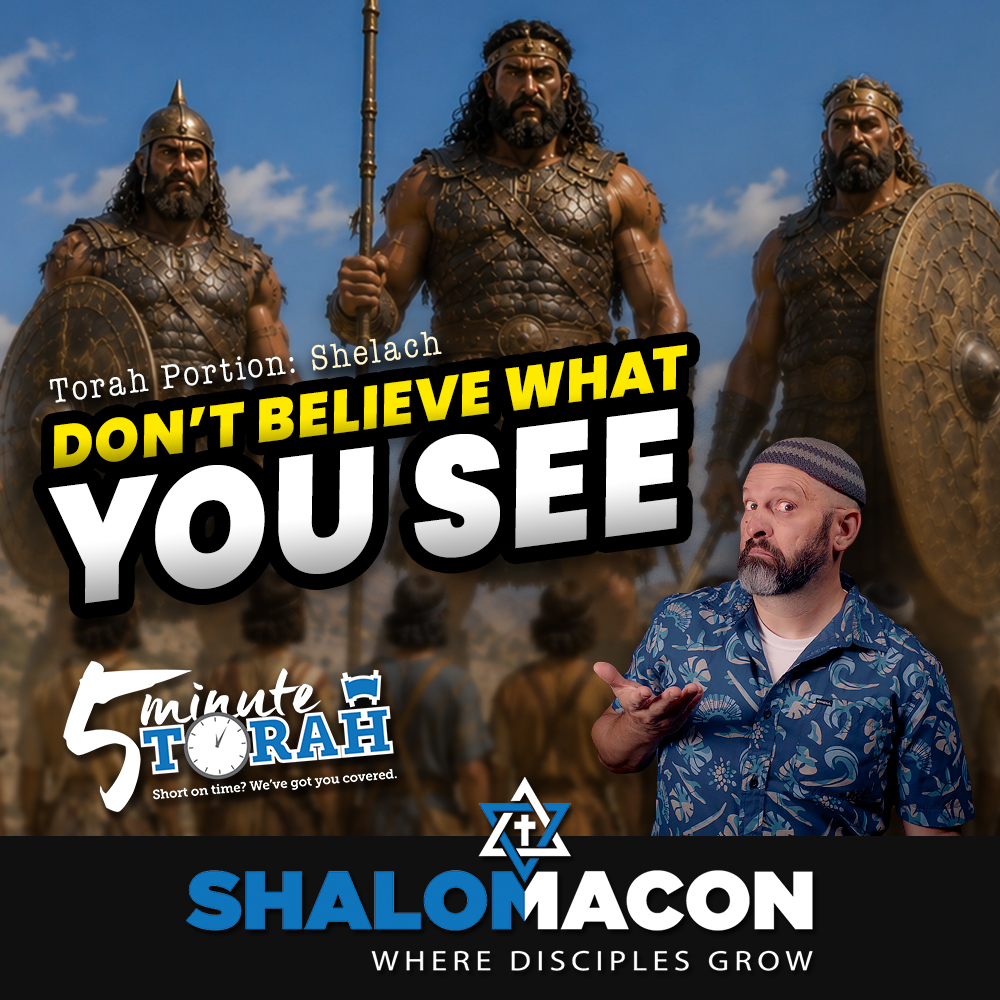
5 Minute Torah - Shelach - Can You Trust Your Eyes?

5 Minute Torah - Shelach - Can You Trust Your Eyes?
Shalom Macon: Messianic Jewish Teachings
5 Minute Torah - Shelach - Can You Trust Your Eyes?

Jun 11 2026 | 00:08:17

/

Show Notes

Have you ever trusted what you could see... only to discover you were completely wrong?

In Parashat Shelach, twelve spies entered the Promised Land. They all saw the same giants, the same cities, and the same challenges. Yet ten returned in fear while two returned in faith. What made the difference?

At the end of the Torah portion, God commands Israel to wear tzitzit—tassels on the corners of their garments—as a reminder to obey His commandments. At first glance, these two stories seem unrelated. But hidden in the Hebrew text is a fascinating connection that reveals why the spies failed and why God gave Israel the mitzvah of tzitzit.

Could it be that the greatest danger isn't what our eyes see—but how our hearts interpret what they see?

What happens when fear becomes our lens for reality? How often do we allow circumstances, emotions, or appearances to speak louder than God's promises?

In this week's 5 Minute Torah, we'll explore the surprising connection between the spies, the tzitzit, and the battle between faith and fear. Discover why God's Word—not our feelings, fears, or perceptions—must shape the way we see the world.

Join Shalom Macon Live! at 11am EST every Saturday (#Shabbat) for uplifting Worship Music and Teachings

If you get value from our work, please
consider Supporting Shalom Macon

https://www.shalomacon.org/give

-- Ways to Support Shalom Macon --

Our Website | https://www.shalomacon.org/give
Tithe.ly | https://tithe.ly/give?c=329563
PayPal | [email protected]
Text "GIVE" to (706) 739-5990

God provides for the work of Shalom Macon through the giving of those who benefit from that work and in turn, give generously to allow it to continue.

Whether you are an in-person or virtual member, your support is vital to sharing the message.

We thank you for joining us, Shabbat Shalom!Join Shalom Macon Live! at 11am EST every Saturday (#Shabbat) for uplifting Worship Music and Teachings

If you get value from our work, please
consider Supporting Shalom Macon

https://www.shalomacon.org/give

-- Ways to Support Shalom Macon --

Our Website | https://www.shalomacon.org/give
Tithe.ly | https://tithe.ly/give?c=329563
PayPal | [email protected]
Text "GIVE" to (706) 739-5990

God provides for the work of Shalom Macon through the giving of those who benefit from that work and in turn, give generously to allow it to continue.

Whether you are an in-person or virtual member, your support is vital to sharing the message.

We thank you for joining us, Shabbat Shalom!

View Full Transcript

Episode Transcript

[00:00:00] The ten spies weren't lying. The giants were real. The fortified cities were real. The obstacles were real. So why did God punish them for just telling the truth? We have real hurdles in our lives as well, so how are we supposed to deal with them? Is there something we can learn from the situation with the 12 spies? The answer may reveal one of the greatest spiritual dangers any of us face. Let's take a look at this idea together in this week's five minute tour. Foreign. [00:00:34] Blessings from Shalom Macon, the place where disciples of Yeshua learn, connect and grow. I'm Darren and before I get into the five minutes of my five minute Torah commentary, let's cover a few quick facts about this week's Torah portion. This week we are studying the 37th Torah portion and the fourth portion of the Book of Numbers. We are in the portion of Shilak Numbers 13:1 through 15:41 and here are the three things that you need to know about it. Number one Moses intercedes standing in the gap in the Torah portion of Shalach, following the negative report of the 10 spies and the subsequent rebellion of the Israelites, God threatens to destroy the children of Israel for their lack of faith. Moses intercedes on their behalf, pleading with God to forgive them. He appeals to God's attributes of mercy and recalls his promises to the patriarchs. Moses argues that destroying the Israelites would cause other nations to question God's power and his faithfulness. God responds to Moses plea the by pardoning the people, yet decrees that the current generation will not enter the Promised Land. The only exceptions are Joshua and Caleb. This act of intercession by Moses highlights his role as mediator, emphasizing the importance of the Good shepherd in both guiding and advocating for the children of Israel. Number two the Sabbath Breaker More Than Sticks and Stones in this week's Torah portion, a man is found gathering sticks on the Sabbath, although it's unclear from a surface reading of the text what commandment he's violating, which we find out the severity of his actions. As things escalate, the people bring him to Moses and Aaron and ask what should be done with him. God instructs Moses that the man must be put to death by stoning, and the community carries out the sentence. This severe punishment not only serves as a stark reminder of the sanctity of the Sabbath, a covenantal sign between God and Israel, but it also allows us to read between the lines and distinguish between intentional and unintentional sins based on the context of the passage. And Number three Fringe benefits the commandment of Tzitzit in this week's Torah reading, God commands the Israelites to wear tzitzit, or fringes, on the four corners of their garments with a thread of tekhelet, a special type of blue, in each fringe. This commandment serves as a visual and tactile reminder for Israel to observe all of God's commandments and to live a holy life. The tseitzit are meant to help the children of Israel remember their duty to God and avoid being led astray by their own desires. Desires. By looking at the tzitzit, they are reminded of their covenant with God and the importance of obedience and holiness. When seen outwardly, the tzitzit are a sign that the Jewish people are distinct from all the other peoples of the world. [00:03:09] What does it really mean to live by the Spirit of the Law and not the letter of the Law? For centuries, believers have been told that the law of God is a burden and something Yeshua came to set us free from. [00:03:22] But what if that's not what the scriptures say at all? What if Paul's words about the letter of the law killing were never meant to pit God's spirit against his own commandments? If you've ever struggled to reconcile law and grace, Spirit of the Law will open your eyes to a richer, more faithful understanding of both. It will challenge assumptions, bring clarity to misunderstood passages, and invite you into a deeper walk of obedience, one that's alive with the Spirit of God. Pick up your copy today and let the spirit of the Law transform the way you see God's Word and the way you live it. This week's Torah commentary is called the Eyes of the Heart and comes from my book, Five Minute Torah, Volume 1. This week's Torah reading begins by recounting the spies being sent into the land of Canaan on behalf of the children of Israel. Joshua, Caleb, and the 10 other qualified leaders were chosen from from among each of the 12 tribes and sent into the land of Canaan ahead of the children of Israel in order to scout out the land and report back their findings. As it says in Numbers three two send men to spy out the land of Canaan. As we know, 10 of these 12 men came back with an evil report that slandered the land God had promised to them. That evil report delayed their entrance into the land of promise by 40 long years. [00:04:39] the end of the portion, we read about how the children of Israel are to make tzitzit ritual fringes or tassels on the corners of their garments. Even to this day religious Jewish men wear a special garment with these tassels attached to it as a normal part of their daily attire. The commandment is as Speak to the people of Israel and tell them to make tassels or tzitzit on the corners of their garments throughout their generations, and to put a cord of blue on the tassel of each corner and it shall be a tassel for you to look at and remember all the commandments of the Lord to do them not to follow after your own heart or your own eyes which you are inclined to whore after. Numbers 15:38 39 how is the beginning of this portion the evil report of the spies connected to the seemingly unrelated topic of wearing tassels? In Hebrew, the word used for spy is a form of the word tuur. When we read about tzitzit, this same word is included in the instructions warning about pursuing after the lusts of our hearts. But we smooth it out in our English translations, the passage literally says that the tzitzit are to be a reminder not to tour or spy after your own heart and your own eyes. What does this mean? Rashi, in his commentary in this portion, connects these two passages and explains that the eyes and the heart are are types of spies that search out sins for the bodies. The eyes see and the heart desires, but the body commits the sin. This kind of language is reminiscent of a teaching by James, the brother of our master. But each person is tempted when he is lured and enticed by his own desire. Then desire, when it is fully conceived, gives birth to sin, and sin, when it is fully grown, brings forth death. James 1, verses 14 and 15 Remember the children's song that says, be careful, little eyes, what you see. It's true, our eyes are the gateways to our souls. The temptation for Eve was that she saw the fruit of the tree of knowledge of good and evil, and it was a delight to her eyes. Genesis 3. 6 the lust of the eyes and the desire of the heart, left unchecked, will lead us down paths of destruction. The tzitzit are reminder to guard these gateways and to follow the commandments of God. But the tzitzit are not just a reminder to keep the commandments. In a way, they also are a constant reminder to not repeat the same mistake as the spies. Whenever we allow our eyes and our hearts to dictate reality rather than what God has spoken, we fall prey to the same trap as the 10 spies who brought back the evil report. Our reality should be shaped by the word of God rather than our own imaginations. The commandment of TSE is a constant reminder of this. What reminders do you have in your life that help you win the battle between the eyes, the heart, and the body? You haven't subscribed to the Shalom Making Kids channel yet. If you have children who love learning Torah in a fun and engaging way, we've created a space and a place just for them. Rabbi Shmiely Socks and all of our Socks on youn Table videos now have a brand new home on the Shalom Macon Kids YouTube channel filled with kid friendly Torah teaching designed to help children learn, connect and grow with the Scriptures. Be sure to head on over, subscribe and turn on notifications so that your little menes don't miss a new episode. And as always, thank you for making Torah a part of your home. You can check us out right here.

Other Episodes