Episode Transcript
[00:00:05] Picture in your mind.
[00:00:07] Jacob stands before Pharaoh not as a refuge or one who's inferior, but as a patriarch of the people God chose from among the entire world.
[00:00:19] The promises of God rest on him. The covenant flows through him.
[00:00:24] His son essentially rules the mighty kingdom of Egypt. He and the mighty Pharaoh asks Jacob a strange but extremely perceptive question.
[00:00:36] He asks him, how many are the days of the years of your life?
[00:00:44] Not how old are you, but how many are the days of the years of your life? Or how many days have you actually lived?
[00:00:57] Think about that.
[00:00:59] Jacob responds, the days of the years of my sojourning are 130 years.
[00:01:05] And then, unprompted, he adds a confession.
[00:01:10] Few and evil have been the days of the years of my life.
[00:01:16] Few. How old is he? He's 130 years old. That's a little bit more than most of us in this room.
[00:01:22] At 130 years old, he says, my days have been few. Jacob isn't confessing sin here. When he's confessing, he's confessing his sorrow.
[00:01:32] He's telling Pharaoh that although he's lived long, he hasn't lived well.
[00:01:40] But this is the same man that wrestled with God and prevailed. Think about that. The same man God renamed Israel, Prince of God, the same man who carried the promises given to Abraham and to Isaac. And yet, when given a moment to reflect, Jacob doesn't speak of blessing.
[00:02:01] He speaks of regret.
[00:02:04] Somewhere along the way, Jacob lost sight of who he was and who he was to become, and obsessed over the hardships and the disappointments of life.
[00:02:17] The past became heavier than the promises.
[00:02:22] What Jacob reveals at this moment is something deeply uncomfortable for us as well.
[00:02:27] It's possible to belong to God, to be blessed by God, and to even be renamed by God, and still allow regret and disappointment to quietly poison the life we were meant to to live. And that's what we're going to confront today. So let's look at the actual text. Genesis 47, 7, 10 says, Then Joseph brought in Jacob his father and stood him before Pharaoh. And Jacob blessed Pharaoh.
[00:02:56] And Pharaoh said to Jacob, how many are the days of the years?
[00:03:01] Excuse me. And said to Jacob, how many are the days of the years of your life? And Jacob said to Pharaoh, the days of the years of my sojourning are 130 years. Few and evil have been the days of the years of my life. And and they have not attained to the days of the years of my life, of my fathers in the days of their sojourning. And Jacob blessed Pharaoh and went out from the presence of Pharaoh. So, Rabbi Hirsch, if you're familiar with Rabbi Hirsch, I enjoy some of his commentaries. Really good. He gives us some insight into this passage. He says that Pharaoh, being a very wise and perceptive ruler, asks Jacob this very specific and uniquely worded question for a specific point. Okay. Rather than simply asking him how old he was, like I said earlier, he asks, how many are the days of the years of your life? In other words, how many meaningful days have you lived?
[00:03:53] And Jacob responds, the days of the years of my sojourning are 130 years, few and evil.
[00:04:02] Evil. He used the word evil.
[00:04:05] Have been the days of the years of my life, and they have not attained to the days of the years of the life of my fathers and the days of their sojourning. So Hirsch interprets this as Jacob saying, my life is not comparable to the lives of my fathers.
[00:04:20] They lived more in the sense that every day of their existence, they were truly living and they were able to carry out their mission under cheerful conditions.
[00:04:32] But evil, seriously evil Jacob, I mean, sure, who says that he had problems? He had real problems, right? So let's list out some of the problems he had. He was born into conflict. Remember the whole thing with the twins in the womb, Jacob and Esau in the womb? What happened? They were at it in the womb from the very start, before they even came out. They were button heads, right. And so at the very beginning, he was wrestling with his brother Esau. He was raised in a divided household marked with favoritism. Remember, his father loved Esau, right. His mother loved Jacob. And they sort of had this clash there. And he had to flee for his life after deceiving his father, after stealing Esau's blessings, Right? And he was on the run pretty much. He did not want to see Esau when they had an opportunity to see each other again. He was shaken in his boots. And so he lived in exile and was a sojourner in a foreign land.
[00:05:30] He was exploited and he was deceived for 20 years by his father in law.
[00:05:37] Okay.
[00:05:39] He was forced into a marriage through deception.
[00:05:43] Anybody want that? No, no, thank you.
[00:05:46] He wrestled with infertility, favoritism and family tension. And like I said earlier, he lived in fear of his brother Esau. He experienced violence and disgrace through his son's actions. And then, of course, the thing that led to that was he experienced the disgrace of his daughter Dina being abused. Right.
[00:06:10] He lost the love of his life, Rachel, during childbirth, the first of the second child, right?
[00:06:19] And he believed that his favorite son was killed.
[00:06:24] And then his sons come to him and say, we've got to take your other son, Jacob. He had legitimate reason, right? It wasn't just all made up in his head, but he said his fathers had it better than him. Is that really the case? Is this true? Did Abraham and Isaac really live carefree lives, free from fear, sorrow, and regret? Okay, well, Abraham waited decades for his promised son, right?
[00:06:54] He was ancient by the time he had his first son, only to be told. To do what?
[00:07:03] Offer him up as a sacrifice?
[00:07:06] He lived as a stranger and a sojourner, often unsure of where he would sleep or who would threaten his family next.
[00:07:14] And his wife was taken by another man twice.
[00:07:22] Right?
[00:07:23] And then he lost his wife, and she was buried among foreigners.
[00:07:29] What about Isaac? Isaac grew up under the shadow of the Akedah, the. The binding on Mount Maria, right? His father bound him and raised the knife to slaughter him. Talk about childhood trauma. Right?
[00:07:42] Childhood trauma. That's. That's what I'm talking about. Later in life, he'd also endure famine, conflicts over Wells, deception within his own household, a fractured relationship between his sons, and have his wife taken by another man, just like his mom.
[00:07:59] I mean, that's.
[00:08:00] I mean, we haven't experienced a tenth of that.
[00:08:04] These were not easy lives. They weren't painless. They weren't untouched by fear or loss.
[00:08:10] But Jacob makes this claim.
[00:08:13] Their lives were fuller than mine.
[00:08:17] Not longer, but fuller. Which tells us something critical. Even though God singled out Jacob from everyone on the face of the planet, and he helps him to overcome obstacles at every turn, and he gives him an opportunity to wrestle past and earn a new name of victory.
[00:08:38] Jacob still views his past as simply a series of unfortunate events. And he went on to write a children's series based on that. No, I'm just joking. Some of you guys may know it.
[00:08:53] Series of Unfortunate Events. Anyway, it's a kid's book series, so Jacob is not saying my life was harder than my father's necessarily.
[00:09:02] He's saying, I carried the pain with me.
[00:09:05] I held onto it. I tucked it deep in me and cherished it.
[00:09:14] So let me sidetrack for just a second and say that wounds are wounds. We can't deny this.
[00:09:21] But we don't have to use them to milk pity from everyone around us.
[00:09:25] If the wound seeps, we tend to it. And we may even have to explain to somebody about it, but we don't use it as a badge of identity, especially one that makes others treat us differently.
[00:09:42] Abraham And Isaac faced hardship, but they didn't carry it with them.
[00:09:48] Jacob did.
[00:09:50] They walked forward. Abraham and Isaac, they walked forward even when the path in front of them was shrouded with uncertainty.
[00:10:03] Jacob, he kept looking back even though the path in front of him was clear.
[00:10:12] Have you ever seen someone driving a car while they're looking over their shoulder?
[00:10:17] Maybe they're looking at something back behind them. Maybe they think there's somebody following them. Maybe the kids in the backseat are going crazy.
[00:10:24] Maybe they're talking to somebody else or whatever.
[00:10:29] Technically, they're going where they need to go. But would you want to be behind somebody like that?
[00:10:35] No.
[00:10:36] And that's an accident waiting to happen.
[00:10:40] Because their eyes aren't focused on the road ahead.
[00:10:43] There's always potential of something happening.
[00:10:48] And that's what living in the. In the pain and the hurts of the past is like.
[00:10:54] You can recklessly head toward your destination, but the chance of an incident along the way increases significantly.
[00:11:04] So when Jacob stands before Pharaoh and reflects on his life, he sounds like a man who reached his destination but spent the whole journey looking behind him.
[00:11:15] And that difference, more than the circumstances that he endured, more than tragedies that he experienced, are probably the source of Jacob's regret.
[00:11:27] Because regret is rarely about an event.
[00:11:31] It's about what we do with those moments afterwards.
[00:11:35] Because left unattended, regret becomes something we return to again and again. We replay conversations in our mind. We revisit losses.
[00:11:46] We rehearse how it could have come out differently.
[00:11:50] Not because we seek healing, but because we want to relive the pain over and over and feel justified for it.
[00:12:01] One of the most important findings in modern psychology is this memory is not stored, necessarily. This is an interesting tidbit of information here. Memory is not stored and replayed like a video.
[00:12:16] It's reconstructed every time we recall it.
[00:12:22] Think about that.
[00:12:25] That's pretty wild.
[00:12:27] Cognitive psychologist Elizabeth Loftus, one of the leading researchers on memory distortion, demonstrated that each act of remembering subtly alters the memory itself.
[00:12:40] When we recall an event, we simply don't retrieve it.
[00:12:45] We rewrite it.
[00:12:47] You can think of incidents in your life in the past, especially events around trauma, tragedy, heartbreak, or whatever.
[00:12:57] And those events have either softened over the years or they've hardened over the years based on what we've done with them, how we retold that story to ourselves.
[00:13:08] And that's why marriages fail a lot of times, because that continues to get harder and harder and harder, and that person becomes the devil.
[00:13:22] I'm trying to think of an example That I just thought about just a second ago, but. Oh, in police academy, I'm sure Lance will confirm this. You know, you have this incident where a person runs through or comes into the classroom and then does something and then goes back out. And then you get questioned on it without knowing that this is part of the, of the thing, right?
[00:13:43] Like who was this person? What they look like, describe them, their height, their weight, their, their appearance, all that kind of stuff. What they were wearing, what they do generally. It's a really bad test on people because they usually fail it. Right.
[00:13:59] People even mix.
[00:14:01] They can't even get the gender or the, the skin tones right or anything like that. And so our memory is very, very tricky. What we may think is actually an absolutely true.
[00:14:13] May be completely a farce because we have reprogrammed our own minds to believe something that we want to believe.
[00:14:23] Psychologists use the term rumination. You probably heard this, Dr. Ervin, to describe repeated mental replay of distressing events, especially conversations, failures and losses. Studies consistently show that rumination actively distorts memory.
[00:14:43] It amplifies emotional intensity. With each replay, it strips away contextual details, including tone, timing, mitigating factors, et cetera.
[00:14:54] And the centers of memory around personal blame, threat or loss are skewed.
[00:15:01] It replaces what actually happened with how it feels.
[00:15:06] Okay, we feel hurt, we feel excited or whatever. I mean, you can have. There's. I told someone about this recently. I may have mentioned it in one of my sermons or whatever, but there's a book called the Power of Moments. I believe that's the name of it, the Power of Moments.
[00:15:22] And the example in this is, that stood out to me is they give the example of something called the.
[00:15:33] I forgot the name of now. I think it's called the Magic Hotel. I think it is. Anyway, supposedly, some of you guys may know about it, it's a hotel near Disneyland Disney World. One or the other. I think it's Disney World and it is a hot pink looking building or whatever. And so this guy, he looks up reviews and he's gonna take his family there.
[00:15:58] And this place has like tens of thousands of five star reviews. So he's like, man, this must be really, really great, really nice.
[00:16:09] It's gonna be primo. I'm gonna take my family there and we're gonna be living luxury during our vacation.
[00:16:15] So he takes his family there and he gets in the room and it's average.
[00:16:21] You know, he's like, okay, what's the big deal? And everything about it is average.
[00:16:27] And then he's trying to still try to figure this out. They get down to the pool. His kids are in the pool. And they see this kid jump out of the pool, run over to a red phone that's on the wall, pick up the phone, and then hang it up. And then like a minute later, a very dressed to the tee, you know, tails and everything, Butler comes out, white gloves, black and white tux, with a silver tray full of popsicles.
[00:17:01] Okay? And these kids are scrambling around, grabbing popsicles. And then he finds out more of these little tiny little things throughout their stay that they have that are service oriented, that make you feel like you're royalty. Okay?
[00:17:17] Average place, but treated exceptionally is. And it made that trip memorable, especially for his kids and family.
[00:17:28] And so just something that normally you would think, what's the big deal? But in that context and in that moment, it stood out and it changed the perspective of this whole vacation, you know, so the power of moments.
[00:17:43] The more we replay the painful moments in our minds, the less accurate it becomes. And over time, that pain stops being something we feel and becomes a way we see and interpret our lives.
[00:17:57] Not only is attached to that moment and that circumstance, but now every interaction, every experience that I have, I'm interpreting through that pain. And so everybody is out to get me.
[00:18:17] So focusing on pain and regret reshapes our memory. It edits the past so that pain grows larger and goodness grows smaller. It teaches us to measure life not by what God has done, but by what we wish had gone differently.
[00:18:39] And that's what we hear in Jacob's words.
[00:18:41] He doesn't deny the blessings. He doesn't question the promises. But when he's asked to reflect on his life, he looks through the lens of regret.
[00:18:52] And here's the sobering part. Recounting pain or loss.
[00:18:56] It feels genuine. It feels honest. I'm just saying it. Telling you like it is right sounds humble. This happened to me.
[00:19:05] Everything's not hunky dory.
[00:19:08] But focusing on past wounds is not the same as humility. Humility says God was faithful even when I was weak.
[00:19:16] Regret says the story could have been better if only fill in the blank.
[00:19:22] And once regret becomes the dominant voice, it begins to define how we understand our lives.
[00:19:28] Rather than being the hero of our journey, we become the victim, poisoned by our own egocentrism.
[00:19:40] Jacob doesn't say my life was a mixed bag of blessings and challenges. He says few and evil were my days.
[00:19:49] Regret compresses a long God filled life into a short, painful summary.
[00:19:55] And when regret becomes the narrator of our story. It robs us of the ability to rejoice in the blessings that pour in and surround us every day.
[00:20:04] I've been there. I've done that. I bought the T shirt. Okay, some of you guys have heard my testimony and my story about serving God, but with the wrong attitude, with the wrong perspective. And I had to consciously change that to get back in right standing with him.
[00:20:24] And this raises an uncomfortable question.
[00:20:27] Why does regret so often feel more natural and so much more comfortable than gratitude?
[00:20:35] Maybe because regret puts me at the center of the story.
[00:20:38] Gratitude puts Hashem at the center. Gratitude asks us to believe that God was present even when it hurt.
[00:20:49] Regret allows us to stay anchored to that hurt and that resentment, often blaming others for the pain in our lives.
[00:20:58] Gratitude looks outward and forward.
[00:21:00] Regret turns inward and backward.
[00:21:04] It gives us the illusion of control.
[00:21:07] If we can identify where things went wrong, we believe we can protect ourselves from ever being hurt that way again.
[00:21:15] Gratitude does the opposite. It admits that life was never fully in our control to begin with.
[00:21:22] It requires surrender, especially when the story includes pain.
[00:21:27] So regret, holding on to pain and nursing old wounds oftentimes feels safer. It feels familiar. It feels earned.
[00:21:36] And that's why regret so easily becomes the default way we interpret our lives.
[00:21:42] Again, Jacob didn't deny God's faithfulness, But when asked to summarize his life, gratitude really wasn't much in that equation.
[00:21:53] Regret became the dominant voice. And once regret becomes the lens, it doesn't just color our past, it reshapes our identity. And this is exactly what happened with Jacob. He didn't just experience regret. He began to interpret his life, his entire life, through it. Even after God named him Israel, Jacob continued to describe himself as a man who was struggling through life rather than a man held firm by God's promise. And you notice how the scripture, it uses Jacob, Jacob, Jacob, and then occasionally, it will use Israel. And you'll find that those times, it uses Israel. We'll talk about that more next week. Is the times that he is holding on to Hashem and fulfilling his role.
[00:22:40] So when Jacob looks back, he doesn't see a story marked by God's faithfulness. He sees interruptions, detours, losses, pain, suffering.
[00:22:53] And those losses become the defining moments in his memory.
[00:22:57] So Jacob's identity slowly narrows. It changes. It alters course. Instead of Israel, the one who wrestled and overcame, he returns to being Jacob, the heel grabber, the striver, the man always reaching for what seems just out of reach.
[00:23:18] Regret was the lens through which he understands himself.
[00:23:24] His problem was not that life lacked blessing. It was that regret convinced him that those blessings don't matter.
[00:23:35] Jacob's mistake wasn't that he suffered. We all suffer. It was that suffering became the story he told about himself.
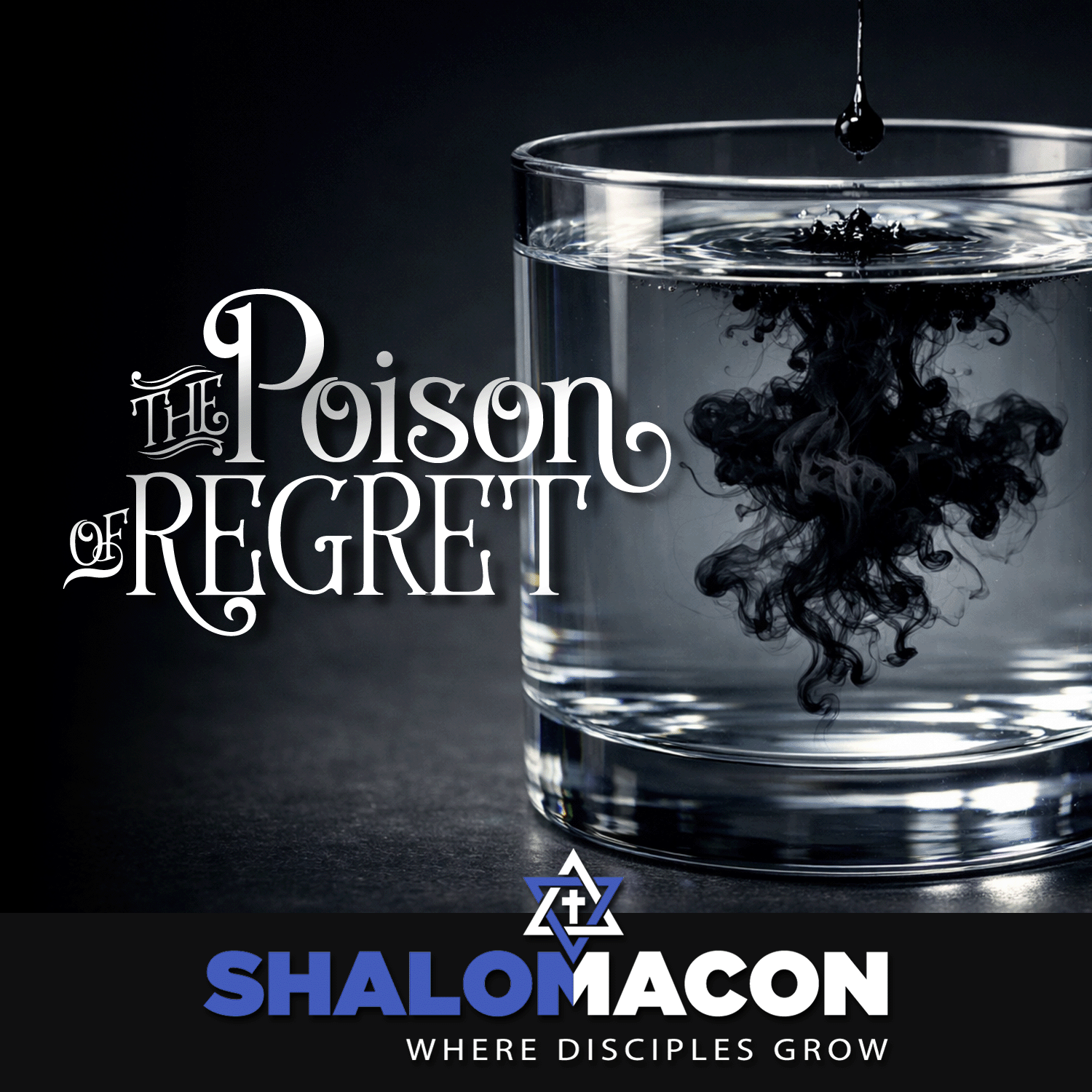
[00:23:42] He drank his own poison, the poison of regret.
[00:23:48] But we all share this cup with him. We poison ourselves all the time, using every tool we can find to sabotage our success so that we can remain the victim of of our own devices.
[00:24:00] We live our lives regretting what could have been rather than creating what could be.
[00:24:08] We see ourselves as a victim, that someone is always out to get us rather than seeing that God is wanting to do something in us and wants to do something beyond our trials.
[00:24:24] So how do we resolve the problem?
[00:24:26] How do we break free from the poison of regret? And what about Jacob? Did he ever wake up and change his outlook on life?
[00:24:35] Well, thankfully, Scripture doesn't end Jacob's story in this week's Torah portion.
[00:24:42] Next week in the Torah portion, Vayikhi, when we wrap up the Book of Shemod or the Book of Exodus, we'll see that Jacob again.
[00:24:50] He's older, weaker, and nearing the end of his life.
[00:24:54] But something remarkable happens to let us know that even late in life, even after years of regret, he will show us that it's still possible to change the story we've been telling ourselves, that it's truly possible to let go of the pain and the hurt and live free once more.
[00:25:17] So we'll talk about that next week when we discuss what it means to turn from being Jacob to becoming Israel. Shabbat Shalom I'm Darren with Shalom Makin. If you enjoyed this teaching, I want to ask you to take the next step. Start by making sure you subscribe to our channel. Next. Make sure you hit the like button on this video so that others know it's worth their time to watch.
[00:25:40] Last head over to our website to learn more about Shalom Macon, explore other teachings and events and if you're so inclined get contribute to the work that we're doing to further the Kingdom. Thanks for watching and connecting with Shalom Macon.