Episode Transcript
[00:00:03] Speaker A: Welcome, everyone.
For those of you online, we know a lot of you guys, but some of you may not know us. We are Darren and Sabrina Hucky.
I'm rabbi's assistant. Sorry, look in the microphone here. I mean, at this camera, camera there. I am rabbi's assistant and Sabrina is the educational director here for the kids.
And we just for clarity, we are not Jewish.
A lot of people are going to see this online that have never experienced shalom making. They're going to see the replay. And anyway, may think that we are Jewish because we look Jewish and. But we are not.
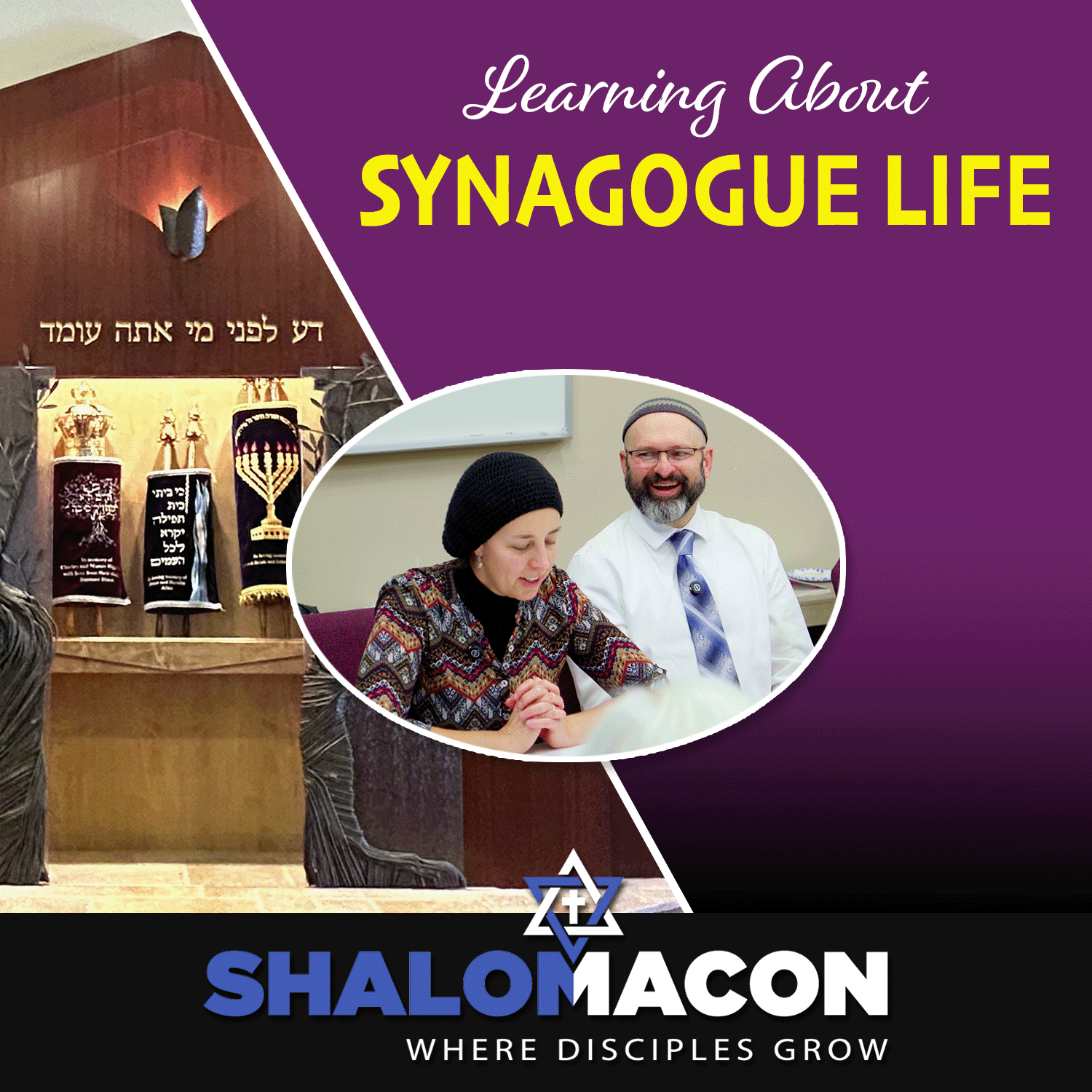
We look this way on Shabbat. We honor the Shabbat. This is our way of honoring Shabbat. So just want to make that clear up front. Today we're going to be talking about life in the hood. I mean, life in the shul.
Okay. Life in the shul.
[00:01:03] Speaker B: The Shaloma Khan hood.
[00:01:04] Speaker A: Yeah, the Shlomo Khan hood.
So we're gonna do some. Do some discussion here.
And again, just, you know, both of us, we grew up charismatic Pentecostal. We in the, you know, 90s, we began learning about Judaism and practicing about 25 years ago. Our kids have been raised in Messianic Judaism. That's pretty much all they know.
And so we're going to be talking about synagogues, in particular, our synagogue. We're going to be talking about synagogues in general, our synagogue, specifically, because Shalom Macon is a unique community.
Everybody agree?
Yes. It's amazing. We have a unique community, a unique congregation, and we even have a unique synagogue. And so we're not a church.
And we're not. But we're not your typical synagogue either.
And so we are a. What type of synagogue?
Messianic synagogue.
So what makes us different than other synagogues?
We believe in Yeshua Jesus. Right. Okay. That's a big, big factor. Okay. And so as a Messianic synagogue, we want to endeavor to teach to and demonstrate and live out Messianic Judaism as it applies to both Jews and those of us from the nations. Non Jews, Gentiles, goyim, whatever you want to call us.
So our community is unique even among Messianic gentiles, because some of them are Messianic congregation. Messianic congregation, excuse me, Some of them are pretty much all Gentile. Some of them are all or mostly Jewish. We have a good mix here. Okay.
So we want everybody to feel welcome, connected, loved, and provide opportunities for you to learn, connect and grow. I gotta point at the camera. Right.
Okay. With this in mind, most of it. Most of Us did not grow up attending a synagogue. And so having a deeper understanding of its history and the sanctity of the synagogue will really help us enrich our faith and our worship experience while we're here. So let's talk about shrill life. So there are three primary terms you'll hear in relation to Jewish house of worship. And hit this, okay?
[00:03:22] Speaker B: Some of this you'll hear people use these terms, and sometimes you won't because we're going to kind of COVID general synagogue customs and, you know, generally, but then more specifically us too. So there are three primary terms in relation to a Jewish house of worship. Synagogue. Synagogue, which comes from the Greek language, and shul, which comes from Yiddish, and Beit Knesset. That's your blank on your handout. Beit Knesset. And let's talk about what these mean.
[00:03:57] Speaker A: Spell that for them.
[00:03:57] Speaker B: Oh, I'm sorry. Bait. B, E, I, T.
Knesset, K, N, E, S, S, E, T.
Where do these words come from? What do they mean?
So from the time of Moses, let's go all the way back to Moses. Children of Israel just came out of Egypt.
And we read this week, in this week's Torah portion, they're starting to build the tabernacle, okay? So that they have a place of meeting God. God can dwell with them as they travel in the desert.
So from the time of Moses until after the first Temple, after the second Temple, First Temple is destroyed.
Second Temple is.
The temple is renewed, rebuilt. Now we have the second Temple, and even that is destroyed, okay?
So from the time of Moses until the restoration of the second Temple, so the obligation to pray was fulfilled daily by composing one's own prayers at home, one's home privately.
So I want you to think about that.
Before there were synagogues, everyone prayed in their home. And they. There were no set prayers or communal prayers.
It was just praying at home on your own. Okay?
After the destruction of the first Temple. Temple, okay, this is the Babylonian exile.
So who built the first temple?
[00:05:34] Speaker C: God.
[00:05:35] Speaker B: Well, God. He used somebody God said to do it. And who did he use?
King.
Who said that King Solomon built the first Temple and that was destroyed when. Who came along?
[00:05:54] Speaker A: David?
[00:05:55] Speaker B: No, no, good.
[00:05:58] Speaker A: Good guesses, though. This is. This is a bad guy.
[00:06:00] Speaker B: The Bab. Nebuchadnezzar. The Babylonians came along. Okay, no, not the Philistines. Now, they messed up with the Ark of the Covenant, but that was before this.
So Babylonians come in, they destroy the first temple, take away the Israel to captivity in Babylon.
And after about 70 ish, 50 ish years, somewhere in there, the Jewish people were allowed to start coming back, leaving Babylon, come back and there's talk, of course we're going to try to get the temple going again. Okay, so, but they didn't all come back at the, at once. There were waves.
But after the, this destruction of the first temple, after, and then they're beginning to restore and this will be the second temple, okay?
There was a man that we all know of from the Bible that was under the, that spiritually led the people in rebuilding and restoring this second temple. And that is Ezra.
Everybody know the book of Ezra, okay? Also we know Nehemiah in there too.
So Ezra and the men of the great assembly.
So we'll just talk about that in just a second. And number two, they headed up the spiritual renewal that would make prayer instead of. It will be become centralized, okay? Prayer is going to become communal and formalized for the first time. And with that we need a place of prayer.
Okay? A place of prayer.
[00:07:40] Speaker A: Besides the Temple?
[00:07:41] Speaker B: Besides the Temple. Because the temple, it's, it's, it's the, it is the most important place of prayer. But then we're going to need other places. Especially if God forbid, an exile happens again and they can't come in to get to the temple. The temples, you know, they just experienced its first destruction.
What did they, they didn't know. I mean, they had to do something while they were in Babylon. Okay? So now this could happen again. We need places of prayer no matter where we are.
[00:08:12] Speaker A: So what they're doing is building in a safety mechanism. So we're going to unify the people and unify the prayer structure so we have uniformity in a certain type of way. We're going to have cohesion and we're going to be able to be on the same page.
[00:08:27] Speaker B: Okay? So number two, this is Hebrew, the Anshe Knesset Hagedolah means the men of the great assembly. They are credited for the following.
They are credited for finalizing or preserving parts of the Hebrew canon. And that means this Hebrew scriptures.
Number two, they establish the structure of key prayers and we still pray them today. Some of the prayers, we didn't list them, but you can go back and look and see what are those prayers that Ezra established that we still pray today in our prayer service here at Shalom Macon and in every synagogue.
Number three, they standardized certain blessings.
And number four, they strengthened Torah observance in a fragile post exile community. Torah observance, not your blank.
So you will hear of the men of the great assembly as you learn more about the history of Judaism and the history of the synagogue and the leadership of Israel.
Although there's evidence. This is. Number three. Although there is evidence that gathering places for prayer may have already existed in Babylon during exile, the Ansheiknesset Hagedullah helped standardize prayer so that Torah communities could thrive in the event of another exile. These places of gathering became known as, again, bait Knesset.
B E I T K N E S S E T Bait Knesset. If you're in Israel, that's what they use. They don't ever. I've never heard. I. I don't. I hear Senate. I don't hear synagogue. I hear Beit Knesset. Okay. Beit Knesset is the Hebrew way of referring to a house of gathering and is referred to as a house of prayer.
[00:10:21] Speaker A: That's your next blank.
[00:10:25] Speaker D: It was about. Well, can you.
[00:10:29] Speaker B: Yeah, you've heard the word knesset referred to in the government, right? Yes, because it just means gathering. Gather.
[00:10:37] Speaker A: Okay, so if you. By the way, if you'd like to have questions, write your questions down. We're going to open it up at the end and take hopefully about half of the class to answer questions.
[00:10:46] Speaker B: Trying to kind of get through our notes, and then we can talk and ask questions.
But this is one point we want to really emphasize, and this is probably one of the biggest differences in, in my opinion, between a church and a synagogue.
A church, we call it a house of worship.
The synagogue, Beit Knesset is a house of prayer. It was established as a house of prayer initiative. I mean, that is. That is its purpose. Okay, number four. Another term commonly used by Ashkenazi Jews is shul.
You'll hear.
You know, we Americans like to say the least amount of syllables. So I'll say shul a lot of times instead of synagogue because it's shorter, but it's Yiddish and it actually means school.
School.
[00:11:39] Speaker A: Don't tell anybody. Don't tell anybody, because that's the school you're in school.
You're being schooled.
[00:11:45] Speaker B: Because I don't know if this is in our. In our notes.
Nope.
Because this is also referred to as a house of study. Technically, this room right here, the midrash means.
[00:11:57] Speaker A: Actually, we have it.
[00:11:58] Speaker B: Oh, is it. Oh, it is on here. Okay, we'll get there then. Okay, number five. We are most familiar with the English word synagogue, which comes from the Greek and means bring together or assembly. So bring together.
[00:12:11] Speaker A: That's the blank. Number five. Bring together.
[00:12:13] Speaker B: When you say synagogue, you're not saying anything you shouldn't. It's just a different.
A different origin.
Second or next Page of your notes here. These places to gather for communal prayer were established throughout Israel and the Diaspora. Diaspora means outside of Israel.
Okay, so it's okay. We won't go there. I'm not going to take any rabbit trails. Number six. Synagogues typically contain a Beit Midrash. Here's bait again. B E I T, which means house. And then midrash. M I D R A S H. Midrash, Hebrew for a house of study.
And is considered less holy than the Beit Knesset, the house of prayer.
So the sanctuary here at Shalom Macon could be considered our Beit Knesset. It's where we pray. Not that you can't pray in here, but some synagogues are designed. Their Beit Midrash is like a mini sanctuary. They'll have another ark. They'll have Torah scrolls. If you go to Congregation Sha'rei Yisra', el, you go into their little. They have a. They have their main sanctuary and then they have their smaller. With. With an ark and Torah scrolls.
So. But we don't have that here. This is just a Beit Midrash. There's no Torah scrolls in here, by the way.
[00:13:37] Speaker A: A lot of people refer to this as the library. And that's shorter words, too, but technically we're trying to focus on it being more of not just a place to look at books, but a place to study, which is a Beit Midrash.
[00:13:50] Speaker B: Yeah. So this number seven. The synagogue as well as the home and the Beit Midrash are all considered a mikdash meat, which means a small sanctuary or miniature. Or a miniature. Or a small sanctuary.
[00:14:10] Speaker A: Mini sanctuary.
[00:14:11] Speaker B: Mini sanctuary.
[00:14:12] Speaker D: Can you spell that? Goes in the blank.
[00:14:17] Speaker A: Small.
[00:14:18] Speaker B: Just small.
Small sanctuary.
Yeah. The English words small sanctuary.
[00:14:24] Speaker A: Try to make things a little easier to write down.
[00:14:27] Speaker B: Sorry.
[00:14:27] Speaker D: That's okay.
[00:14:30] Speaker B: But as a reminder, the primary public worship experience remains.
Remains.
And we can't do it yet. Well, we can, but we can't go up to the Temple to do all the things yet, but we can go to Jerusalem. But that is still the primary place of worship experience, to participate in and be inspired by the Temple service.
And we pray that it would happen soon and in our day.
[00:14:55] Speaker A: Amen.
[00:14:58] Speaker B: Number eight. As central as the synagogue is today, when starting up a new Jewish community, it is not the first thing on the list to build. Okay. The synagogue building is not number one on the list.
It is a mikveh.
M I K V E H.
You will see it. Mikveh.
That's more Ashkenaz. Mikveh. Mikveh is the first priority in order to uphold the laws of family, family purity. We do not have time to go into the details on that. But the mikveh, this is another big difference. In a church, in a synagogue, we don't have a baptismal. Okay, Churches, a lot of them. I didn't grow up with a baptismal. We went down to the creek, we went down to Blue Hole, and we. We got immersed in a creek. But a mikvah is just that. It is a body of water that is living water.
That can be the ocean, that can be a spring that can be a lake that's spring fed, a river that's spring, spring fed, a creek that's spring fed.
Or it can be a. A built. A constructed mikvah, which is a very complex and intricate design of. Of a thing. But that is number one in, in traditional Jewish communities.
[00:16:22] Speaker A: The point is immersion in immersion, right?
[00:16:25] Speaker B: It's. It's built, it's a pool so that you can immerse completely. Okay.
[00:16:32] Speaker A: Although.
[00:16:32] Speaker B: Oh, we already talked about that. No, we didn't. Okay. Although. The community, our synagogue, Shalom Macon.
Any synagogue, any community, it's important to be. To have a community, to be a part of a community.
But to remember that the primary focus of God's.
God's ways, God's just how he wants us to live our faith out is in our own individual lives first.
Has to be in us first. Our home, remember, our home is a Mayat mikdash, a little sanctuary. Mikdash Mayat.
And so in our home, in our family, that's. That's Judaism's focus. Okay. The synagogue comes along secondary. Okay, well, home then he said Tabernacle Temple and then the synagogue. Okay, so. So just to kind of keep a perspective of the importance of things. So we don't gather in a synagogue because it's holy per se, but a synagogue is holy because that's where we gather. Okay.
We bring.
We're. And we say this in Christianity too. We say the church is not a building. The church is the people.
So that's a similarity between us.
[00:17:58] Speaker C: Okay.
[00:17:59] Speaker A: Okay. Let's talk about synagogue etiquette.
The Sabbath is seen. This is number nine. Sabbath is seen as a bride or a queen that we welcome every week.
Not only that, but on Shabbat, we have a holy appointment. Appointment to meet with God.
If you. If you're familiar with the Torah, Leviticus 23 says the are. These are the modima. These are the appointments of God. And it talks about, lists out the festivals, what's the first one listed, Shabbat is the first thing God says, this is my holy appointment. Okay?
And so therefore, because of this holy appointment, we are greeting the bride or the queen.
It is customary to dress our best on these days in honor of the occasion. That's why you see everybody dressed up.
And of course, everything private needs to be covered. We're in public.
Now, here's the deal. A keeper, this thing on my head, this right here is a traditional garment of a Jewish male in public.
And.
But in a synagogue context, males, whether they're Jewish or not, have the freedom to wear a keeper and are even encouraged to wear a keeper. Okay. So it's not a Jew gentile thing inside of a synagogue. I do not wear this out in public. I wear it when I am in the synagogue and when I'm teaching from a Jewish perspective.
And so the Hebrew word for this thing on my head, the kippah, is. It's the word kippa, but it means dome or covering. Okay. Kaporet or kapura. You've heard those Hebrew worms. That means to cover.
What's that words? Yeah.
So whether fact or fiction, tradition says that the word yarmulke is a Yiddish word that and is a contraction of the Aramaic words. Yare malka. And this is your blank. This is a little harder. Y A R E I yare malka. M A L K A malka. Yare malka, which means all fear or reverence. That's the yare of the king. Malka, which is.
We usually say melech malka is generally. Sounds more like. Like a queen in. In Hebrew. But this is supposedly to be Aramaic. And the.
The definite pronoun gets added to the end. Okay, let's see. Talit and Talitot.
Number 11 is the traditional prayer shaw with the tsitzit. That's the Hebrew word for the fringes. That's your next blank on the four corners.
It's worn by Jewish men during prayer and Torah services and at Shalom Makin. This is one way we give distinction and honor to our Jewish brothers.
You'll see some people wearing a tallit during service. And 99% of the time, those are Jews or probably a visitor.
Now, we don't call people out if they wear a tali and they're not Jewish. We just take them aside, lock them in a room, we never see them again.
I am joking. I am joking. Now, we generally don't even address it because we figure hashem can work on people a lot quicker than we can.
We just talk about Our values. And so if you've gone into our sanctuary, you'll notice something gorgeous at the front of the building. Right.
One of the most beautiful I've ever seen, by the way.
It is called. This is your number 12. It's called an aron in Hebrew, and it is the. An ark. That's your blank, A R K in Hebrew, it's called an aron. You'll hear it called that because it contains sifray Torah, books of Torah, just like the Ark of the Covenant or the Ark of Testimony that contains the tablets with the ten Commandments that we read about in these last several Torah portions. Right.
The Aron with the Torah scrolls is what makes the sanctuary holy.
When we enter that place, we have the living word. I mean, in a sense, a living. The living word of God. And we don't have. It's different from just a book of the Bible because that is a translation.
These are the actual words God gave to Moses, written by hand.
[00:22:53] Speaker B: Can I say something real?
[00:22:54] Speaker A: Go for it.
[00:22:56] Speaker B: So we, we've. We're learning about this, the construction of the tabernacle in our Torah readings. Right now it's beginning. And we know that the Ark of the Covenant is in the holy of holies, the most holy, holy, holiest part of the whole thing. Right? And so that's where, that's where the aron. Our aron. So the Ark of the Covenant is also called an aron.
So our aron in a sanctuary of a synagogue, that's. It's connected to that. And so that's why it's considered holy and sancti sanctified.
The sanctity comes because it is similar to the Ark of the Covenant, which was in the holy of holies. And, you know, we don't say, you know, the synagogue has the holy of holies because we have the Torah scrolls or anything like that, but it's just that
[00:23:49] Speaker A: connection.
[00:23:50] Speaker B: That connection, yeah.
[00:23:51] Speaker A: Very good.
Number 13, situated above and in front of the Aron is probably something most people have not even noticed.
Is anybody know what's above the. The ark?
A little, little thing about yay big.
What is it? A light. Right? It's a light and it's called the Nair tamid N E r tami T a M I D, which literally means eternal flame or eternal candle.
We say Nair shell. Shabbat. The flames are the candles of Shabbat. When lighting the Shabbat candles, that's a part of the blessing.
So this is representative, the ongoing divine presence or the Shekhinah that was associated with the miracle of the western lamp of the Menorah in the tabernacle that never went out. And this is why it was so weird when it, it would not stay lit. Thank you, sweetheart.
In. In the last generation of the second Temple period when that and when the destruction of the temple was impending, it would not stay lit. Otherwise it would stay lit all the time and hardly anything could make it go out.
[00:25:02] Speaker B: In older time, before there were electricity, this would be a literal light. I mean, fire, okay. Like a literal fire would be constantly burning in front of the ark in a synagogue. But since the invention of electricity and LED lights and all that, it's not. So I, um. But that light never goes off here at Shalom Macon. There is a switch for it.
So I don't know.
[00:25:29] Speaker A: You touch it, you go in that room.
[00:25:31] Speaker B: I think it's inside.
I don't know where it is, but hopefully. I don't know.
[00:25:36] Speaker A: Hopefully. I think it's hardwired, but I'm not sure.
[00:25:38] Speaker B: It may be hardwired, but never go out.
[00:25:42] Speaker A: Number 15. Actually 14. Sorry, I skipped ahead. Synagogues are designed purpose, purposely or purposefully so that worshipers are facing where?
Ah, I knew that would be the answer. But it's wrong faced. Facing Jerusalem.
Okay. I did that intentionally because I know we've. People have said that a lot. And it's, it's a, it's a. It's a. Almost true for us. It is truth because we are in the west. But that's not wise. We face that way. It's not so we can face east. It's so we can face Jerusalem.
Okay.
[00:26:19] Speaker B: It's in the east from here.
[00:26:21] Speaker A: So if we, if we are on the other side of Jerusalem, we will face China. Yeah. We will face west now to face.
To pray.
[00:26:31] Speaker B: We're in heaven. In. I don't know.
[00:26:34] Speaker A: Yeah, Australia. Face north something. Right. Okay.
And so this is based on King Solomon's prayer in First Kings. If you haven't read that or haven't read it in a while, be worth reviewing because he talks about anyone praying toward this place, Jew or gentile. May God hear from heaven and answer their prayer.
Number 15, written above the Aron is a verse or phrase that reflects a saint, reflects the sanctity of the space and the values and aspirations of the congregation. It's different in every synagogue. Okay. A lot of phrases they will repeat in different synagogues, but it's not one set thing. They have the choice.
[00:27:18] Speaker B: Scripture.
[00:27:18] Speaker A: Right.
The phrase above the aram here at Shalom Macon is A common inscription that's meant to enforce, to foster awe, reverence, and intentionality during prayer. Does anybody know what the Hebrew says?
Good. Yay.
Which means know before whom you stand.
It's a quote taken from the Talmud in conjunction to prayer.
And last 16, in this little part right here in the front or middle of the sanctuary is the bema. Now, now, here's the confusion. This is your blank. We talk about the bima. And bima is both your blanks. Here I'm just B, I, A, B, I, M, A, H. Thank you.
It's the. The bema is really the platform that you step up to. To approach the Torah. Okay. But it's also used for the table or the. We would say, like a podium type thing that the Torah sits on when it's read from. They're interchangeable. So technically it means the. The platform area that you step up. But it can also mean the stand. We'll take it from there.
[00:28:35] Speaker B: Sure. So the bema, like Darren, we just said in this one, it can be in the very middle of the room. And then the seating is. Is surrounding that.
[00:28:44] Speaker A: A lot of Orthodox congregations, that's where it is. It's in the middle of the sanctuary.
[00:28:48] Speaker B: Okay. And if not, it's in the. In the front.
So.
So let's go back to talking about the Torah. The Torah, which we know means God's instruction, but specifically the first five books of the Torah, I mean, of the Bible, it's treated with dignity and respect. It's likened to. And treated as a bride.
If you ever come to the 9 o' clock service and see a Torah service, then you know that we stand when the Torah is brought out of the ark, we stand to give reverence and respect.
If, whenever the Torah is being lifted, we stand.
When it's being processed, we stand.
It's a. And we make an effort to not turn our back to it.
So when the Torah is being processed. Processed, you will see people touch it. Men might have tzitzi, touch it with their tzitzit and kiss their tzitzit. Touch it with a holy book, a Siddur, or your Bible. You can touch it with your hand if you want, and touch it and kiss your hand.
The older tradition is to actually kiss it with your lips. But over time, we've moved away from that just to, you know, protect against germ, contamination of germs. But so kissing it isn't. We're not worshiping the Torah or the. Or this object.
We are saying it's like honey. And we Want it to be sweet to our soul, sweet to our lips like honey is.
[00:30:23] Speaker A: Can I say one other thing real quick? If you've been to a wedding in the United States, what happens when the bride enters the room?
Everybody does what stands and then what you face the bride. Okay, if we do that for a bride, how much more so the word of God, right?
[00:30:42] Speaker B: And when the Torah is being processed, you know, this just takes time to learn because a lot of us have never been to another synagogue to see any of this happen, right? So we are not familiar with it, and that's okay.
But we, again, we go to the Torah as the Torah is being processed. We don't wait for the Torah to come to us. The Torah is to just go. And we go towards it, to kiss it. Okay, we pursue the Torah. And so we.
[00:31:16] Speaker A: So that's just a note for you guys who are carrying the Torah. If you can move a little bit quicker, Cliff, you can go and allow
[00:31:22] Speaker B: people, people will come to, to the Torah.
So during prayer service, this is, this really applies to our 9 o' clock time.
Or if you ever happen to visit another synagogue and you walk in and prayers are going, Torah service is going. Talking, we should not talk. I mean, talking should be kept to a minimum.
There's no playing or running or carrying on in the synagogue, especially the sanctuary.
And we're careful. This is something interesting that you might not be aware of.
We're careful to not use the sanctuary as a shortcut.
So if you're in the lobby and you want to get to the cafe, the sanctuary is not a shortcut. We don't just use it like it's just anything else. Just a hallway. It's not a hallway, it's the sanctuary. So we'll go all the way around to get to the cafe. If you're in the cafe, you want to get to the lobby. Don't use the synagogue as your little shortcut.
Go around. You know, it makes us more mindful, you know, to treat this space with the sanctity that it has.
So if your children are being noisy, we have a place, we have a nursery for 0 to 2 year olds. You can sit in there. Or the lobby, they're displaying the service on the monitor.
So if you have toddlers or, or older children that need to sit, you can sit with them out there.
Just to remember that the sanctuary is a sacred place and Shabbat is a sacred time.
So with that in mind, this, this is also a per, this is a personal thing. But also as a congregation, we can begin to be mindful that just like we try to decrease certain activities or limit certain activities on Shabbat, so we can focus on Hashem, focus on learning, focus on our community, on our family.
This is an opportunity to detach from our phones, from devices six days out of the week. You know, we have that thing, right? And it's in our hand, in our pocket, in our purse.
Shabbat's a time where we can set it aside and focus, make our focus and our attention more intentional as my
[00:33:49] Speaker A: phone is buzzing under my leg.
[00:33:51] Speaker B: You know, some of us, security team, you know, we just had our security, Whatever it was anyway, our safety training. That's what the word.
Had our safety training. And you know that he's like, you know, safety team. You got to have your phone so you can communicate with one another.
Okay? So we use electronics here at Shalom Macon. But just a word to say if we can, if we have the freedom and the opportunity and the permission to not have our phones on us and going, if you do have it, make sure your ringer is on silent.
[00:34:31] Speaker A: I will say this, too. If you visit another synagogue, especially an Orthodox synagogue, devices like that are not acceptable. Okay? You need to have it put away somewhere. So I don't want you visiting someplace and. And. And feeling like you're getting chastised or whatever. If somebody gets onto you, I want you to be aware of that ahead of time because that's. That's just the way they're going to treat that. Okay? They're gonna probably be hopefully tasteful and respectful, but in an Orthodox synagogue, it's like, hey, we don't do that here.
[00:35:03] Speaker B: Okay, do you want to take over?
[00:35:06] Speaker A: So 17, we're running out of time. We've got to run through these at a quick clip. We always think we have too little information, that it ends up being a lot.
When someone is praying, please do not interrupt, especially during the amida. That's your blank, A M I D, a H. This is the standing prayer, and it's the central point of the prayer service. Now, here at Shlomakin, most of the time, our amida is corporate.
We do it together out loud. But in tradition, there's supposed to be a silent Amidah, and that would be crucial not to interrupt that. Okay? And so sometimes we do if we have extra time or something as special is going on. And so, because we don't want to interrupt Amidah, because the Amidah is the place that we have made our way past the outer course and figuratively into the Holy of holies. And we are standing before the king. And that's your next blank king.
We are standing before the king. And the Talmud, or the Mishnah, I should say, says even if a king greets him during this time, he should not respond. Even if a snake is wrapped around his heel, he should not interrupt. That's how important this is seen. Okay, just a little etiquette that we cover to make sure everybody knows covered drinks are allowed in our sanctuary.
Community events are exceptions until we have a separate fellowship hall, God willing, that'll be in the near future.
Number 18.
Holy books. Books that contain Hashem's name. God's name in Hebrew should be treated with the utmost care. They should not be set on the floor and that your blank floor or taken into the restroom. That's with tallits and things like that too, Siddharim.
If they're dropped and touch the floor, it's traditional to kiss them, like Sabrina was saying early, displaying our affection for Hashem and his commandments, His. His words when they're picked up. So we kiss a holy book after it's dropped as an honor of act of honor and repair.
Not because the book is magical or something like that, but because it carries the sanctity of the Lord's name in Hebrew, his original name. So we also make an effort to ensure they are not placed upside down in the bookshelf, just as an issue of respect. You know, just something simple like that.
Hit this next part.
[00:37:30] Speaker B: Okay, so if you guys. You guys know by now, after being in a messianic synagogue, God has, you know, in church, we use God, Lord, the Almighty Father.
But once we kind of get into a Jewish space, we learn that he actually has a divine name that's four letters long in the original text, and it's Yud hey. And Vavin. Hey.
And because of that, there are certain things that we do to avoid making God's name common, which is the opposite of holy. The opposite of holy.
It's not wicked, isn't wicked? It's common. Okay.
Holy.
Common.
Holy. Common. Okay. So to keep it holy and not common, we. Or used lightly, we use substitutes.
So if I'm just talking about God or talking to you or talking to you about the Lord, I might use Lord and God in English, but you will hear us say Hashem.
That's your blank.
So during conversation teaching, we generally refer to God with Hashem because it means the name.
So when I want to talk about God, I will say Hashem.
But then in our Bibles, our Siddarim when we see the word hashem in them, we will, or Lord. That's your blank. L, O, R D. Because in English Bible, in the English we'll see capital L, small caps, O, R D.
When we see that in our Bible or a Sedur, it means in the Hebrew there's the divine name.
So it's, that's, that's where the divine name happens in Scripture. And when we're praying or we're reading the scripture publicly, we will substitute Adonai.
So that's our. Your second blank in there.
[00:39:36] Speaker A: So just for clarification, so if you come up to read, I call you up to the Torah or like for the half Torah or the Gospels or whatever like that.
When you see the Word, I think everything that we have, our text is going to say Hashem.
It's okay to say Hashem, but it's preferable to say Adonai when you're reading
[00:39:55] Speaker B: that, which means my Lord or my Master.
So hashem is used when we're talking about God and Adonai is used when we're talking to him or reading from His Word.
[00:40:10] Speaker D: Well, when you're a child and you can't remember what you wanted to ask.
[00:40:14] Speaker B: Yeah, I was going to call Ellie. What's your question?
[00:40:17] Speaker C: Did I get a point?
[00:40:19] Speaker B: Can you get a point?
[00:40:21] Speaker A: Did he?
[00:40:22] Speaker B: Did you get a point? When you come to Hebrew class, you will get a point.
You sure will.
He's ready.
Yeah, I can do this. Okay. Five minutes. Okay. We're going to skip down.
Okay.
[00:40:41] Speaker A: It's not a skip for them.
[00:40:43] Speaker B: Oh, we're not skipping anything.
[00:40:44] Speaker A: I don't have all these extra notes.
[00:40:45] Speaker B: That's right. So number 21, we'll just touch on this.
[00:40:49] Speaker A: Haha.
[00:40:52] Speaker B: Most synagogues practice something now, and these are more Orthodox synagogues practice something known as shomer nagia, which means guarding the touch.
[00:41:02] Speaker A: That's your blanks.
[00:41:03] Speaker B: That's your blanks. Guarding the touch. And just like there are extensive laws surrounding the Shabbat and Kashrut, which is food laws in Judaism, this is the same for physical touch.
You not only need to be aware of this when visiting other synagogues, but even for those within our congregation who might be trying to minimize contact with the opposite sex. So it's just a matter of mindfulness and awareness.
I have a friend back in Arkansas. I love her.
She won't listen to this. I won't say her name. Still, she doesn't like hugs.
Not from anybody. Like, I want to hug her so bad, but she's like, nope, I'm like, okay, I love you.
Air hug. So not everybody wants hugs. Not everybody wants physical touch. And then so we just have to be mindful of people's personal space.
[00:41:53] Speaker A: It's hard when you're from the South.
[00:41:54] Speaker B: We are Southerners and we love to hug. And there's nothing wrong with that whatsoever.
Excuse me, excuse me.
But we just want to be aware.
Just be aware and so, and be respectful.
So we're just going to touch quickly on food. You guys already know kind of our guidelines here and why we do it. It's for unity. It's to minimize division and just to keep everything kosher. Okay. So we already know that when we bring food here from home, it's a dairy meal, a dairy dish, it's a parve dish, meaning it has no dairy or meat in it. So that's, that's a. We're not going to go into all of that.
[00:42:37] Speaker A: I will just say one thing. Some people still don't understand that. So just for clarity, okay, we do have meat meals at the synagogue, but the meat is provided by the synagogue. Anything else that comes from home to be shared or eating inside the synagogue probably needs to be. Well, especially if it's potluck, it needs to be no meat or no meat derivatives, like broth, blah, blah, blah. If you're going to eat it on your own, that's a whole different story. But for a potluck, for a group setting, that's something that we have to just, just. We are trying to keep a standard as a community. It's not saying what you do on your. In your home, on your own, right. At all, for sure.
[00:43:15] Speaker B: Last, this is another difference between Judaism, Christianity or structure. Church and synagogue is growing up. We heard the word tithe used a lot, and that's, that's what our giving was based on, is a tithe. And there's nothing wrong with that. You can continue doing that, but we won't use that word per se because we know now that has to do with the temple. Okay, Tithes were for the temple and there is no temple. So we can't give our ties the way it was intended. So. But we can give offerings giving to the synagogue or other organizations, charities, ministries, but we call our giving Tzedakah, which literally means righteousness.
[00:44:00] Speaker A: Got your blank? Righteousness.
[00:44:01] Speaker B: So until the priesthood, the temple and the priesthood are functioning again, reinstituted tithes are not applicable. So here at Shalom Macon, we have online giving and then we have a pushka or a tzedakah box that's wooden with a little slit in it. And you can put your offering in it when you're here if you want to do it that way.
Okay.
Questions?
Anything?
Floor is open.
Mr. Rogers,
[00:44:35] Speaker A: That's. That's a great question that we still haven't worked out.
[00:44:38] Speaker B: At one point he asked how can the. How can this library and all the
[00:44:42] Speaker A: books be used for the recording?
I said, that's a great question that we still haven't unfortunately worked out because I know during the week it's open, you know, during Shabbat it's open to. For use as far as checking anything out. We used to have a little system that somebody would keep track of that we don't. And so right now we don't really have a way to do that. But we need to figure out maybe
[00:45:05] Speaker B: something that's an area that there's a. There's a space waiting for the person that says me.
[00:45:11] Speaker A: Right? Exactly.
[00:45:13] Speaker B: I would love to catalog these. They really need to be reorganized.
[00:45:16] Speaker A: Honestly, they're just sort of stuck up there right now. They are more in categories. Categories.
[00:45:20] Speaker B: So. Yeah, Cat, it's an on. Yeah, it is.
[00:45:24] Speaker A: It's really a no borrow policy.
[00:45:26] Speaker B: Borrowing right now. You just come and use it here. Don't take it home until we have someone who can keep track of it.
[00:45:36] Speaker A: Okay, we got a question for Pam online.
[00:45:44] Speaker C: For the women, the things that.
What is the protocol for wearing something on your head and when are we supposed to wear it?
[00:45:53] Speaker A: Great question.
[00:45:55] Speaker B: So there's no protocol.
It's a personal decision.
But in you'll see women in a Jewish more Orthodox or modern Orthodox and then ultra Orthodox it's women who are married will cover their hair.
[00:46:12] Speaker A: It's a sign of marriage and Orthodoxy. Okay, next question. Online or in person?
Either we did really good job or you guys are don't care very much. No.
[00:46:39] Speaker B: At what age would a boy wear a keepa?
[00:46:44] Speaker A: As long as I can keep it on.
[00:46:47] Speaker B: Keeping it on. And if they can't keep it on
[00:46:49] Speaker A: and if they can't you just staple it to their head.
[00:46:51] Speaker B: No, you can. There's little clips in the. So we have a little stand.
It's in the main one, the hallway down here and there's little keepas. If you don't have one, you can put one on there and they have somewhere in there is a little clips or bobby pins to try to keep them on.
[00:47:10] Speaker A: Yep. Great question.
Yes.
[00:47:16] Speaker C: Because this is a digital age and sometimes people. It's easier to travel with a device that has any kinds of study or so how does that fit into the packing, the stacking, the reading, the preference? Because it's part of a larger team.
[00:47:39] Speaker B: That's not the digital.
[00:47:40] Speaker A: Right, okay. So she's asking about the. Basically the reverence for digital media in the things that we're talking about. Right. So those have the name of Hashem in it, laptops, all that kind of.
Okay. So from my understanding, the sages say because it exists in digital format, it's virtual. It's not like real because you can turn the power off and it's gone. Okay, so it doesn't count.
Right, Right. So like on screen, if you digitally display stuff, it's okay to have the divine name where we wouldn't, we wouldn't promote it. We wouldn't necessarily want it on a T shirt or something like that.
[00:48:23] Speaker C: What about bringing it into the synagogue, if that's your thing that you're going to read from, whereas it's not.
[00:48:31] Speaker A: I got you. Yeah, so that, that is a good question. And, and here's the deal. Shalom, Macon. We allow for that.
Now it. If it's.
We just have to be careful because it's one thing to use it for that purpose, it's another thing to have it and that be part of the purpose and it be a distraction for the kids as another purpose. You know what I'm saying?
Right.
Okay.
So great question.
Somebody else. Somebody else have a question?
What, a chat?
Oh, my goodness. 11 chat messages.
If you want to ask us. Hold on.
A question. Online, you can digitally raise your hand or try to wave us down. So blanks. We got those blanks covered.
What if, what do you do if you have printed something and no longer need it? Oh, that's a great question, Maxine. Okay, so in traditional synagogues that we really need to establish something. Here they have what's called a.
I just went blank. A geniza. Okay. A geniza is a repository for damaged texts that contain the divine name.
[00:49:55] Speaker B: Just time to retire them.
[00:49:57] Speaker A: Right. Okay. And so who has heard of the Cairo geniza? Anybody?
The Cairo geniza. Who has heard of the Dead Sea Scrolls? Dead Sea Scrolls are thought to be possibly a geniza. Okay. That's why we don't find the Book of Esther in there, because it doesn't contain the name of God.
Now, the Cairo geniza is another big place where Solomon Schecter, I believe it was, he went up into the.
The upstairs, like, attic of a, Of a big, large synagogue in Cairo that was massive upstairs. That. That was their geniza. And it had fragments of documents of Holy texts from a thousand years. Okay. Something like that in there. And that's where they pulled. They got permission after long adieu to pull out those texts. And they had to wear, you know, masks and all that kind of stuff because it was just so much mold and dust and everything. And they cataloged all that stuff. And we now have texts that have survived that hadn't. We hadn't known about before.
So.
[00:51:07] Speaker B: But a Geniza.
[00:51:08] Speaker C: You.
[00:51:09] Speaker A: Oh, I'm sorry. So. So here. Yeah. Technically, you would bury them. Yeah, but we would. It would be nice if we had a place to collect them here as a community and then have a proper burial for them.
[00:51:22] Speaker D: So is there any time it would be correct to burn them?
[00:51:26] Speaker A: No, I don't think so.
[00:51:27] Speaker B: No.
Just like a body.
A body would not be burned after passing away.
It's treated as.
As a.
The same dignity as a. As a person.
[00:51:43] Speaker D: What I find so fascinating, Lady Sabrina, is surely. I was not raised in San.
But Lord, my mommy, she did not play with all this.
You don't fit anything on this bath.
I find myself.
I got so many little pieces that have fallen out and I can't do anything with them. But I place them in something I wanted. Sometimes I wanted to go like to the nursing home where I go. Can I just leave it lay right there. Somebody will get it.
The respect. Because he would. And also his spirit would lead to regarding the holiness of his word. I.
I find myself now.
I won't say east anymore.
I find myself wouldn't even place the Bibles turning toward Jerusalem.
That's. And then I'm sitting here going, whoa, you're confirming your word. That's why I ran in here on a special day like today, I'm like, we gotta get some teachings.
[00:52:50] Speaker A: Nice.
[00:52:51] Speaker D: You know.
[00:52:53] Speaker A: Very good. Thank you. Thank you. Okay, last question. We gotta give this space over.
Jade has a question online here. She says when it comes to morning prayers, the zamanim. And zamanim is a Hebrew word that literally means times. And that's basically the halakhic or legal times for prayer. You can go to myzamanaim.com and find out. Prayer times is daylight, which is 7am Most mornings for me. On Saturday, the prayer service starts at the same time, meaning on at Shlom Macon because she's two hours behind us.
Should.
Should I do basically same time I do the morning prayer? Should I do the morning prayers on my own and then join shalom making? Or should I just join shalom making?
So that's a great question. It's a little bit more related to specific prayers we did last time. But my recommendation is this.
Sorry, my nose just started itching for some reason, is to say all of your prayers that we don't say in service. Like all your prayers leading up to things like the morning, the asher yatsar, the elohei neshama, in other words, the prayer for the body, prayer for the soul. Of course. You say when you wake up the morning, blessings of. I thank you for this and that. That, that the basically the individual prayers and then everything leading up to where we start. So that's my recommendation. Great question.
Yes.
Myzimonim.com okay, we're going to close it down unless there's a final real quick question.
[00:54:38] Speaker B: Well, we can stop the recording.
Is it recording?
[00:54:41] Speaker A: Up top.
[00:54:50] Speaker D: It.
[00:54:51] Speaker C: She was talking about recording stopped.
[00:54:56] Speaker B: Rachel, you're so sharp.
What was my rabbit trail?
[00:55:00] Speaker A: Rachel's always chasing those rabbits.
[00:55:07] Speaker B: I don't remember.
I don't remember.
[00:55:14] Speaker A: Places to gather for communal clare established throughout the Israel.
[00:55:17] Speaker B: Not sure.
[00:55:18] Speaker A: No.
[00:55:19] Speaker B: Oh, well, I don't remember.
Sorry.
[00:55:22] Speaker A: Well, thank you guys for coming. We're going to call it a day and if you have any feedback for us, we would love to hear it. You can email us at info shalom macon.org and give us positive and negative feedback. We want to get better at what we do. Okay. So thank you guys so much. Shabbat shalom.
[00:55:41] Speaker B: Shabat Shalom.